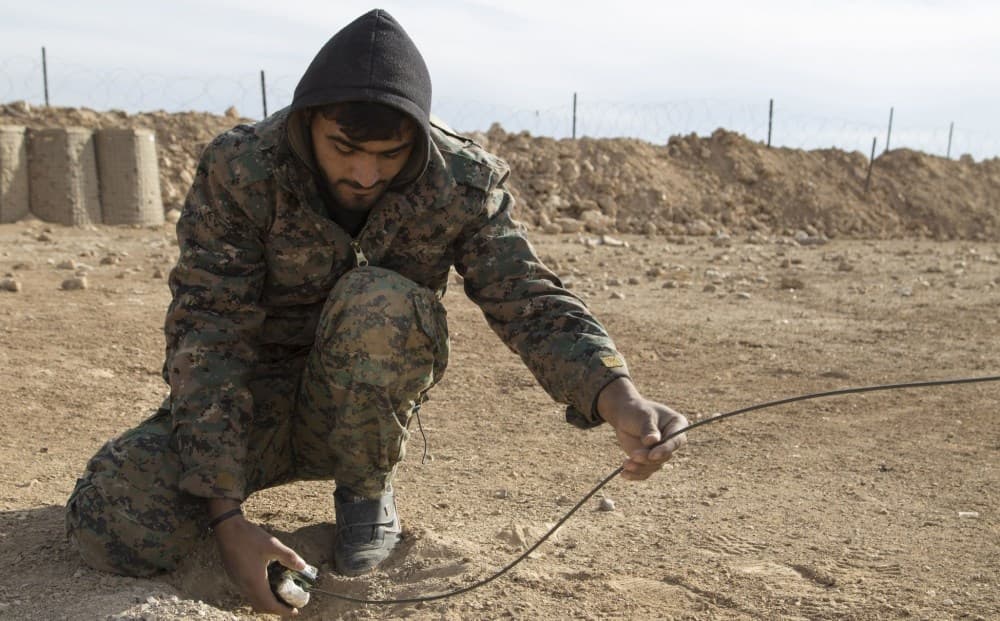

"There is a goal of a final force of approximately 30,000,” Col. Ryan Dillon, the coalition spokesperson told AFP on Sunday, adding that approximately half would be retrained Syrian Democratic Forces (SDF) fighters, while recruiting for the remaining forces is under way.
Syria’s foreign ministry condemned the US announcement, stating on Monday that it was a “blatant aggression against the sovereignty and territorial integrity of Syria and flagrant violation of international law,” as reported by state-run SANA.
Russia, a key ally of Damascus, alleged that the creation of the force was an effort to divide the country.
“The actions, we can see now, demonstrate that the United States does not want to keep territorially integrated Syria," Russian Foreign Minister Sergey Lavrov said on Monday, according to Russia’s news agency (RIA).
Moscow is also concerned about the ethnic makeup of the force.
"Those territories now are controlled by the Syrian Democratic Forces, but mutual relations there between the Kurds and the Arabs are very complicated," Lavrov said. "The statements that zone would be controlled by groups, led by the US, and they may be up to 30,000, is a very serious matter, which causes fears about the aspirations to split Syria."
Ankara, which considers the Kurdish forces in northern Syria to be terrorist organizations and has strongly condemned US support for them, views the border force as a threat to Turkey, a NATO member.
The US initiative contradicts “US commitments and statements, endanger Turkey’s national security and the territorial integrity of Syria, and are totally unacceptable,” the Turkish Foreign Ministry declared in a statement on Sunday.
Turkish President Recep Tayyip Erdogan threatened to “nip this terror army in the bud.”
“Do not stand between us and the terrorists," he said in a speech in Ankara on Monday, telling the US to lower its flags “from above the terrorists so that we are not forced to return them to you.”
Turkey has built up its forces on the Syrian border near Afrin canton in northwestern Rojava, northern Syria, where they clashed with Kurdish forces over the weekend and threatened a full scale offensive.
"Preparations are done. The movement may begin at any time. After that it is the turn of other regions,” Erdogan said. “These operations will continue until there is not a single terrorist — not just 30,000 — on our borders.”
Turkish officials have repeatedly said they will not allow a “terror corridor” on its borders and would carry out a military offensive in northern Syria to prevent Kurdish advances.
The SDF are in control of about a quarter of Syrian territory. The border security force (BSF) will be tasked with securing the northern border with Turkey, the southeastern border with Iraq, and along the Euphrates River Valley, an unofficial dividing line between the SDF and Syrian government forces, the coalition detailed to Reuters.
Mustefa Bali, director of SDF’s media center, confirmed that training had already started. "The wide areas and cities that were liberated need someone to protect them,” he explained.
Dillon said that the “inaugural class” was receiving training at the moment.
"There are approximately 230 individuals that are training right now in the border security force,” he said.
Dillon added that the SDF in eastern Syria are already coordinating with Iraqi Security Forces to target any “transient movement” between the two countries by ISIS fighters.
The SDF is made up of the Kurdish dominant People’s Protection Units (YPG), an alliance of northern Syrian forces that has been backed by the US-led coalition in the war against ISIS with weapons, training, and support.
The force declared Raqqa liberated on October 20 and continues to fight ISIS in eastern Deir ez-Zor province.
Damascus has said that it will bring all Syrian lands back under its control.
.jpeg&w=3840&q=75)