ERBIL, Kurdistan Region - Kurdish families have begun returning to the city of Hasaka in northeast Syria (Rojava) following a fragile, US-brokered ceasefire, which was extended on Saturday and was meant to pause the Syrian-led offensive on Kurdish-held areas. While the truce has eased fears of renewed fighting, residents remain cautious.
The local market in Hasaka city’s Mufti neighborhood was once again bustling after many families fled last week, fearing the violence might spread to the Kurdish province.
In mid-January, the Syrian Arab Army and allied armed groups launched a large-scale offensive to retake areas held by the Syrian Democratic Forces (SDF) for nearly a decade - territories that the Kurdish-led forces had previously liberated from the Islamic State (ISIS).
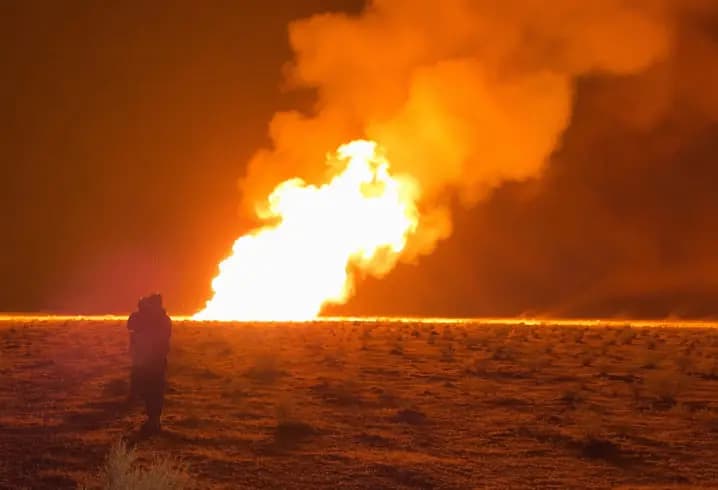
However, the extended ceasefire has encouraged residents to return, and some locals have taken it upon themselves to secure their neighborhoods.
"Young and old, we all light fires and stay outside our homes. By God, if I could, I would go to defend them too, but I no longer have the strength,” Zhima Zave, a Kurdish resident of Hasaka, told Rudaw. “Still, I pray for them [Kurdish fighters]. O God, grant them strength. We put our trust in God; our hope is in God."
Abdulrazzaq Zave, another Kurdish resident of Hasaka, told Rudaw that “in Hasaka, everyone does their part. At night, people keep watch and patrol the streets. Every household has been armed, and they take turns standing guard through the night.”
The extended ceasefire aims to allow the transfer of Islamic State (ISIS) detainees from SDF-run prisons in Syria to Iraq. It follows an initial four-day truce announced last week.
Despite the agreement, SDF forces remain on high alert across all five frontlines in Hasaka province, citing sporadic attacks by Syrian army and affiliated militant groups.
Residents say their hopes for calm depend on political solutions.
Salah Khalil, a Kurdish resident of Hasaka, said, “They need to reach a political agreement, and war [should] not break out. No one wants war - except for thieves and gangs; only they want it. For everyone else, it serves no one’s interest.”
Meanwhile, Ali Abdullah, an Arab resident of the Kurdish province, told Rudaw."We hope they [Damascus and Rojava] reconcile and put an end to this. The people can no longer bear this situation or the atmosphere.”
Another Arab resident of Hasaka, Hamid Haji, said, "Everyone here is afraid - afraid of the unknown. No one knows whether things will get better or worse if those [forces] arrive, because we’ve been through this before.”
Unlike areas in eastern Aleppo, Deir ez-Zor, and Raqqa, Rojava’s eastern Hasaka province remains under SDF control, with forces deployed at the city’s entrances and throughout the area. However, it remains unclear whether Damascus will launch a new offensive once the ceasefire expires to alter the status quo.