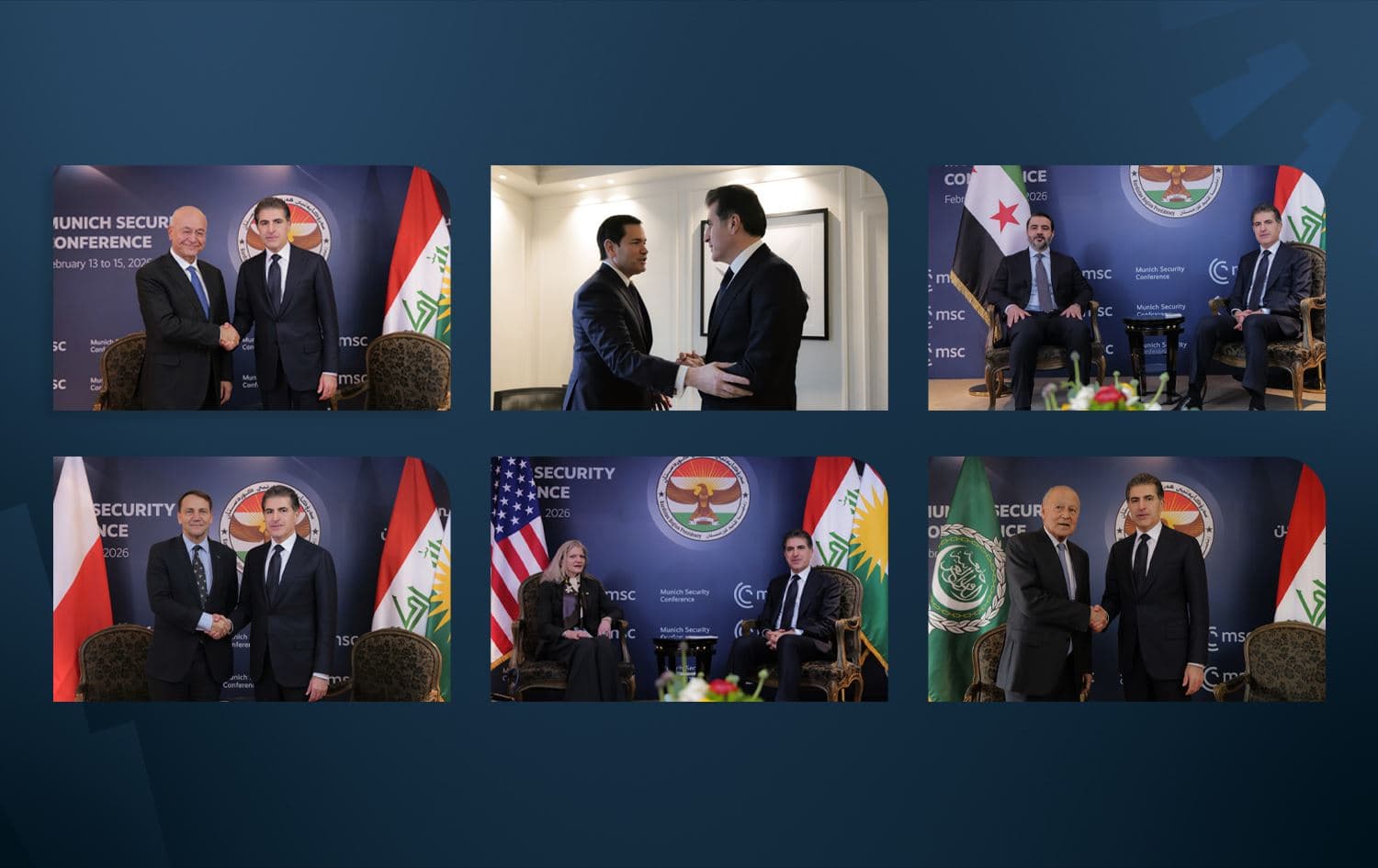
ERBIL, Kurdistan Region - Kurdistan Region President Nechirvan Barzani held a series of high-level meetings with world leaders in Munich on Saturday, where international officials praised Erbil as a “vital partner and a stabilizing force” amid escalating regional challenges.
On the sidelines of the Munich security conference, President Barzani engaged with senior officials from the United States, Europe, the Arab world, and the United Nations, focusing on regional stability, humanitarian responsibilities, and political cooperation involving Iraq, the Kurdistan Region, and neighboring countries - particularly Syria.
Among his key meetings was a high-level discussion with US Secretary of State Marco Rubio, where talks centered on US-Iraq relations and cooperation with the Kurdistan Region.
According to a statement from his office, President Barzani conveyed his appreciation for “the support provided by the US to Iraq and the Kurdistan Region,” while Rubio reaffirmed Washington’s commitment to both, stressing the importance of maintaining “peace and stability in the region.” The US secretary of state also commended the Kurdistan Region for its role as a “vital partner and a stabilizing force.”
Syria took center stage in the talks, with both sides emphasizing the need to safeguard “the rights of the Kurds and other communities within a unified Syria,” in light of ongoing political and security developments.
President Barzani also held talks with Allison Hooker, US under secretary of state for political affairs.
The meeting focused on US relations with Iraq and the Kurdistan Region, with Barzani emphasizing the need for continued American assistance to ensure stability and institutional development, according to President Barzani's office.
"Hooker commended President Nechirvan Barzani’s contributions to the agreement between Damascus and the SDF [Syrian Democratic Forces] and reaffirmed her country’s commitment to supporting Iraq and the Kurdistan Region, as well as resolving the issues between Erbil and Baghdad," the statement said.
President Barzani also met Asaad al-Shaibani, Syria’s interim Foreign Minister. Their discussions focused on Syria’s relations with Iraq and the Kurdistan Region, the broader Syrian crisis, and its implications for regional peace and stability.
Both sides underscored the necessity of addressing the crisis while safeguarding “the rights of all communities,” according to the Kurdistan Region Presidency.
Humanitarian issues and national dialogue were also discussed, with Shaibani praising the Kurdistan Region’s leadership for its role in the recent agreement between Damascus and the Kurdish-led Syrian Democratic Forces (SDF), its support for refugees, and its efforts to maintain regional stability.
"President Nechirvan Barzani expressed his wishes for success, peace, and stability for Syria," the statement said, adding that he "underscored the importance of ensuring Kurdish rights in the future constitution of a unified Syria."
President Barzani’s diplomatic engagements extended to Europe, where he met Radoslaw Sikorski, Poland’s minister of foreign affairs. The two discussed advancing relations between Poland, Iraq, and the Kurdistan Region across various sectors, emphasizing cooperation that contributes to economic growth and long-term stability.
"Minister Sikorski commended the Kurdistan Region’s role in the region and reaffirmed his country’s commitment to furthering relations with both Iraq and the Kurdistan Region," the Presidency said.
Humanitarian responsibilities were a central theme in President Barzani’s meeting with Barham Salih, United Nations High Commissioner for Refugees (UNHCR).
The talks addressed the conditions of refugees in Iraq, the Kurdistan Region, and the wider region.
The Presidency said that President Barzani highlighted the situation of refugees hosted by the Kurdistan Region and stressed the importance of continued UN support.
Salih, for his part, praised the Kurdistan Region’s “humanitarian and historical role” in assisting displaced persons and refugees, reaffirming the UN’s commitment to improving living conditions and meeting urgent needs.
As part of his broader regional outreach, President Barzani also met Ahmed Aboul Gheit, secretary-general of the Arab League. Their discussions focused on political and security developments in Iraq and the wider region, as well as relations between the Kurdistan Region and Arab states.
According to the Presidency, both sides emphasized the necessity of preserving stability and preventing conflict. Aboul Gheit commended President Barzani and the Kurdistan Region for efforts to “maintain balance and foster a spirit of coexistence,” reiterating the Arab League’s support for peace and stability in both Iraq and the Kurdistan Region.