


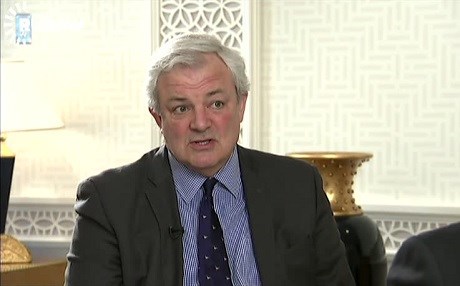
Amid increasing concerns for protection of civilians in west Mosul, warnings from the UN and the Kurdistan Regional Government (KRG) that they are reaching their maximum capacity to accommodate civilians fleeing Mosul, and the anticipated launch of an offensive on the urban centre of Raqqa just days away, the UN’s Under Secretary General and Emergency Relief Coordinator Stephen O'Brien sat down with Rudaw to discuss the UN’s concerns and ongoing efforts.
Rudaw: What do you know about the reports of 200 deaths in western Mosul after a bombing?
Stephen O’Brien: I am very, very concerned about the deaths. That is the first thing of great concern. But this matter is still clearly under investigation. There are differing accounts of what either caused it or what the effects were. What I do know is that now we’ve reached the point where Iraqi security forces are pushing into the western part of Mosul with all those who are helping to recover Mosul after the eastern side where we did see a number of people fleeing. This is a very densely populated, very narrow streets with a very vulnerable populations who are trapped inside. So we know that any kind of broad attack is likely to have very large consequences. So I think the investigation is important, but most importantly I am concerned about the deaths.
Have you noticed that civilian casualties have increased in the fight against ISIS not only in Iraq but in Syria too?
We need to be extremely careful not to bandy numbers around unless they’re really rooted in clear demonstrable facts. Because of course wherever there is fighting there is always massive risk for civilian casualties, those who are part of the fight, not a combatant
but those who happen to find themselves in the line of fire or in an area controlled by one of the factions or another. So we are always concerned about the very severe effect on civilians. And it is absolutely right that all of us engaged in these matters should at all times remind the parties that whatever their fight, whatever their ambitions, whatever their need for what they regard as their defense, everybody, not just member states, is subject to international humanitarian law. And there is an absolute obligation for the protection of civilians, at the time whenever a conflict is taking place. And nobody who is not part of a combat should ever be put at risk.
Have the Americans or the Iraqi government given you any guarantees about the protection of the huge number of civilians in western Mosul?
We seek those assurances from all combatants. We do not single out any particular side or party. I will always look whether it is a direct party or proxy supporters, whether it is in this or any other conflict that is taking place around the world today and there are so many, as you know, which is why we have the highest humanitarian need, certainly since the United Nations was formed, 71 years ago, with conflict settings exacerbating so many other things which are leading to humanitarian needs. All parties at all times must be reminded and must adhere and one day, it is very important they are held to account for their compliance with international humanitarian law principles, and we should have the space, safe and unimpeded, to reach people who have humanitarian needs, either life-saving or protection.
Two months before the Mosul operation started, which is the biggest counter-terrorism campaign in the world, you told me at the time that alongside your teams you were preparing for the worst scenario. How bad is the situation?
The latest broad numbers are about half a million people who are in the western part of Mosul who are caught up, trapped. That, therefore, represents the potential number that could possibly need to flee.
Secondly, there is already from the eastern campaign, there have been about 330,000 who have fled, 76,000 have returned. So we do have the numbers to show that planning for the absolute, outside maximum would have been too much. We planned for the median,
and that’s been roughly where we are. So there are about 19,000 places, which we have currently in capacity able to reach people who might be fleeing. But, of course, if it grows quicker than that — and it has that potential — because as I say west Mosul is a much more densely populated with narrow streets; and therefore, it may well be that need to flee.
On the other hand, part of the lessons we learned from the very reasonable and good policy that was led by the forces who are seeking to retake Mosul through the east was to have a humanitarian concept of operations, and that is to try to preserve and to make sure lives are saved even as you are seeking to recover militarily ground space and against hostile actors. So that was extremely welcome because that’s a very important aspect to this and is helping to preserve lives which might otherwise be at risk or even lost.
Concerning the continued fleeing people from Mosul, two weeks ago, the coordinator of humanitarian programs in Iraq told me that if the number of refugees exceeds current figures, the UN will not be able to help more people. Are we at that breaking point? How many more refugees can the UN help?
As these things are all estimates, it’s very, very difficult to predict the absolute reaction — just as it would be for you and me — depending on how the conflict develops, where the threats are coming from, where they’re perceived to be coming from, indeed, where you think they may next come from, is actually what will drive you, if you have children, to decide, “We’re getting out of here, if we can.” You don’t know. And therefore the fact that there is always going to be a point at which you could reach a breaking point — and Lise Grande has done outstanding job as our humanitarian coordinator in predicting and using the prior information to be as prepared as possible, but we have to recognize that our whole ambition is to stay ahead of the breaking point.
So we still do have capacity. We are working night and day to build more capacity in anticipation that the numbers who might flee from western Mosul will actually increase, and that’s why the whole time we are trying to keep ahead of what otherwise would be a breaking point. So no, we haven’t reached that point as yet, and I very much hope along with all the humanitarian family of actors, not least led by the United Nations and the humanitarian coordinator Lise Grande, that we can stay ahead of that, and therefore meet the needs of people as they arise.
Certainly your teams and that of Lise Grande have been successful in Iraq, but there is an economic crisis in the Kurdistan Region and Baghdad has cut the Region’s budget. The KRG persistently asks for assistance from the UN to help the refugees. Do you think in the near future funds will be made available for the UN’s humanitarian programs in the Kurdistan Region?
It’s very important to recognize that last year when there was a sudden mid-year appeal for more money as we saw this dynamic approaching us of the recovery of Mosul, and having some time to plan, which is unusual in these emergencies, and in the job that I have to seek to coordinate the best response we have to meet humanitarian needs when emergencies arise. And so, that was about
90-percent funded, which is really a great result financially and enabled us to meet those very basic needs. But it was a prioritized plan. It was only the basic needs, and it was for last calendar year. In 2017, it’s clear that we need something in the region of just short of a billion dollars in order to meet the anticipated humanitarian needs for people in Iraq, as not just the recovery of Mosul, but the broad consolidation of recovery is taking place. At the moment, that’s about 9 percent funded — so clearly, insufficient. It is the international community that has the opportunity to get behind a clear, well-prepared, detailed plan to meet humanitarian needs.
But very importantly, as new governance, as the ability to recover control of the territory both by the Iraqi security forces and indeed those who are supporting them from the Erbil angle, it is very clear that the needs in order for them to not be remaining in emergency have to be supported going forward. And that’s why we need to build the money that will enable people no longer to be vulnerable, and that we have a chance for them to have hope from the camps to be able to return home. Already many are in host communities, and otherwise informally settled, and many will want to go home. But you have to have security. And if you don’t address those needs then there will be instability, and these vacuums get filled by people who are not keen to be part of the new hope, the new economy, the new governance.
Are you optimistic that countries and donors would give you the needed money to help refugees in Iraq? According to numbers you mentioned, you are in need of $900 million to help the refugees.
We are making a very strong case. This requires a very detailed plan because, quite rightly, the donors who tend to be the other member states of the world who need to come together and we need to get many more member states than perhaps what are regarded as perhaps being the traditional ones who give significant amounts of money. But we need to broaden that base of donors as well as intensify those who have been so generous in the past in going forwards. But in order to do that [it requires] not only a detailed plan, but one which carries the credibility of backing the success of having delivered what we said we would deliver last year and the year before. And that’s why it’s been very important that we got the planning right for what has been so far through 2016 the emergency as Mosul has been recovered.
Things like making sure we reassure people about the dam that was looking extremely shaky after the negligence of not keeping it maintained during the time it was under the control of ISIL. So these are very important aspects which help to give people confidence that their money will be well spent.
Now the other thing that really matters is that unfortunately, ‘round the world today, we are faced with the most enormous number of humanitarian challenges. And indeed, there are four threatened famines. Indeed, famine has been declared in two parts of South
Sudan. This is putting an enormous burden and expectation on member states. And we have to therefore try to make sure that there is a genuine support for all the humanitarian needs wherever they arise around the world, and so many these days are governed by conflict which is why it’s so difficult. Because if they’re man-made, they’re clearly avertable, they’re clearly stoppable. And that is our first duty, is to stop the conflict, to stop the guns firing to find peaceful dialogue so we can have settlements and the political solution is the best solution to all these man-made, protracted crises out of conflict which are leading to such enormous volumes of human suffering.
Could you please tell us which countries provide most of the funding to the UN’s humanitarian programs?
Well over the past recent number of years, it has been countries from both the North American continent, from the whole of the area of Europe and the European Union, and beyond. And it’s been very important to recognize that we need to increase and intensify the amount of support that can come from member states in the Gulf area, and also many other parts of the world, and we should also make sure that proper mention is made of Australasia, as well as some increased amount of bilateral aid.
I’m very much focused on through the UN, through the multilateral channels which means we’ve got these combined plans where we can come to a clear prioritization of how we meet the needs of people suffering around the world or who need protection, civilians who are caught up in conflict, but also there is a lot of bilateral aid that goes from one country to another country or to part of another country. And that doesn’t get counted within the multilateral UN. We martial the data as well as, obviously the coordination is through my office and beyond. But of course, there is a large family of actors who are engaged in humanitarian work.
So that’s where it’s been to date. But I’m both encouraged and I’m hopeful that we can broaden as well deepen the base of donations. After all, we have a world where everybody knows what’s going on now. Within nanoseconds, we can see it on our handheld screens. People want to be able to meet the needs of their fellow human beings, citizens, around the world wherever this arises. They feel particularly anxious of course when it’s a natural disaster — that’s almost easier to envisage how you could suddenly get caught up in that. But there’s an equal anxiety about the terrible humanitarian needs that come as a result of man-made, protracted, conflict-led humanitarian needs. And that’s where also that governments, quite rightly, are wanting to reflect their ambition and aspiration of the people they represent in order to meet those needs and to play a significant part in alleviating that suffering and protecting civilians.
One of the major concerns when it comes to fighting ISIS in Iraq is the usage of chemical weapons. Lately, the Red Crescent Organization and the World Health Organization have reported some people in the Mosul fight have been injured by chemical weapons. The Iraqi government rejects these reports, saying there is no evidence to prove it, but the international parties, including Britain and the US call for deeper investigations. Has ISIS used chemical weapons in Mosul?
I am not in a position to give you a categoric answer to this, but there is a very important and detailed, ongoing investigation. What I have been told is that there are 15 cases of people who have manifested this sort of blistering that you would expect to see from
having chemical agents on them as a result of attack. Those, I think, came about as a result of being seen in a hospital in Erbil. There are further 13 cases, as reported to me anyway, which certainly suggest they need further investigation. And the whole of this does need to be looked at in great detail. It’s absolutely right that should anybody, at any point, have used or tried to use chemical weapons, that should be known, the facts be established, and those responsible of course must be held to account. There are all sorts of international laws and treaties. But just on a strict moral basis, it is absolutely horrendous and outrageous that there should be any contemplation of their use, let alone the actual use which has such a debilitating and terrible effect upon civilians and people whether or not it sadly results in death or scarring for life. So we must look at this very carefully. But I don’t have any more information than that.
You have thousands of aid workers who help refugees. Are they prepared to protect themselves and refugees with masks in cases of chemicals attacks?
Well both in terms of those who work in the medical facilities that are available and open where training and retraining is given for people to be able to handle this, because they are often dealing with the first presentation before protection and so forth has been put in place. But likewise for people generally, whether its aid workers or those out in the field, whether they are preparing camps or wherever those who might seek to flee are arriving, yes, there is both training information and some protective equipment and clothing being made available. But these are contingent issues. One is always in the position of trying to make sure one is prepared. But until you have facts, of course, it’s only ever an estimate of what might happen. And these are very difficult things to judge. All I know is that it’s much better if people abide by the law — even the rules of the laws of war and that is no chemical agents, no chemical weapons are used by anybody at any time, ever.
As an operation to retake the ISIS de facto capital city of Raqqa looms and many people will also get displaced as in Mosul, has the UN made any preparation for an influx of refugees expected to leave the city? Could you please give me some details in this regard?
Raqqa of course is currently not accessible to most aid organizations, the UN, or indeed aid workers. So our information is very much by reports. We have to assess those very carefully to try and get a real sense of both the scale and the human impact that any activity is likely to have. It’s clear that we are talking about hundreds of thousands of people at risk in the Raqqa governorate. We’re talking about hundreds of thousands within Raqqa city itself, something like 230,000. And we’re talking about tens of thousands who have
already fled and the potential for fleeing, maybe as much as half a million. We don’t know for sure. But we have to do everything we can to prepare.
Now whether that means we have to prepare new camps or channels of safe, channels of passage, or making sure we urge all competent parties not to disrespect the rules of war and to conform to international humanitarian law. Of course having the leverage to make that happen when people are engaged in a fight, and determined to win their fight, is always a huge pressure. But we have to make sure we say it and say it loudly: insist upon accountability and transparency, and do everything we can to make sure people have not just life-saving supplies, but are protected from the terrible ravages of conflict. Because through no fault of their own they find themselves in a geographic place where they’re caught up with it.
Compared to the Mosul offensive, it does not look like you are as prepared for the fight for Raqqa. Are you?
The difficulty in Syria is that of course compared to in Iraq where all the international agencies have full access and are working in tandem with the government of Iraq, with all those who are supporting the recovery of Mosul, not least coming from the direction of Erbil. And so we can see very well in Iraq there is a cooperation, a coordination of the ability to be prepared and to have access — safe, unimpeded access — by humanitarians to prepare emergency centers, to prepare prepositioned stocks, to prepare even camps where people might need to flee and to be housed in camps until it’s safe for them to return. That is not the same situation that we have in Syria because the difficulty of the continuing conflict in Syria has been that access for aid agencies, particularly the UN and international agencies, has been extremely dependent upon trying to secure through negotiations safe, unimpeded access and this has been extraordinarily difficult to secure — and above all with government of Syria.
We continue to do so, we continue to press our case, we continue to be very clear that we have an absolute an absolute obligation as humanitarians under international humanitarian law which we hope everybody understands and is brought to everybody’s gaze, so they hold people to account for this. But it’s impartial, it’s independent and it is neutral. So we help people who have humanitarian need whoever they are, wherever they are, however that has arisen. And that means there will be times when it is not of one’s side, particularly if it happens to be a state, a government, if it is not to their interest, then there is a degree to which that gives you a blockage. And we have had difficulty with cross-border, cross-line, and even with some of the enclaves such as Qamishli, and getting the supplies up to what is quite near Raqqa, relatively, in that part of Syria. So it’s not the same situation as Mosul, but it will not in any way deter us from our continuing advocacy, above all our continuing attempts on the ground to reach people in need at all times.
Thank you very much on behalf of Rudaw.
Rudaw: What do you know about the reports of 200 deaths in western Mosul after a bombing?
Stephen O’Brien: I am very, very concerned about the deaths. That is the first thing of great concern. But this matter is still clearly under investigation. There are differing accounts of what either caused it or what the effects were. What I do know is that now we’ve reached the point where Iraqi security forces are pushing into the western part of Mosul with all those who are helping to recover Mosul after the eastern side where we did see a number of people fleeing. This is a very densely populated, very narrow streets with a very vulnerable populations who are trapped inside. So we know that any kind of broad attack is likely to have very large consequences. So I think the investigation is important, but most importantly I am concerned about the deaths.
Have you noticed that civilian casualties have increased in the fight against ISIS not only in Iraq but in Syria too?
We need to be extremely careful not to bandy numbers around unless they’re really rooted in clear demonstrable facts. Because of course wherever there is fighting there is always massive risk for civilian casualties, those who are part of the fight, not a combatant
 All parties at all times must adhere... with international humanitarian law principles
Have the Americans or the Iraqi government given you any guarantees about the protection of the huge number of civilians in western Mosul?
We seek those assurances from all combatants. We do not single out any particular side or party. I will always look whether it is a direct party or proxy supporters, whether it is in this or any other conflict that is taking place around the world today and there are so many, as you know, which is why we have the highest humanitarian need, certainly since the United Nations was formed, 71 years ago, with conflict settings exacerbating so many other things which are leading to humanitarian needs. All parties at all times must be reminded and must adhere and one day, it is very important they are held to account for their compliance with international humanitarian law principles, and we should have the space, safe and unimpeded, to reach people who have humanitarian needs, either life-saving or protection.
Two months before the Mosul operation started, which is the biggest counter-terrorism campaign in the world, you told me at the time that alongside your teams you were preparing for the worst scenario. How bad is the situation?
The latest broad numbers are about half a million people who are in the western part of Mosul who are caught up, trapped. That, therefore, represents the potential number that could possibly need to flee.
Secondly, there is already from the eastern campaign, there have been about 330,000 who have fled, 76,000 have returned. So we do have the numbers to show that planning for the absolute, outside maximum would have been too much. We planned for the median,
The 2017 humanitarian aid appeal for Iraq is "about 9 percent funded"
On the other hand, part of the lessons we learned from the very reasonable and good policy that was led by the forces who are seeking to retake Mosul through the east was to have a humanitarian concept of operations, and that is to try to preserve and to make sure lives are saved even as you are seeking to recover militarily ground space and against hostile actors. So that was extremely welcome because that’s a very important aspect to this and is helping to preserve lives which might otherwise be at risk or even lost.
Concerning the continued fleeing people from Mosul, two weeks ago, the coordinator of humanitarian programs in Iraq told me that if the number of refugees exceeds current figures, the UN will not be able to help more people. Are we at that breaking point? How many more refugees can the UN help?
As these things are all estimates, it’s very, very difficult to predict the absolute reaction — just as it would be for you and me — depending on how the conflict develops, where the threats are coming from, where they’re perceived to be coming from, indeed, where you think they may next come from, is actually what will drive you, if you have children, to decide, “We’re getting out of here, if we can.” You don’t know. And therefore the fact that there is always going to be a point at which you could reach a breaking point — and Lise Grande has done outstanding job as our humanitarian coordinator in predicting and using the prior information to be as prepared as possible, but we have to recognize that our whole ambition is to stay ahead of the breaking point.
So we still do have capacity. We are working night and day to build more capacity in anticipation that the numbers who might flee from western Mosul will actually increase, and that’s why the whole time we are trying to keep ahead of what otherwise would be a breaking point. So no, we haven’t reached that point as yet, and I very much hope along with all the humanitarian family of actors, not least led by the United Nations and the humanitarian coordinator Lise Grande, that we can stay ahead of that, and therefore meet the needs of people as they arise.
Certainly your teams and that of Lise Grande have been successful in Iraq, but there is an economic crisis in the Kurdistan Region and Baghdad has cut the Region’s budget. The KRG persistently asks for assistance from the UN to help the refugees. Do you think in the near future funds will be made available for the UN’s humanitarian programs in the Kurdistan Region?
It’s very important to recognize that last year when there was a sudden mid-year appeal for more money as we saw this dynamic approaching us of the recovery of Mosul, and having some time to plan, which is unusual in these emergencies, and in the job that I have to seek to coordinate the best response we have to meet humanitarian needs when emergencies arise. And so, that was about
'Round the world today, we are faced with the most enormous number of humanitarian challenges
But very importantly, as new governance, as the ability to recover control of the territory both by the Iraqi security forces and indeed those who are supporting them from the Erbil angle, it is very clear that the needs in order for them to not be remaining in emergency have to be supported going forward. And that’s why we need to build the money that will enable people no longer to be vulnerable, and that we have a chance for them to have hope from the camps to be able to return home. Already many are in host communities, and otherwise informally settled, and many will want to go home. But you have to have security. And if you don’t address those needs then there will be instability, and these vacuums get filled by people who are not keen to be part of the new hope, the new economy, the new governance.
Are you optimistic that countries and donors would give you the needed money to help refugees in Iraq? According to numbers you mentioned, you are in need of $900 million to help the refugees.
We are making a very strong case. This requires a very detailed plan because, quite rightly, the donors who tend to be the other member states of the world who need to come together and we need to get many more member states than perhaps what are regarded as perhaps being the traditional ones who give significant amounts of money. But we need to broaden that base of donors as well as intensify those who have been so generous in the past in going forwards. But in order to do that [it requires] not only a detailed plan, but one which carries the credibility of backing the success of having delivered what we said we would deliver last year and the year before. And that’s why it’s been very important that we got the planning right for what has been so far through 2016 the emergency as Mosul has been recovered.
Things like making sure we reassure people about the dam that was looking extremely shaky after the negligence of not keeping it maintained during the time it was under the control of ISIL. So these are very important aspects which help to give people confidence that their money will be well spent.
Now the other thing that really matters is that unfortunately, ‘round the world today, we are faced with the most enormous number of humanitarian challenges. And indeed, there are four threatened famines. Indeed, famine has been declared in two parts of South
We need to increase and intensify the amount of support that can came from... the Gulf area
Could you please tell us which countries provide most of the funding to the UN’s humanitarian programs?
Well over the past recent number of years, it has been countries from both the North American continent, from the whole of the area of Europe and the European Union, and beyond. And it’s been very important to recognize that we need to increase and intensify the amount of support that can come from member states in the Gulf area, and also many other parts of the world, and we should also make sure that proper mention is made of Australasia, as well as some increased amount of bilateral aid.
I’m very much focused on through the UN, through the multilateral channels which means we’ve got these combined plans where we can come to a clear prioritization of how we meet the needs of people suffering around the world or who need protection, civilians who are caught up in conflict, but also there is a lot of bilateral aid that goes from one country to another country or to part of another country. And that doesn’t get counted within the multilateral UN. We martial the data as well as, obviously the coordination is through my office and beyond. But of course, there is a large family of actors who are engaged in humanitarian work.
So that’s where it’s been to date. But I’m both encouraged and I’m hopeful that we can broaden as well deepen the base of donations. After all, we have a world where everybody knows what’s going on now. Within nanoseconds, we can see it on our handheld screens. People want to be able to meet the needs of their fellow human beings, citizens, around the world wherever this arises. They feel particularly anxious of course when it’s a natural disaster — that’s almost easier to envisage how you could suddenly get caught up in that. But there’s an equal anxiety about the terrible humanitarian needs that come as a result of man-made, protracted, conflict-led humanitarian needs. And that’s where also that governments, quite rightly, are wanting to reflect their ambition and aspiration of the people they represent in order to meet those needs and to play a significant part in alleviating that suffering and protecting civilians.
One of the major concerns when it comes to fighting ISIS in Iraq is the usage of chemical weapons. Lately, the Red Crescent Organization and the World Health Organization have reported some people in the Mosul fight have been injured by chemical weapons. The Iraqi government rejects these reports, saying there is no evidence to prove it, but the international parties, including Britain and the US call for deeper investigations. Has ISIS used chemical weapons in Mosul?
I am not in a position to give you a categoric answer to this, but there is a very important and detailed, ongoing investigation. What I have been told is that there are 15 cases of people who have manifested this sort of blistering that you would expect to see from
Raqqa... is currently not accessible to most aid organizations
You have thousands of aid workers who help refugees. Are they prepared to protect themselves and refugees with masks in cases of chemicals attacks?
Well both in terms of those who work in the medical facilities that are available and open where training and retraining is given for people to be able to handle this, because they are often dealing with the first presentation before protection and so forth has been put in place. But likewise for people generally, whether its aid workers or those out in the field, whether they are preparing camps or wherever those who might seek to flee are arriving, yes, there is both training information and some protective equipment and clothing being made available. But these are contingent issues. One is always in the position of trying to make sure one is prepared. But until you have facts, of course, it’s only ever an estimate of what might happen. And these are very difficult things to judge. All I know is that it’s much better if people abide by the law — even the rules of the laws of war and that is no chemical agents, no chemical weapons are used by anybody at any time, ever.
As an operation to retake the ISIS de facto capital city of Raqqa looms and many people will also get displaced as in Mosul, has the UN made any preparation for an influx of refugees expected to leave the city? Could you please give me some details in this regard?
Raqqa of course is currently not accessible to most aid organizations, the UN, or indeed aid workers. So our information is very much by reports. We have to assess those very carefully to try and get a real sense of both the scale and the human impact that any activity is likely to have. It’s clear that we are talking about hundreds of thousands of people at risk in the Raqqa governorate. We’re talking about hundreds of thousands within Raqqa city itself, something like 230,000. And we’re talking about tens of thousands who have
In Syria... safe, unimpeded access... has been extraordinarily difficult to secure
Now whether that means we have to prepare new camps or channels of safe, channels of passage, or making sure we urge all competent parties not to disrespect the rules of war and to conform to international humanitarian law. Of course having the leverage to make that happen when people are engaged in a fight, and determined to win their fight, is always a huge pressure. But we have to make sure we say it and say it loudly: insist upon accountability and transparency, and do everything we can to make sure people have not just life-saving supplies, but are protected from the terrible ravages of conflict. Because through no fault of their own they find themselves in a geographic place where they’re caught up with it.
Compared to the Mosul offensive, it does not look like you are as prepared for the fight for Raqqa. Are you?
The difficulty in Syria is that of course compared to in Iraq where all the international agencies have full access and are working in tandem with the government of Iraq, with all those who are supporting the recovery of Mosul, not least coming from the direction of Erbil. And so we can see very well in Iraq there is a cooperation, a coordination of the ability to be prepared and to have access — safe, unimpeded access — by humanitarians to prepare emergency centers, to prepare prepositioned stocks, to prepare even camps where people might need to flee and to be housed in camps until it’s safe for them to return. That is not the same situation that we have in Syria because the difficulty of the continuing conflict in Syria has been that access for aid agencies, particularly the UN and international agencies, has been extremely dependent upon trying to secure through negotiations safe, unimpeded access and this has been extraordinarily difficult to secure — and above all with government of Syria.
We continue to do so, we continue to press our case, we continue to be very clear that we have an absolute an absolute obligation as humanitarians under international humanitarian law which we hope everybody understands and is brought to everybody’s gaze, so they hold people to account for this. But it’s impartial, it’s independent and it is neutral. So we help people who have humanitarian need whoever they are, wherever they are, however that has arisen. And that means there will be times when it is not of one’s side, particularly if it happens to be a state, a government, if it is not to their interest, then there is a degree to which that gives you a blockage. And we have had difficulty with cross-border, cross-line, and even with some of the enclaves such as Qamishli, and getting the supplies up to what is quite near Raqqa, relatively, in that part of Syria. So it’s not the same situation as Mosul, but it will not in any way deter us from our continuing advocacy, above all our continuing attempts on the ground to reach people in need at all times.
Thank you very much on behalf of Rudaw.
Comments
Rudaw moderates all comments submitted on our website. We welcome comments which are relevant to the article and encourage further discussion about the issues that matter to you. We also welcome constructive criticism about Rudaw.
To be approved for publication, however, your comments must meet our community guidelines.
We will not tolerate the following: profanity, threats, personal attacks, vulgarity, abuse (such as sexism, racism, homophobia or xenophobia), or commercial or personal promotion.
Comments that do not meet our guidelines will be rejected. Comments are not edited – they are either approved or rejected.
Post a comment