
SULAIMANI, Kurdistan Region - The budget crisis in the Kurdistan Region has jeopardized a promising new law program linking the American University of Iraq, Sulaimani (AUIS) with the Stanford Law School in California.
As the region struggles to pay public employees, fight a war, manage a humanitarian crisis, and maintain fuel subsidies -- all in the face of crippling budget cuts from the central government -- it may not make its annual contribution to the school, which will be forced to cut non-essential programs.
“I would understand if the KRG was unable to make the contribution to AUIS as it has far more pressing needs such as paying the Peshmerga," says Dawn Dekle, the University’s President.
Nonetheless, cutting the fledgling law program would be a major loss for the young university. Since 2011, students and professors at Stanford Law School have been preparing textbooks and coursework on law in Iraq in partnership with AUIS.
They are replacing decades-old materials and update the law curriculum according to Iraq’s 2005 constitution. The ultimate goal is for AUIS to have a competitive law degree program in the next years, with undergraduate law courses and certificates offered in the meantime.
Thanks to fundraising efforts at Stanford, the curriculum will stay on track this fall. But since the goal of establishing a high quality law school will require significant funding in the years to come, AUIS has launched a round of aggressive fundraising to secure the future of the program.
“The reality is that longer-term projects have been put on the backburner,” says Paul Craft, who oversees the program at AUIS. “Very positive, forward-thinking programs could easily go away.”
The school is reaching out to the private sector, focusing efforts on American law firms and companies doing business in Iraq. They have an active interest in supporting the program, Craft says, as “their investment would pay dividends: the program would produce well qualified lawyers with local backgrounds in as little as six years.”
Asked why the American government hasn’t pitched in, Craft smiles. “We’ve been trying for years,” he says, “but they tend to fund things in other parts of the country.”
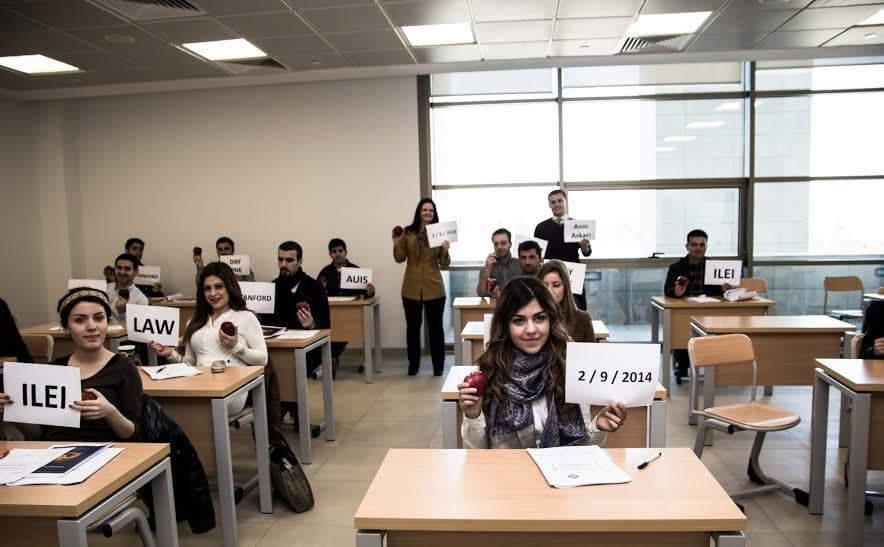
The first law course last spring, Introduction to Laws in Iraq and Iraqi Kurdistan, was an immediate success. A group of students of the class interrupted their summer vacation to sing its praises to Rudaw.
“We covered a lot of ground: history, commercial, criminal, and constitutional law,” said Amed Latif, an International Studies major who graduated in June. “It was very open with a lot of discussion -- generally it was lot of fun.”
Although they studied a variety of subjects, each felt the law program greatly enriched their studies and identified it as a favorite course.
The budget crisis in Kurdistan has had a devastating effect on higher education, even more visible in public universities. Funding for student dorms and security have disappeared, new faculty hires have been frozen, and no new students are being admitted to graduate programs.
A $100 million fund that sponsors bright graduate students studying abroad will most likely be cancelled. For now, private donations are the only way the boldest new programs can keep running.
As the region struggles to pay public employees, fight a war, manage a humanitarian crisis, and maintain fuel subsidies -- all in the face of crippling budget cuts from the central government -- it may not make its annual contribution to the school, which will be forced to cut non-essential programs.
“I would understand if the KRG was unable to make the contribution to AUIS as it has far more pressing needs such as paying the Peshmerga," says Dawn Dekle, the University’s President.
Nonetheless, cutting the fledgling law program would be a major loss for the young university. Since 2011, students and professors at Stanford Law School have been preparing textbooks and coursework on law in Iraq in partnership with AUIS.
They are replacing decades-old materials and update the law curriculum according to Iraq’s 2005 constitution. The ultimate goal is for AUIS to have a competitive law degree program in the next years, with undergraduate law courses and certificates offered in the meantime.
Thanks to fundraising efforts at Stanford, the curriculum will stay on track this fall. But since the goal of establishing a high quality law school will require significant funding in the years to come, AUIS has launched a round of aggressive fundraising to secure the future of the program.
“The reality is that longer-term projects have been put on the backburner,” says Paul Craft, who oversees the program at AUIS. “Very positive, forward-thinking programs could easily go away.”
The school is reaching out to the private sector, focusing efforts on American law firms and companies doing business in Iraq. They have an active interest in supporting the program, Craft says, as “their investment would pay dividends: the program would produce well qualified lawyers with local backgrounds in as little as six years.”
Asked why the American government hasn’t pitched in, Craft smiles. “We’ve been trying for years,” he says, “but they tend to fund things in other parts of the country.”
The first law course last spring, Introduction to Laws in Iraq and Iraqi Kurdistan, was an immediate success. A group of students of the class interrupted their summer vacation to sing its praises to Rudaw.
“We covered a lot of ground: history, commercial, criminal, and constitutional law,” said Amed Latif, an International Studies major who graduated in June. “It was very open with a lot of discussion -- generally it was lot of fun.”
Although they studied a variety of subjects, each felt the law program greatly enriched their studies and identified it as a favorite course.
The budget crisis in Kurdistan has had a devastating effect on higher education, even more visible in public universities. Funding for student dorms and security have disappeared, new faculty hires have been frozen, and no new students are being admitted to graduate programs.
A $100 million fund that sponsors bright graduate students studying abroad will most likely be cancelled. For now, private donations are the only way the boldest new programs can keep running.
Comments
Rudaw moderates all comments submitted on our website. We welcome comments which are relevant to the article and encourage further discussion about the issues that matter to you. We also welcome constructive criticism about Rudaw.
To be approved for publication, however, your comments must meet our community guidelines.
We will not tolerate the following: profanity, threats, personal attacks, vulgarity, abuse (such as sexism, racism, homophobia or xenophobia), or commercial or personal promotion.
Comments that do not meet our guidelines will be rejected. Comments are not edited – they are either approved or rejected.
Post a comment