


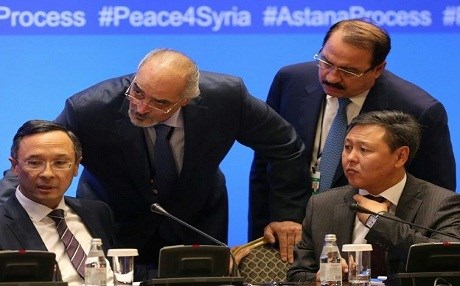
ERBIL, Kurdistan Region – The sixth round of Syrian peace talks in the Kazakh capital of Astana concluded on Friday with the establishment of the final and forth de-escalation zone in Syria’s northwestern Idlib province.
“Few believed in the success of the Astana process launched in January this year, however, thanks to the determination of the participants of Astana talks, there is now hope to resolve this acute crisis through peaceful means,” said Kazakh Foreign Minister Kairat Abdrakhmanov during a plenary session which wrapped up the two-day negotiations as reported on The Astana Times.
“Today, the participants can go further as they managed to overcome many challenges and achieve considerable results in restoring stability and peace in Syria. They reached what seemed to be impossible and efforts in this direction led to the creation of de-escalation zones in different parts of Syria,” he added.
UN special envoy to Syria, Steffan de Mistura, was also present at the sixth round of peace talks in Astana and said the creation of the final de-escalation zone was a positive development.
“Few believed in the success of the Astana process launched in January this year, however, thanks to the determination of the participants of Astana talks, there is now hope to resolve this acute crisis through peaceful means,” said Kazakh Foreign Minister Kairat Abdrakhmanov during a plenary session which wrapped up the two-day negotiations as reported on The Astana Times.
“Today, the participants can go further as they managed to overcome many challenges and achieve considerable results in restoring stability and peace in Syria. They reached what seemed to be impossible and efforts in this direction led to the creation of de-escalation zones in different parts of Syria,” he added.
UN special envoy to Syria, Steffan de Mistura, was also present at the sixth round of peace talks in Astana and said the creation of the final de-escalation zone was a positive development.
"We really welcome this agreement today because we have always been pushing for de-escalation," he said.
"This is what the people of Syria haven been asking and the fact of adding new areas to this de-escalation is crucial," Mistura added. "It already has reduced fighting in many areas."
Iran, Turkey and Russia have held five rounds of peace talks between the Syrian regime and rebel groups in Astana, Kazakhstan since January which supplement the UN-brokered Geneva talks that are meant to find a political resolution to the almost seven-year conflict.
Abdrakhmanov, along with Russia, Turkey and Iran announced in a joint statement the creation of de-escalation zones in the Idlib province, in eastern Ghouta, in parts of the northern Homs province and parts of neighboring provinces including Aleppo, Hama and Latakia as well as the southern part of Syria.
The de-escalations zones will all be in force for six months and extended if necessary based on the guarantor’s consensus.
Russia, Turkey and Iran will deploy forces to control the de-escalation zones as well as set up joint coordination centers to monitor activities within them.
“We believe that the process launched in Astana will strengthen the regime of cessation of hostilities and have a positive impact on upcoming Geneva talks under the auspices of the United Nations,” said Abdrakhmanov.
Bashar al-Jaafari, head of the Syrian government delegation called the Astana talks the “only successful platform in the Syrian process.”
The United Nations, United States and Jordan have at different times sent observers to the Astana talks, which have run concurrently with the UN-brokered, more politically-geared Geneva peace talks.
Syria has been embroiled in an almost seven-year-long civil war that has killed at least 400,000 people according to the United Nations. It has been complicated by the rise of ISIS, further destabilizing the country.
The next round of Astana peace talks are scheduled to continue in October.
Comments
Rudaw moderates all comments submitted on our website. We welcome comments which are relevant to the article and encourage further discussion about the issues that matter to you. We also welcome constructive criticism about Rudaw.
To be approved for publication, however, your comments must meet our community guidelines.
We will not tolerate the following: profanity, threats, personal attacks, vulgarity, abuse (such as sexism, racism, homophobia or xenophobia), or commercial or personal promotion.
Comments that do not meet our guidelines will be rejected. Comments are not edited – they are either approved or rejected.
Post a comment