



ERBIL, Kurdistan Region – British Foreign Minister Boris Johnson informed Kurdistan Region Prime Minister Nechirvan Barzani that there is a "serious effort" underway to jump start dialogue between Erbil and Baghdad, according to a statement from the Kurdistan Regional Government (KRG).
PM Barzani received a letter from Johnson on Wednesday, delivered by the country's new ambassador to Iraq, Jonathan Wilks.
Johnson "reaffirmed that there is a serious effort in place to begin dialogue to resolve disagreements between Erbil and Baghdad in light of the constitution," the Kurdish statement read.
The United Kingdom appreciates Erbil's efforts to deescalate tensions with Baghdad, it added.
PM Barzani thanked Mr Johnson for his effort, and repeated that Erbil has always favoured dialogue with Baghdad to resolve their outstanding issues. He said the international community should do more to bring Baghdad to the table.
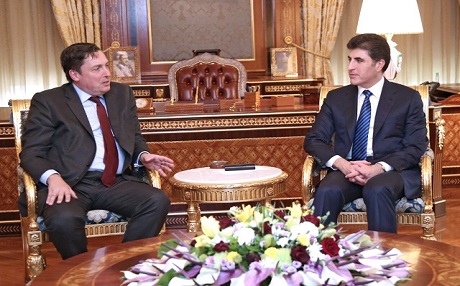
PM Barzani [R] meets with UK Ambassador to Iraq Jonathan Wilks in Erbil on November 22, 2017. Photo: KRG
The UK's Deputy National Security Advisor Christian Turner met with Iraqi Prime Minister Haider al-Abadi in Baghdad on Monday.
The two discussed the final phases of the war with ISIS, as well the Erbil-Baghdad rift. The British official urged the two sides to come together.
"I also emphasised the importance of dialogue between the Iraqi Government and the Kurdistan Regional Government as a vital step towards building a secure, stable and unified Iraq," Turner said.
A number of countries have stepped in with offers to help facilitate the anticipated talks, including the United States and France, as well as the United Nations.
Kurdistan Region's foreign minister, who is currently in the United States where he met with a number of officials like US National Security Advisor HR McMaster, told the Wall Street Journal this week that Erbil asked Washington to send an envoy to meditate diplomatic talks.
He said that while the US has a special envoy in the Middle East, Brett McGurk, his mission is limited to the anti-ISIS efforts, very different from the dispute between Erbil and Baghdad.
Speaking to reporters on Tuesday, State Department spokesperson Heather Nauert said she was not aware of a formal request for an envoy, but said the United States does not think such a move is necessary.
"There's a very long history here," she explained. "These folks have lived together, have fought together, have raised families together. We think that they can probably work it out on their own as well."
Nauert did add that the United States would continue to "try to facilitate conversations."
Almost a month ago, Iraqi and Kurdish forces exchanged heavy fire in Pirde (Altun Kupri), about 50 km outside south of Erbil and then further north near Kurdistan's international border at Fishkhabur. The situation is now calm with the two sides observing a ceasefire since October 28.
Erbil has offered to freeze the results of the Kurdistan referendum on independence and stated that it respects a ruling from the Iraqi Federal Court that stipulates no part of the country has the right of separation. The KRG has, however, not said it would respect a second ruling from the court found the referendum unconstitutional and cancelled the result.
Iraqi Prime Minister Haider al-Abadi praised the decision by the Court and called on Erbil to respect the verdict.
The UN mission in Iraq (UNAMI) stated Tuesday that the referendum issue has been resolved after the verdict and asked the KRG to commit to it.
PM Abadi has insisted that federal authority must extend to the 2003 borders and over the Kurdistan Region's international borders. Arguing that these demands are constitutional, he called on Erbil to cooperate.
The KRG argues that Baghdad violated almost one third of the constitution, thereby pushing Erbil to hold the referendum.
Erbil's main objections are Baghdad's failure to implement Article 140, addressing the disputed areas, and the draft 2018 budget bill that attempts to cut the KRG's share of the 2018 budget and downgrade the official status of the Kurdistan Region.
Abadi said his government has not violated the constitution by naming the Kurdistan Region as the provinces of the Kurdistan region. "There are provinces in the Kurdistan Region," he said in a press conference on Tuesday. He added that the official name of "Kurdistan Region," remains in place.
He also said Baghdad would pay state salaries, but only after an audit of the payroll, claiming the current numbers are inflated.
Comments
Rudaw moderates all comments submitted on our website. We welcome comments which are relevant to the article and encourage further discussion about the issues that matter to you. We also welcome constructive criticism about Rudaw.
To be approved for publication, however, your comments must meet our community guidelines.
We will not tolerate the following: profanity, threats, personal attacks, vulgarity, abuse (such as sexism, racism, homophobia or xenophobia), or commercial or personal promotion.
Comments that do not meet our guidelines will be rejected. Comments are not edited – they are either approved or rejected.
Post a comment