


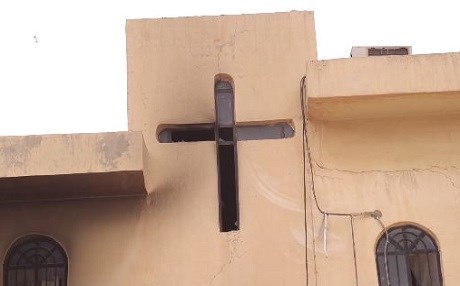
NINEVEH PLAINS, Iraq – Daniel, a priest, took us to a ruined church in Bashiqa. He showed us the smashed statue of Mary. He said that they weren’t afraid of ISIS anymore, but were concerned about the Christian politicians who he described as “puppets” wanting to create divisions among the Christian population of the Nineveh Plains.
“We will not let people listen to them. We as Christians want to live in a place where there is the rule of law,” he said.
The prospect for Christians of living in peace and certainty again, even after the demise of ISIS, is marred by scenes of broken crosses, ruined churches, and trails of devastation from the war that have instilled fear in their hearts. Their new fear is confrontation between Christian neighbours who are under the influence of different entities.
The situation is complicated by the presence of rival forces protecting Christian towns and villages.
Some areas, including Alqosh, Bashiqa, Tal Squf, and Batnaya, are under the protection of Nineveh Plains Protection Forces supported by the Peshmerga. But in Tel Kef, Hamdaniya and other places, Babylon Units, associated with the Hashd al-Shaabi forces, are in control.
“The rivalry is not only between Shiites and Sunnis, or Sunnis with Shiites. Rather, there are unfortunately problems even among Christians. There is big interference,” Rayan Kildani, secretary general of Babylon Units, said.
Kildani indirectly criticized the Christians supported by the Kurdistan Region.
“Saudi Arabia has publicly supported ISIS. In the beginning of the ISIS attack, all the vehicles ISIS was using as car bombs in Anbar had Saudi plate numbers. Nowadays, some Christian politicians go to this country. We have put question marks on them – what are they doing in a country that has helped ISIS?” he said.
A commander of the Nineveh Plains Protection Forces said that the presence of militia forces in the Tel Kef area was causing problems.
“If you are asking about the situations in Tel Kef, I am not sure. I am one of the forces that should go to Tel Kef. I saw how situations were there. It is not established. There are headquarters of some disputing parties. I can go there with a force from Nineveh Plains Protection Units, providing that these militia forces all leave there. We will not go if they don’t leave there,” said Brigadier General Bahnam.
Kamil Jiru Hurmiz, intelligence officer from regiment 3 of the Nineveh Plains Protection Units, said their number is 2,500 persons and their brigade has 3 regiments dispatched to Tal Squf, Hamdaniya, Bartella, Batnaya, Bashiqa, and Bahzany.
“We will be protecting the Nineveh Plains. We will be protecting our regions after the Peshmerga liberate them and then leave. We belong to Kurdistan, but other Christians belong to Baghdad. The places where we are belonging to Kurdistan and are protected by the Peshmerga, I don’t think they can come to this place and create problems,” Hurmiz said of the duties of their brigade.
The number of Christians in the Nineveh Plains is estimated to be around 130,000. They have historically distanced themselves from political affairs that have often resulted in bloodshed. They have always turned their back on politics and opted instead for security and their churches. But in 2014, ISIS left them with no option other than abandoning their religious sites and properties. Nearly 100,000 of them are now internally displaced persons (IDPs) in the Kurdistan Region.
Some of the Christian personalities and military officials who spoke to me in the rubble of their collapsed houses and churches were afraid that their disagreements will deepen after the Kurdistan Region holds its independence referendum and breaks away as “most people will vote to be administered into Kurdistan and it isn’t easy for the Christians within the Hashd al-Shaabi to accept this,” a Christian military official said.
In April 2015, Christian organizations revealed that seven Christian families were fleeing to the US and Europe every day. Basam Habib is a Christian IDP living in Batnaya. He said, “Half of the people of this region returned. But when they saw how the situation was, they regretted it. Some people even wanted to come back from Europe to Batnaya. They too regretted it.”
Since the war on ISIS, international churches have been busy raising money for Christian IDPs. A Christian official who did not want to be identified by name told Rudaw that international churches have sent a lot of money to Christian IDPs. The money has all been spent on buying houses and other essential items for them.
“So far, $30 million has been collected by international churches for Christian IDPs,” he said.
“We will not let people listen to them. We as Christians want to live in a place where there is the rule of law,” he said.
The prospect for Christians of living in peace and certainty again, even after the demise of ISIS, is marred by scenes of broken crosses, ruined churches, and trails of devastation from the war that have instilled fear in their hearts. Their new fear is confrontation between Christian neighbours who are under the influence of different entities.
The situation is complicated by the presence of rival forces protecting Christian towns and villages.
Some areas, including Alqosh, Bashiqa, Tal Squf, and Batnaya, are under the protection of Nineveh Plains Protection Forces supported by the Peshmerga. But in Tel Kef, Hamdaniya and other places, Babylon Units, associated with the Hashd al-Shaabi forces, are in control.
“The rivalry is not only between Shiites and Sunnis, or Sunnis with Shiites. Rather, there are unfortunately problems even among Christians. There is big interference,” Rayan Kildani, secretary general of Babylon Units, said.
Kildani indirectly criticized the Christians supported by the Kurdistan Region.
“Saudi Arabia has publicly supported ISIS. In the beginning of the ISIS attack, all the vehicles ISIS was using as car bombs in Anbar had Saudi plate numbers. Nowadays, some Christian politicians go to this country. We have put question marks on them – what are they doing in a country that has helped ISIS?” he said.
A commander of the Nineveh Plains Protection Forces said that the presence of militia forces in the Tel Kef area was causing problems.
“If you are asking about the situations in Tel Kef, I am not sure. I am one of the forces that should go to Tel Kef. I saw how situations were there. It is not established. There are headquarters of some disputing parties. I can go there with a force from Nineveh Plains Protection Units, providing that these militia forces all leave there. We will not go if they don’t leave there,” said Brigadier General Bahnam.
Kamil Jiru Hurmiz, intelligence officer from regiment 3 of the Nineveh Plains Protection Units, said their number is 2,500 persons and their brigade has 3 regiments dispatched to Tal Squf, Hamdaniya, Bartella, Batnaya, Bashiqa, and Bahzany.
“We will be protecting the Nineveh Plains. We will be protecting our regions after the Peshmerga liberate them and then leave. We belong to Kurdistan, but other Christians belong to Baghdad. The places where we are belonging to Kurdistan and are protected by the Peshmerga, I don’t think they can come to this place and create problems,” Hurmiz said of the duties of their brigade.
The number of Christians in the Nineveh Plains is estimated to be around 130,000. They have historically distanced themselves from political affairs that have often resulted in bloodshed. They have always turned their back on politics and opted instead for security and their churches. But in 2014, ISIS left them with no option other than abandoning their religious sites and properties. Nearly 100,000 of them are now internally displaced persons (IDPs) in the Kurdistan Region.
Some of the Christian personalities and military officials who spoke to me in the rubble of their collapsed houses and churches were afraid that their disagreements will deepen after the Kurdistan Region holds its independence referendum and breaks away as “most people will vote to be administered into Kurdistan and it isn’t easy for the Christians within the Hashd al-Shaabi to accept this,” a Christian military official said.
In April 2015, Christian organizations revealed that seven Christian families were fleeing to the US and Europe every day. Basam Habib is a Christian IDP living in Batnaya. He said, “Half of the people of this region returned. But when they saw how the situation was, they regretted it. Some people even wanted to come back from Europe to Batnaya. They too regretted it.”
Since the war on ISIS, international churches have been busy raising money for Christian IDPs. A Christian official who did not want to be identified by name told Rudaw that international churches have sent a lot of money to Christian IDPs. The money has all been spent on buying houses and other essential items for them.
“So far, $30 million has been collected by international churches for Christian IDPs,” he said.
Comments
Rudaw moderates all comments submitted on our website. We welcome comments which are relevant to the article and encourage further discussion about the issues that matter to you. We also welcome constructive criticism about Rudaw.
To be approved for publication, however, your comments must meet our community guidelines.
We will not tolerate the following: profanity, threats, personal attacks, vulgarity, abuse (such as sexism, racism, homophobia or xenophobia), or commercial or personal promotion.
Comments that do not meet our guidelines will be rejected. Comments are not edited – they are either approved or rejected.
Post a comment