
By Bahman Hassan
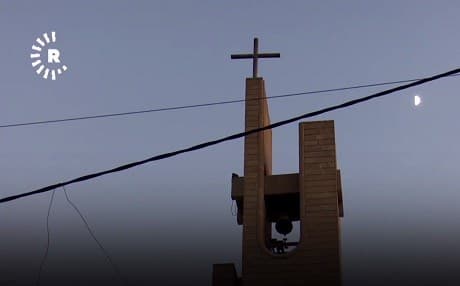
BAGHDAD, Iraq — Some of the few Christians remaining in Baghdad would like to see the international community protect their religion with the establishment of an independent state like the Vatican or Kuwait.
"We as Iraqi Christians call for an independent state, even if it is a small one like Kuwait or Vatican. The UN and UN Security Council should then protect our state," Robert Jameel, a member of Etihad Church in Baghdad, told Rudaw correspondent Bahman Hassan.
Iraq was home to over 1.5 million Christians before the country plunged into bloody sectarian conflict in 2003.
"We call for a state because we have suffered a lot. We have no support and have lost faith in everything. That is why we call for a state for the Christians," added Jameel.
Non-governmental organizations in the Kurdistan Region have told Rudaw English that prior to the rise of ISIS in 2014, they estimate 400,000 Christians lived in all of Iraq.
Since that time half of Christians have emigrated from Iraq, leaving less than 200,000 Christians mostly in the Kurdistan Region.
"Most Christians have emigrated due to bad security situations, which is why some churches in Baghdad have been closed. Priests have also decreased. Regarding the renovation of the churches, the Iraqi government will dedicate [some of the] budget for the churches," said Byus Qasha, the priest of Mar Youssef Church.
Christians, after hearing of what happened to Yezidis in Shingal, largely fled in August of 2014 to the safety of the Kurdistan Region. With only promises of funding and no guaranteed protections, Christians fear their days in the Iraqi capital are numbered
"Demographic changes in Christian neighborhoods of Baghdad have had a big impact on churches, for example areas of Bataween and Kamsara are not the same as they used to be. Many Christians lived in these areas 20 years ago," explained Carlo Sanharib, a Christian from Baghdad.
He believes Iraqi is losing its diversity.
"For instance, there were many Christians living in Shorja in the past,” he said. “These reasons account for the churches closing their doors. Why should they open their doors? There is no one to go and worship there.”
Other Christian leaders have told Rudaw that a Christian-administrated province will support the long-term stability in the volatile Nineveh plains where numerous ethnic and religious groups share common territorial claims.
"Almost all Christian refugees who come to my Church to pray would favor to live in a Christian region or province under international protection," Father Jamil Gorgis, a local priest in Duhok where some 75,000 Christians from Mosul took shelter, told Rudaw last September.
Iraqi Christians are mainly split between Syriac, Chaldean, Assyrian and Armenian sects.
Of the 328 seats in the Council of Representatives, Iraqi law reserves eight seats for members of minority communities: five for Christian candidates from Baghdad, Ninewah, Kirkuk, Erbil, and Duhok; one for a Yezidi; one for a Sabaean-Mandaean; and one for an ethnic Shabak. The Iraqi Kurdistan Parliament reserves 11 of its 111 seats for minorities: five for Christians, five for Turkmen, and one for Armenians.
Kirkuk Governor Najmaldin Karim has expressed that high-level posts in future Kurdistan Regional Governments could be given to minority groups such as Christians.
Many of the Christian areas in Nineveh fall in the so-called disputed areas claimed by both Baghdad and Erbil. These areas may choose to participate in the Kurdistan Region's September 25 referendum on independence.