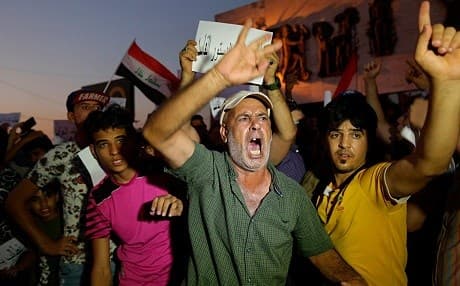

“The Iraqi government has not practically responded to the demands of the legitimate demonstrators, which do not exceed the provision of services and job opportunities,” Hassan Ali al-Khyun, the leader of al-Abooda tribe in Dhi Qar, told Rudaw on Monday.
They also called for the government to support the protesters and their demands, while generally calling for the imprisonment of corrupt people.
Hisham al-Hashimi, a security advisor to influential Sunni politician Salim al-Jabouri tweeted on Monday, that through nine days of protests 487 people (protestors and security personnel) have been injured. Ninety-three people have been arrested for vandalism and violent behavior in the southern protests. Jabouri was the speaker of the previous parliament which ended on June 30.
Iraqi Prime Minister Haider al-Abadi's attempts to negotiate with the protesters have been unsuccessful.
"We don't want the country to sink in political conflict and this is something that could be studied," Abadi stated on Sunday ."We want to listen to our people because a government is alive only when it's in touch with its people."
The premier emphasized that protesting is just, but should not lead to violence.
"Peaceful protests is people's rights and we pay attention to them, but taking them out of context by torching buildings and government offices, blocking roads and attacking security forces is taking the country backwards and there are people in organized crime who are ready to jump on that," he added.
Al-Abooda tribe is influential and popular locally in Dhi Qar. They hold little sway outside of the province or in the Iraqi capital.
The provincial capital of Nasiriyah saw at least eight people — security units and protesters — injured on Sunday.
The main complaint of demonstrators in southern Iraq is a lack of jobs. The official unemployment rate in Iraq is 10.8 percent, but that figure doubles among the country’s large young population. Nearly 59 percent of Iraq’s population is under the age of 25.
The Iraqi government is employing all possible means to end the protests, including cutting internet access, deploying security forces under a state of emergency, and pledging to invest in infrastructure.
.jpg&w=3840&q=75)