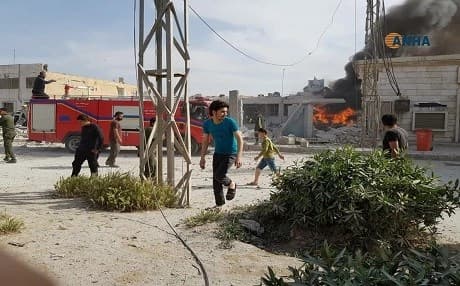

Leaders of the Asayesh (Kurdish security) and SDF died following the explosion of improvised explosive devices (IEDs) and mines in the Tal Abyad countryside, the Syrian Observatory for Human Rights wrote.
Neither official Turkish or SDF media sources or officials confirmed the incident, nor did they reveal what leaders were killed.
Tal Abyad (Gire Spi) is located about 80 kilometers north of Raqqa city and sits on the border with Turkey. The border is known to be heavily mined.
Tensions between the Turkish government and Kurdish fighters span roughly 750 kilometers from Afrin in northwest Syria to Qandil near the Kurdistan Region of Iraq's border with Iran.
In Manbij, Hawar News reported that a car bomb exploded on Thursday afternoon, killing one person and injuring six more including a child. The condition of the injured was described as stable.
Additionally, the reported explosion caused material damage to vehicles and buildings.
The Manbij Military Council, which holds the security portfolio for the city, did not immediately comment on the reported bombing. ISIS through its propaganda channel on Telegram, Furat News, claimed a car bomb attack in Manbij on Thursday targeting Kurdistan Workers' Party (PKK) elements.
The city is located in Aleppo governorate just west of the Euphrates about 30 kilometers south of the border with Turkey.
The SDF have served as the partnered ground force of the US-led international anti-ISIS coalition. On March 23, the SDF declared the defeat of the extremists following the liberation of al-Baghouz in eastern Deir ez-Zor governorate.
In December, Trump announced the United States would with draw all of its 2,200 forces from Syria. However, he later backtracked to leaving 400 forces and implored on regional and international actors to play a greater role in stabilization and preventing an ISIS resurgence.
The United States plans to split the forces in the northeast and at its garrison on the Jordan-Iraq-Syria border at At Tanf. SDF Commander-in-Chief Mazloum Kobane says the US force levels would be “insufficient” to ensure the lasting defeat of ISIS.
Violence in northeast Syria, or Rojava, has persisted following the announcement nearly two months ago.
British Maj. Gen. Chris Ghika, a deputy commander in the anti-ISIS coaliton, told Pentagon reporters on Tuesday that member militaries "must continue working with our partners to create the conditions in which Daesh cannot thrive again..."
The coalition and SDF helped to establish civil and military councils in northeast Syria as cities were liberated.
"Militarily, we continue our campaign to ensure the lasting defeat of Daesh. We cannot do it ourselves. Campaigns cannot be won by fighting alone. Instead, it requires a whole-of-government approach with the support of the international community, assisting the government of Iraq and the Syria civil councils to set the conditions for the stability and the prosperity that they crave," he said from Baghdad via teleconference.
Ghika acknowledged there will be stumbling blocks along the way.
"Having defeated Daesh's physical holdings in Baghouz, our partners are now progressing steadily back up the Euphrates River Valley, clearing the remnants of Daesh," he added. "The pace is slow and it's methodical, with the ground and buildings seeded with IEDs and booby traps. But progress is being made."
RELATED: After ISIS – what next for the SDF?