


ERBIL, Kurdistan Region – The Syrian Democratic Council (SDC), the ruling authority of the self-proclaimed Democratic Federation of Northern Syria, has condemned Turkey’s attacks on two villages in Kobani, calling on Damascus to shoulder responsibility.
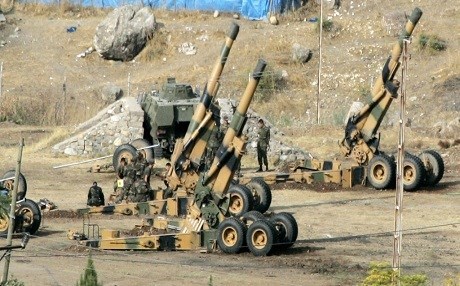
Turkish forces shelled People’s Protection Units (YPG) positions on Sunday, killing a Self-Defense Forces (HXP) conscript. Turkey accused the YPG of constructing trenches along its border.
The attack followed a quadrilateral summit on the future of Syria hosted by the Turkish president, which included the leaders of Russia, Germany, and France.
The SDC said the shelling hampers the war against ISIS, potentially allowing it to resurface. It called on the Syrian government to intervene.
“We in the Syrian Democratic Council, in the strongest terms, condemn the Turkish aggression on safe villages in northern Syria, and we call on the United Nations and the international coalition against ISIS to intervene and take up their responsibility towards this Turkish provocation of Syrian Democratic Forces (SDF),” reads a statement from the SDC published on Monday.
It accused Turkey of provoking trouble in Syria and supporting jihadist groups, particularly in Afrin and Idlib.
“We haven’t taken any step that could justify Turkish barbarism like we saw in Afrin and its occupation,” the SDC insisted. It respects Syrian society and serves no external agenda, it claimed.
The SDC is the political wing of armed SDF, comprised mainly of the Kurdish YPG and Arab militiamen, supported by the US. Turkey argues the YPG is an extension of the Kurdistan Workers’ Party (PKK), a armed group in Turkey fighting for greater Kurdish cultural and political rights, but considered a terrorist organization by Ankara.
It has attacked the Kurdish forces several times and seized control of the Kurdish canton of Afrin in March this year under Operation Olive Branch.
The Turkish president has more than once vowed to attack areas east of the Euphrates River controlled by the SDF. It has also renewed threats to take Manbij.
Turkish forces shelled People’s Protection Units (YPG) positions on Sunday, killing a Self-Defense Forces (HXP) conscript. Turkey accused the YPG of constructing trenches along its border.
The attack followed a quadrilateral summit on the future of Syria hosted by the Turkish president, which included the leaders of Russia, Germany, and France.
The SDC said the shelling hampers the war against ISIS, potentially allowing it to resurface. It called on the Syrian government to intervene.
“We in the Syrian Democratic Council, in the strongest terms, condemn the Turkish aggression on safe villages in northern Syria, and we call on the United Nations and the international coalition against ISIS to intervene and take up their responsibility towards this Turkish provocation of Syrian Democratic Forces (SDF),” reads a statement from the SDC published on Monday.
“We also call on the Syrian government in Damascus to not just stand by and watch, and to start undertaking legal measures on the international level to put a limit to Turkish violations and ambitions in Syria,” the SDC added.
It accused Turkey of provoking trouble in Syria and supporting jihadist groups, particularly in Afrin and Idlib.
“We haven’t taken any step that could justify Turkish barbarism like we saw in Afrin and its occupation,” the SDC insisted. It respects Syrian society and serves no external agenda, it claimed.
The SDC is the political wing of armed SDF, comprised mainly of the Kurdish YPG and Arab militiamen, supported by the US. Turkey argues the YPG is an extension of the Kurdistan Workers’ Party (PKK), a armed group in Turkey fighting for greater Kurdish cultural and political rights, but considered a terrorist organization by Ankara.
It has attacked the Kurdish forces several times and seized control of the Kurdish canton of Afrin in March this year under Operation Olive Branch.
The Turkish president has more than once vowed to attack areas east of the Euphrates River controlled by the SDF. It has also renewed threats to take Manbij.
Comments
Rudaw moderates all comments submitted on our website. We welcome comments which are relevant to the article and encourage further discussion about the issues that matter to you. We also welcome constructive criticism about Rudaw.
To be approved for publication, however, your comments must meet our community guidelines.
We will not tolerate the following: profanity, threats, personal attacks, vulgarity, abuse (such as sexism, racism, homophobia or xenophobia), or commercial or personal promotion.
Comments that do not meet our guidelines will be rejected. Comments are not edited – they are either approved or rejected.
Post a comment