


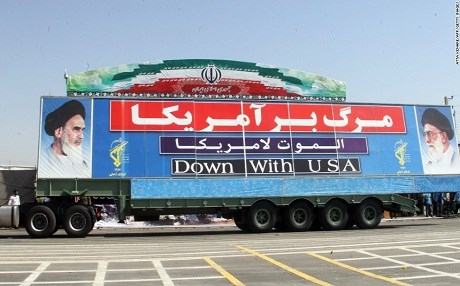
The impact of US economic sanctions on the lives of ordinary people in Iran is being documented almost in real time by the international news media, presumably with the tacit approval of the regime.
Expectedly, the reports don't make for pleasant reading or watching. From all accounts, the mood across the country is somber, the near-term outlook for the economy grim, and the case for considering emigrating compelling.
The big question is: Will the rulers of Iran for once put the best interests of the people ahead of the exigencies of regime survival?
Supreme Leader Ayatollah Ali Khamenei and his inner circle are hardly helpless spectators as the new rounds of American economic sanctions go straight for the jugular.
A solution is within their grasp, if only they are willing to take a pragmatic and unsentimental approach, putting aside their propensity for bombast.
The clerics do not have to mend their ties immediately with Washington or pretend to be President Donald Trump's best friend.
All they have to do is to intimate they are ready to enter into talks with the Trump administration, which wants Iran to renegotiate the 2015 nuclear agreement and end its perceived interference in Yemen, Syria and Lebanon.
After all, this is 2018, not 1979, the year of the Islamic revolution in Iran and the seizure of the grand mosque in Mecca by Saudi insurgents.
The world has moved on, and so should Iran.
"If [Mohammad] Mossadegh had been in charge today, he would have engaged in direct talks with Trump," Davoud Hermidas-Bavand, a former Iranian diplomat, told Al Jazeera recently, referring to the deposed prime minister and revered national figure.
"For Dr Mossadegh, everything was towards the realisation of the country's national interest."
The remarks can be considered an oblique criticism of Iran's current leadership in the context of the sanctions challenge.
President Hassan Rouhani has said Iran will not negotiate while sanctions are in place, while Khamenei has declared that all negotiations are off the table while Trump is US president.
In all fairness, they may not be entirely to blame for their unrealistic stance and wishful thinking.
False hopes have been raised by the European Union that the nuclear deal, abandoned by Trump in May, can be salvaged by the measures it is taking to shield Western companies doing business with Iran from financial harm.
The EU has just approved €18 million ($20.6 million) out of a planned €50m aid package for Iran, ostensibly to help offset the impact of the US sanctions that began snapping back into place from August 6.
But if truth be told, positive perceptions of Iran in Europe, attributable perhaps partly to the "smile diplomacy" of foreign minister Mohammad Javad-Zarif, do not count for much in the all-important corridors of power in Washington DC.
Iran's rulers may also be relying excessively on China, Japan, South Korea and India to keep on buying Iranian oil even it that means thumbing their nose at the Americans.
As it turns out, a perfect storm of trade tariffs, economic protectionism and a high dollar has kept America's foes as well as friends on edge, leaving Iran with very few countries it can count on to come publicly to its defence.
Now imagine if the Iranian regime were ready for realpolitik. They need look no further for inspiration than the Kurds in neighbouring Iraq, who have quietly pulled off a comeback after the events of October 2017 in the independence referendum's aftermath.
The main political parties of the Kurdistan Region have no illusions about the hostility of the regimes in Baghdad, Tehran and Ankara to ethnic Kurds' self-rule aspirations.
But the Kurdish politicians have not chosen to cut off their nose to spite their face. Despite their own factionalism, they have succeeded to a large extent in healing the rifts at the regional level: with the government and rival political blocs in Baghdad and with the authorities in Tehran and Ankara.
The stakes are far higher for the Iranians. But they have a chance to show off their bargaining chops by agreeing to sit down with the Americans to discuss the new set of demands threadbare rather than dismiss them out of hand.
For good measure, they should consider the worst-case scenarios upfront - that Trump will go on to complete his term and his nascent containment strategy will continue to target rivals of the US and its partners from the Persian Gulf to the South China Sea.
For the long term, Iran's rulers should heed the message that their people have been trying to deliver time and again: A militarily overstretched, economically mismanaged and socially regressive regime cannot expect to be loved or respected, no matter how lofty its self-image.
If anything, the frequent flare-ups both inside Iran and in the predominantly Shia areas of southern Iraq are a clear indication that the people supposed to be the natural constituency of the clerical regime are fed up with empty promises of stability and prosperity.
For the immediate term, Iran's leaders can keep trying to soften the shocks of the incoming US sanctions with speeches full of sound and fury signifying nothing.
Or they can trim their sails to suit the political winds, compete with their Sunni counterparts in social progress and economic modernisation, and pivot to a soft-power strategy anchored in Iran's cultural heritage and dual Persian and Islamic identities.
As far as ordinary Iranians are concerned, the choice is unambiguously clear. What they lack is a voice.
Arnab Neil Sengupta is an independent journalist and commentator on the Middle East.
The views expressed in this article are those of the author and do not necessarily reflect the position of Rudaw.
Comments
Rudaw moderates all comments submitted on our website. We welcome comments which are relevant to the article and encourage further discussion about the issues that matter to you. We also welcome constructive criticism about Rudaw.
To be approved for publication, however, your comments must meet our community guidelines.
We will not tolerate the following: profanity, threats, personal attacks, vulgarity, abuse (such as sexism, racism, homophobia or xenophobia), or commercial or personal promotion.
Comments that do not meet our guidelines will be rejected. Comments are not edited – they are either approved or rejected.
Post a comment