


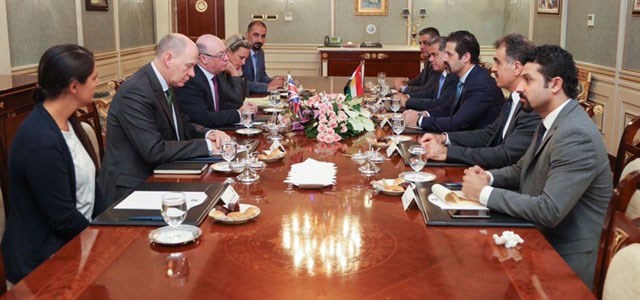
ERBIL, Kurdistan Region – Efforts are underway to build “unanimity” in Kurdistan’s politics and society in advance of a historic referendum scheduled to take place in three weeks’ time, the deputy prime minister told a visiting UK delegation.
Deputy Prime Minister Qubad Talabani received Burt Alistair, Minister of State for the Department for International Development and Minister of State for the Foreign and Commonwealth Office, in Erbil on Monday.
Talabani told the British minister that “efforts are ongoing to restore confidence among political parties with the purpose of building political and social unanimity with respect to national and all the other current questions,” according to a statement published by the Kurdistan Regional Government (KRG) after the meeting.
“Current conditions require us to be unanimous more than we have ever been especially with respect to the question of self-determination and how to confront any possibility or change in the region,” Talabani said to Alistair.
“There are indications that change is under way,” he added, according to the statement.
While all Kurdistan’s political parties support independence, disagreement over the timing and mechanism of the referendum has threatened to derail the vote.
The Change Movement (Gorran) and Kurdistan Islamic Group (Komal) both want to see the September 25 vote delayed. They issued a joint statement on Monday reiterating that the referendum should be postponed until the “right time,” when it has a mandate from the currently defunct parliament.
Parliament has not sat since 2015 after a dispute between Gorran and the ruling Kurdistan Democratic Party (KDP). The KDP is leading a coalition of parties preparing for the referendum and holding negotiations with Baghdad.
Talabani’s party, the Patriotic Union of Kurdistan (PUK), will meet with Gorran on Tuesday. The meeting will be decisive with respect to the issues of reactivation of parliament and the referendum, Rudaw has learned.
The PUK has alliances with both the KDP and Gorran and has played a mediator role, holding meetings with both sides in an effort to resolve the stalemate.
Deputy Prime Minister Qubad Talabani received Burt Alistair, Minister of State for the Department for International Development and Minister of State for the Foreign and Commonwealth Office, in Erbil on Monday.
Talabani told the British minister that “efforts are ongoing to restore confidence among political parties with the purpose of building political and social unanimity with respect to national and all the other current questions,” according to a statement published by the Kurdistan Regional Government (KRG) after the meeting.
“Current conditions require us to be unanimous more than we have ever been especially with respect to the question of self-determination and how to confront any possibility or change in the region,” Talabani said to Alistair.
“There are indications that change is under way,” he added, according to the statement.
While all Kurdistan’s political parties support independence, disagreement over the timing and mechanism of the referendum has threatened to derail the vote.
The Change Movement (Gorran) and Kurdistan Islamic Group (Komal) both want to see the September 25 vote delayed. They issued a joint statement on Monday reiterating that the referendum should be postponed until the “right time,” when it has a mandate from the currently defunct parliament.
Parliament has not sat since 2015 after a dispute between Gorran and the ruling Kurdistan Democratic Party (KDP). The KDP is leading a coalition of parties preparing for the referendum and holding negotiations with Baghdad.
Talabani’s party, the Patriotic Union of Kurdistan (PUK), will meet with Gorran on Tuesday. The meeting will be decisive with respect to the issues of reactivation of parliament and the referendum, Rudaw has learned.
The PUK has alliances with both the KDP and Gorran and has played a mediator role, holding meetings with both sides in an effort to resolve the stalemate.
Comments
Rudaw moderates all comments submitted on our website. We welcome comments which are relevant to the article and encourage further discussion about the issues that matter to you. We also welcome constructive criticism about Rudaw.
To be approved for publication, however, your comments must meet our community guidelines.
We will not tolerate the following: profanity, threats, personal attacks, vulgarity, abuse (such as sexism, racism, homophobia or xenophobia), or commercial or personal promotion.
Comments that do not meet our guidelines will be rejected. Comments are not edited – they are either approved or rejected.
Post a comment