


The leftist group involved in an Istanbul courthouse siege on Tuesday in which two gunmen and a prosecutor they took hostage were killed, has waged a violent anti-government crusade in Turkey for more than three decades.
Since its creation in 1978, the Marxist Revolutionary People's Liberation Party-Front (DHKP-C) has been involved in a number of daring attacks. These have spiked since greater US interventions in Turkey and the region.
The rebels, whose gunmen were disguised as lawyers to sneak into the Istanbul courthouse, have claimed dozens of hits, some targeting leaders and institutions at the very top.
In 2013, the group targeted the headquarters of the ruling Justice and Development Party (AKP), the Turkish National Police and a Justice Ministry building. In 2005, a man wearing explosives failed to get into the building of then prime minister Recep Tayyip Erdogan, who is now president.
The group has been in existence for as long as the Kurdistan Workers’ Party (PKK), which is also leftist and outlawed, but its attacks have been relatively minor in comparison.
The DHKP-C is an offshoot of a Marxist-Leninist movement that began in the late 1970s, with the aim of replacing Turkey’s government with a Marxist one. It came into existence in 1978 as Dev-Sol, or the Revolutionary Left.
For more than a decade, the group has intensified its opposition to what it calls “US imperialism.” It has consistently denounced American involvement in Turkey, Syria, Iraq and Afghanistan.
On Tuesday, two gunmen from the rebel group and a prosecutor they held hostage inside Istanbul’s main courthouse died after a shootout between the hostage takers and police, officials said.
Authorities said they had negotiated with the gunmen for six hours before the standoff came to a violent end. Media reports said Turkish Special Forces had been brought in.
The prosecutor, identified as Mehmet Selim Kiraz, was shot in the head and rushed to hospital during the standoff, but doctors could not save his life. He was the prosecutor investigating the death of Berkin Elvan, a teenager killed by a police gas canister during the Istanbul Gezi protests in 2013.
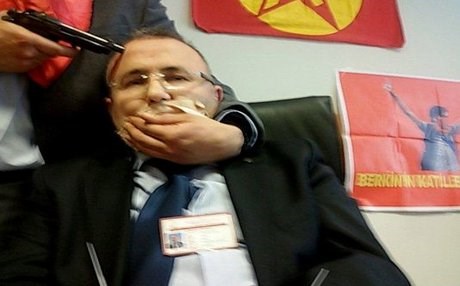
Shortly after the gunmen took their hostage around midday, a website close to the rebels posted a picture online of Kiraz with a gun to his head. It warned he would be “punished by death” if their demands were not met within three hours.
They wanted policemen held responsible for the teenager's killing to confess to the death on live television and their trial in "peoples' courts." It also demanded that Turkish courts drop prosecutions or investigations against people who took part in protests denouncing the boy's death.
The DHKP-C, which is considered a terrorist organization by Turkey, the United States and European Union, has targeted the Ankara government as well as Western interests in Turkey.
It has targeted US military personnel and diplomatic missions several times.
In February 2013, a suicide bombing outside the US Embassy in Ankara killed a Turkish guard: it was the group’s response to the arrival of 400 US soldiers in Turkey, tasked with operating Patriot anti-missile batteries to protect against a spillover of the Syrian civil war.
Following simultaneous attacks on three targets in April 2003, including two outlets of US fast food giant, McDonald’s, the group declared: “We carried out these attacks to demand a reckoning from America and the collaborationist government for the massacres in Iraq and in our country."
Ankara blames the rebels for the deaths of dozens of police officers and soldiers along with more than 80 civilians.
Comments
Rudaw moderates all comments submitted on our website. We welcome comments which are relevant to the article and encourage further discussion about the issues that matter to you. We also welcome constructive criticism about Rudaw.
To be approved for publication, however, your comments must meet our community guidelines.
We will not tolerate the following: profanity, threats, personal attacks, vulgarity, abuse (such as sexism, racism, homophobia or xenophobia), or commercial or personal promotion.
Comments that do not meet our guidelines will be rejected. Comments are not edited – they are either approved or rejected.
Post a comment