


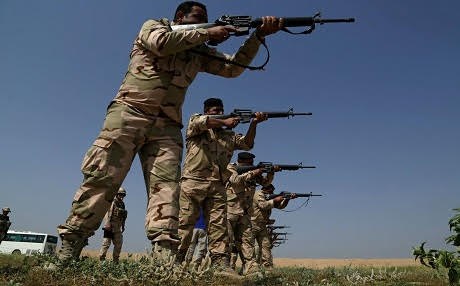
Recently President Obama announced the addition of 250 US troops to the fight against ISIS in Iraq/Syria. What effect will the addition of 250 special forces have on the fight is a question that apparently was never raised in either the White House or the Pentagon. There is a concept of war put forth by Carl von Clausewitz called economy of force. The use of the word economy appears to be misunderstood by the current command structure.
Past Army manuals, most notable FM 100-5 and FM 3-0, both titled operations, spoke to the operational concepts in detail. The new iteration of this manual is ADP (Army Doctrine and Training Publication) 3-0 which is titled Unified Land Operations and is the new concept of manuals, that are more narrative and shorter. In the old FM’s, economy of force was laid out as "Allocate minimum essential combat power to secondary efforts. Economy of force is the reciprocal of mass. It requires accepting prudent risk in selected areas to achieve superiority—overwhelming effects—in the decisive operation. Economy of force involves the discriminating employment and distribution of forces. Commanders never leave any element without a purpose. When the time comes to execute, all elements should have tasks to perform." The key is “…accepting prudent risk in selected areas to achieve superiority—overwhelming effects—in the decisive operation.” ADP 3-0 does not specifically define the concept but it must be assumed it is taught somewhere in an officers training. ADP 3-0 runs 28 pages while FM 3-0 ran 220 pages. Perhaps the next manual will not exceed 140 characters. I mention all of this in the hopes that it might explain why any one believes 250 troops can be in any way effective against ISIS.
Other problems that have been taught as operational mistakes is to piecemeal units into combat. Putting 250 troops in is piecemealing. In Kurdistan there was an ISIS attack that was larger than many would have believed could be launched. This attack claimed the lives of Kurdish Peshmerga and one US Navy Seal, PO1 Charles Keating IV, before it was push back. Through the fog of both war and the public affairs office we may never know exactly what happened, but what we do know is that the constant drum beat of the Obama administration that ISIS is being defeated and reduced as a fighting force is looking less truthful.
US military intervention is not wholly missing in the fight. Recently the village of Bashir was liberated by the Peshmerga after several failed attempts by the Shia Hashd al-Shaabi militia to do the job. One of the main difference was the use of US air power to provide overhead cover for the Peshmerga, which the US was not willing to provide Hashd al-Shaabi nor was it asked for, or would it have been accepted.
The Peshmerga have shown that ISIS can be defeated in a straight on battle, provided there is adequate training and support. The Iraqi Army and the Shia militias have shown they can win only through the use of massive fire power, such as in Ramadi, which was taken at the cost of the city. Ramadi today exists only as a place on a map.
Now that we know the Peshmerga can not only defend Kurdistan from ISIS but when supported, defeat them in open combat, why not let them take the whole battle on and just provide air power? The answer depends on the end state desired. If all that is needed is to provide Kurdistan with a buffer that allows it to live in peace, then it can be done with little additional support. If the end state desired is the defeat or ultimately the destruction of ISIS a large ground force will be needed. For this last to happen a large ground force will be needed in Syria as well. The Syrian Kurds have also proved effective in defending themselves and pushing back the ISIS threat but would not on their own be able to defeat ISIS.
ISIS is a global threat and will not be defeated by piecemealing in Special Forces or any other type of force. The world must decide it is time and authorize a large overwhelming force. It would be best should this force be predominantly from Muslim countries but if not then let the US and/or Russia lead the way. Once ISIS is dealt with then the other problems can be confronted, Syria’s Assad, a Nuclear Iran, a despotic Turkey and other problems that have left the region’s population in need of support.
I am sorry to say that 250 troops are not a good start, 25,000 would be a good start. Leadership needs to look at the big picture and not just take action that may look good on the home front but accomplishes nothing but put soldiers’ lives in danger.
Paul Davis is a retired US Army military intelligence and former Soviet analyst. He is a consultant to the American intelligence community specializing in the Middle East with a concentration on Kurdish affairs. Currently he is the President of the consulting firm JANUS Think in Washington D.C.
Past Army manuals, most notable FM 100-5 and FM 3-0, both titled operations, spoke to the operational concepts in detail. The new iteration of this manual is ADP (Army Doctrine and Training Publication) 3-0 which is titled Unified Land Operations and is the new concept of manuals, that are more narrative and shorter. In the old FM’s, economy of force was laid out as "Allocate minimum essential combat power to secondary efforts. Economy of force is the reciprocal of mass. It requires accepting prudent risk in selected areas to achieve superiority—overwhelming effects—in the decisive operation. Economy of force involves the discriminating employment and distribution of forces. Commanders never leave any element without a purpose. When the time comes to execute, all elements should have tasks to perform." The key is “…accepting prudent risk in selected areas to achieve superiority—overwhelming effects—in the decisive operation.” ADP 3-0 does not specifically define the concept but it must be assumed it is taught somewhere in an officers training. ADP 3-0 runs 28 pages while FM 3-0 ran 220 pages. Perhaps the next manual will not exceed 140 characters. I mention all of this in the hopes that it might explain why any one believes 250 troops can be in any way effective against ISIS.
Other problems that have been taught as operational mistakes is to piecemeal units into combat. Putting 250 troops in is piecemealing. In Kurdistan there was an ISIS attack that was larger than many would have believed could be launched. This attack claimed the lives of Kurdish Peshmerga and one US Navy Seal, PO1 Charles Keating IV, before it was push back. Through the fog of both war and the public affairs office we may never know exactly what happened, but what we do know is that the constant drum beat of the Obama administration that ISIS is being defeated and reduced as a fighting force is looking less truthful.
US military intervention is not wholly missing in the fight. Recently the village of Bashir was liberated by the Peshmerga after several failed attempts by the Shia Hashd al-Shaabi militia to do the job. One of the main difference was the use of US air power to provide overhead cover for the Peshmerga, which the US was not willing to provide Hashd al-Shaabi nor was it asked for, or would it have been accepted.
The Peshmerga have shown that ISIS can be defeated in a straight on battle, provided there is adequate training and support. The Iraqi Army and the Shia militias have shown they can win only through the use of massive fire power, such as in Ramadi, which was taken at the cost of the city. Ramadi today exists only as a place on a map.
Now that we know the Peshmerga can not only defend Kurdistan from ISIS but when supported, defeat them in open combat, why not let them take the whole battle on and just provide air power? The answer depends on the end state desired. If all that is needed is to provide Kurdistan with a buffer that allows it to live in peace, then it can be done with little additional support. If the end state desired is the defeat or ultimately the destruction of ISIS a large ground force will be needed. For this last to happen a large ground force will be needed in Syria as well. The Syrian Kurds have also proved effective in defending themselves and pushing back the ISIS threat but would not on their own be able to defeat ISIS.
ISIS is a global threat and will not be defeated by piecemealing in Special Forces or any other type of force. The world must decide it is time and authorize a large overwhelming force. It would be best should this force be predominantly from Muslim countries but if not then let the US and/or Russia lead the way. Once ISIS is dealt with then the other problems can be confronted, Syria’s Assad, a Nuclear Iran, a despotic Turkey and other problems that have left the region’s population in need of support.
I am sorry to say that 250 troops are not a good start, 25,000 would be a good start. Leadership needs to look at the big picture and not just take action that may look good on the home front but accomplishes nothing but put soldiers’ lives in danger.
Paul Davis is a retired US Army military intelligence and former Soviet analyst. He is a consultant to the American intelligence community specializing in the Middle East with a concentration on Kurdish affairs. Currently he is the President of the consulting firm JANUS Think in Washington D.C.
Comments
Rudaw moderates all comments submitted on our website. We welcome comments which are relevant to the article and encourage further discussion about the issues that matter to you. We also welcome constructive criticism about Rudaw.
To be approved for publication, however, your comments must meet our community guidelines.
We will not tolerate the following: profanity, threats, personal attacks, vulgarity, abuse (such as sexism, racism, homophobia or xenophobia), or commercial or personal promotion.
Comments that do not meet our guidelines will be rejected. Comments are not edited – they are either approved or rejected.
Post a comment