


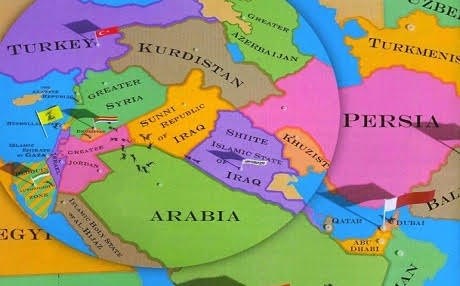
During a period from the early 19th century through the end of the Cold War and beyond the terms “The Great Game” and “The New Great Game” have been used to describe the geopolitical interactions between Russia and the West. Starting as a concept of control of central Asia, predominantly Afghanistan, between imperial Russia and the British Empire, it can now be seen as a clash of influence between the United States and Russia. While Russian influence in the Middle East has waxed and waned over the years, it appears to be ascending against a US foreign policy that is embracing disengagement from the region and across the world. The impact of this transitional change will be most felt by the Wests strongest allies in the region, Israel and the Kurds of Iraq and Syria as well as the Kurdish populations of Turkey and Iran.
We can add to this another player of the game from the past, Iran. Iran and Russia have had diplomatic and military ties that go back to the 16th century. Driven by economic need, allowing Persian trade with Britain, moving goods through Russia and avoiding the lands of the Ottoman Empire, and with Persia attempting to set up a joint force against the mutual enemy, the Ottomans. While this relationship has gone through strong friendship and tremendous stress it is currently at a mutual beneficial stage opposing a common enemy, the United States.
This new great game is coming at a time of increased tension in the world, especially in the Middle East and is shaping up to be a challenge to the West and will adversely affect the way the world develops.
Currently the Middle East is the epicenter of change. Other than Egypt, most countries are less than 90 years old. Regardless of being the cradle of civilization (one of several) the current countries were designed by Europe after the First World War, following the formula designed by Sikes-Picot. The boundaries were chosen to satisfy European political and economic needs, not those of the people who had just thrown off Ottoman rule.
During the various wars between the Arabs and Israel the majority of the Arab military equipment came from the Soviet Union, while the Israelis used western manufactured equipment plus captured Soviet tanks and APC’s. Soviet influenced declined when President Anwar Sadat kicked out all Soviet military advisers. US influence increased within both Egypt and Jordan and a secure peace was established with Israel.
Jumping ahead three decades we find the Soviet Union is gone but replaced by a decidedly new country that retains the Soviet propensity for foreign mischief and a Tsarist style of government. The United States on the other hand seems to have expended its desire to be the major player in not only the Middle East but a major leader in the world. This reversal of influence will have far reaching consequences, or more to the point will be a study in the law of unintended consequences on an international scale.
The great game is now playing out to the detriment of the West, especially the United States. The last time the game played on this level was during the cold war and both sides knew the consequence of failure. Two influential studies during this time were “The Study of Conflict” and the follow-on “Arms and Influence,” both by Thomas Schelling, a professor at Yale and Harvard, pointed out the need to always have the military option on the table.
The need to maintain the military option has been written about and known from Machiavelli to Clausewitz and onto Liddell-Hart and Moshe Dayan, and of course Schelling. Schelling points out that force can be used to not only coerce, through the use of force, but also to compel, through the threat of force. This is the lesson lost on the west today which is evidenced in the recent Iran nuclear deal accepted by the P5+1 delegation led by the United States. Would Iran have acted differently had there been a credible threat of military action, we will never know? Iran could have been compelled to accept terms more in line with stated intentions of the West, however they knew there was no intention of the United States to use its military to enforce its policies.
How is the game playing out? Russia has, through successive US administrations, occupied parts of Georgia, Ukraine and annexed the Crimea. It controls most of the Black Sea and airspace over Poland and the Baltic states. It has reasserted itself into the Middle East and can command air space over the eastern Mediterranean as well as threaten shipping lanes. Russia is seen by most of the Arab world as the sole source of power in defense of it friends. The United States on the other hand is withdrawing forces who would otherwise defend allies and has left its friends such as Israel and the Kurds to fend for themselves. It ignores clear violations of international law as well as ignoring its own stated policies. The current administration has lost militarily, diplomatically, and morally across the board.
The game is not over just one side is waiting for a new coach.
Paul Davis is a retired US Army military intelligence and former Soviet analyst. He is a consultant to the American intelligence community specializing in the Middle East with a concentration on Kurdish affairs. Currently he is the President of the consulting firm JANUS Think in Washington D.C.
We can add to this another player of the game from the past, Iran. Iran and Russia have had diplomatic and military ties that go back to the 16th century. Driven by economic need, allowing Persian trade with Britain, moving goods through Russia and avoiding the lands of the Ottoman Empire, and with Persia attempting to set up a joint force against the mutual enemy, the Ottomans. While this relationship has gone through strong friendship and tremendous stress it is currently at a mutual beneficial stage opposing a common enemy, the United States.
This new great game is coming at a time of increased tension in the world, especially in the Middle East and is shaping up to be a challenge to the West and will adversely affect the way the world develops.
Currently the Middle East is the epicenter of change. Other than Egypt, most countries are less than 90 years old. Regardless of being the cradle of civilization (one of several) the current countries were designed by Europe after the First World War, following the formula designed by Sikes-Picot. The boundaries were chosen to satisfy European political and economic needs, not those of the people who had just thrown off Ottoman rule.
During the various wars between the Arabs and Israel the majority of the Arab military equipment came from the Soviet Union, while the Israelis used western manufactured equipment plus captured Soviet tanks and APC’s. Soviet influenced declined when President Anwar Sadat kicked out all Soviet military advisers. US influence increased within both Egypt and Jordan and a secure peace was established with Israel.
Jumping ahead three decades we find the Soviet Union is gone but replaced by a decidedly new country that retains the Soviet propensity for foreign mischief and a Tsarist style of government. The United States on the other hand seems to have expended its desire to be the major player in not only the Middle East but a major leader in the world. This reversal of influence will have far reaching consequences, or more to the point will be a study in the law of unintended consequences on an international scale.
The great game is now playing out to the detriment of the West, especially the United States. The last time the game played on this level was during the cold war and both sides knew the consequence of failure. Two influential studies during this time were “The Study of Conflict” and the follow-on “Arms and Influence,” both by Thomas Schelling, a professor at Yale and Harvard, pointed out the need to always have the military option on the table.
The need to maintain the military option has been written about and known from Machiavelli to Clausewitz and onto Liddell-Hart and Moshe Dayan, and of course Schelling. Schelling points out that force can be used to not only coerce, through the use of force, but also to compel, through the threat of force. This is the lesson lost on the west today which is evidenced in the recent Iran nuclear deal accepted by the P5+1 delegation led by the United States. Would Iran have acted differently had there been a credible threat of military action, we will never know? Iran could have been compelled to accept terms more in line with stated intentions of the West, however they knew there was no intention of the United States to use its military to enforce its policies.
How is the game playing out? Russia has, through successive US administrations, occupied parts of Georgia, Ukraine and annexed the Crimea. It controls most of the Black Sea and airspace over Poland and the Baltic states. It has reasserted itself into the Middle East and can command air space over the eastern Mediterranean as well as threaten shipping lanes. Russia is seen by most of the Arab world as the sole source of power in defense of it friends. The United States on the other hand is withdrawing forces who would otherwise defend allies and has left its friends such as Israel and the Kurds to fend for themselves. It ignores clear violations of international law as well as ignoring its own stated policies. The current administration has lost militarily, diplomatically, and morally across the board.
The game is not over just one side is waiting for a new coach.
Paul Davis is a retired US Army military intelligence and former Soviet analyst. He is a consultant to the American intelligence community specializing in the Middle East with a concentration on Kurdish affairs. Currently he is the President of the consulting firm JANUS Think in Washington D.C.
Comments
Rudaw moderates all comments submitted on our website. We welcome comments which are relevant to the article and encourage further discussion about the issues that matter to you. We also welcome constructive criticism about Rudaw.
To be approved for publication, however, your comments must meet our community guidelines.
We will not tolerate the following: profanity, threats, personal attacks, vulgarity, abuse (such as sexism, racism, homophobia or xenophobia), or commercial or personal promotion.
Comments that do not meet our guidelines will be rejected. Comments are not edited – they are either approved or rejected.
Post a comment