


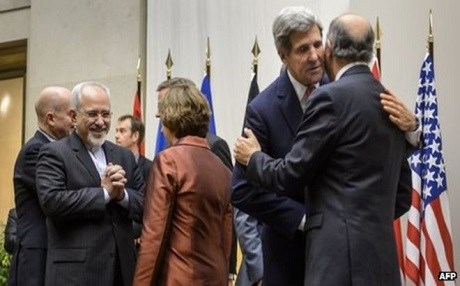
January 16th marked Implementation Day of the Joint Comprehensive Plan of Action (JCPOA) between Iran and the rest of the world, most notable the United States. According to many, this is a landmark decision and the high water mark of the Obama administration’s foreign policy legacy. The intent of the deal is to ensure that Iran never gets a nuclear device. The reality of the deal is yet to be seen. The intent of the deal is admirable but as the old saying goes “we judge ourselves by our intent, others judge us by our actions.”
Since Adoption Day, October 18, 2015, Iran has increased its presence in the fighting in Syria and Iran, launched two ballistic missiles and captured an American naval vessel and held ten sailors captive before releasing them and photos of the crew on their knees. On implementation day but prior to signing the final bit of paper work, Iran released four Americans that had been imprisoned or detained including Washington Post reporter Jason Rezaian as part of an apparent backdoor agreement but connected to the lifting of sanctions on Iran by the US. Included in the deal was the release of seven Iranians in US custody as well as dropping Interpol warrants on 14 others.
Watching the actions of both sides prior to and following implementation day is an initial indicator of how the process will go forward. It does not look good. President Obama called it a triumph of diplomacy saying “smart, patient and disciplined” diplomacy can improve relations with a longtime foe. The prisoner swap was a backdoor deal not shared with the world until it happened then and only then did the US sign the instrument of implementation.
Once the US prisoners were in the air the President set down new sanctions on 11 individuals based on the ballistic missile tests which violated the letter of a UN sanction and the spirit of the JCPOA. While the new sanctions were intended for some time the announcement was delayed so as not to interfere with implementation or the prisoner swap. This was hardly in the spirit of the new relationship Obama said he wanted with Iran.
On the other side Iran launched the missiles right after Adoption Day. They stated at the time that the JCPOA would have no effect on Iran developing military hardware intended to protect the Islamic Republic. While the intent of the JCPOA was to deny Iran a Nuclear device the only military purpose of the missiles is to carry nuclear warheads. Iran has continued to be involved in destabilizing the region through the use of the IRGC in both Iraq and Syria and training and controlling Shia militia’s in Iraq and arming and training Hezbollah in Syria and Lebanon.
On implementation Day the world got a promise from Iran to not develop nuclear weapons but could still do “peaceful” nuclear research. The United States agreed to give Iran 1.7 billion dollars in compensation and release 100+ billion dollars in frozen assets, immediately. Just prior to the implementation the IRGC Navy seized two small US Navy boats and used the captured crew as propaganda in violation of international norms.
The promise of Iran to stop its research is likely to last a short time and will be preceded by increased hegemonic maneuvering in the region. The United States threat to snap back sanctions is little more than posturing, regardless of the new sanctions on just 11 individuals. The day after implementation three American contractors were kidnaped in Baghdad and it is widely assumed the kidnapers were Shia militia trained and paid by Iran.
Diplomacy is difficult at best and is not always an end unto itself. It becomes even more difficult when neither country likes or trust the other. We can equate this to the diplomacy that transpired between the US and the Soviet Union during the cold war. Negotiations were long, tedious and difficult as both sides maneuvered for best advantage, but once a deal was struck it was adhered to. The negotiation for the JCPOA will most likely turn out to look more like Nazi Germany’s treaties with the Soviet Union or the US peace talks with Imperial Japan just before the attack on Pearl Harbor. Based on its past actions it appears that the agreement is most likely a delaying tactic on the part of Iran while it rebuilds its economy. For the United States they achieved a short termed political victory and if they are wrong the world will pay a heavy price.
Paul Davis is a retired US Army military intelligence and former Soviet analyst. He is a consultant to the American intelligence community specializing in the Middle East with a concentration on Kurdish affairs. Currently he is the President of the consulting firm JANUS Think in Washington D.C.
Comments
Rudaw moderates all comments submitted on our website. We welcome comments which are relevant to the article and encourage further discussion about the issues that matter to you. We also welcome constructive criticism about Rudaw.
To be approved for publication, however, your comments must meet our community guidelines.
We will not tolerate the following: profanity, threats, personal attacks, vulgarity, abuse (such as sexism, racism, homophobia or xenophobia), or commercial or personal promotion.
Comments that do not meet our guidelines will be rejected. Comments are not edited – they are either approved or rejected.
Post a comment