


ERBIL, Kurdistan Region — Through increased exports in the volume of oil, Iraq took $7.38 billion in revenue for May compared to $7.11 billion in April, according to Baghdad.
On average, Iraq exported 3.572 million barrels per day (bpd) in May.
The average price per barrel sold was $66.683 — slightly down from the $67.419 mark in April, according to the Iraqi Ministry of Oil.
However in total, Iraq exported nearly 111 million barrels in May, compared to 104 million barrels in April.
The exports consisted of 3.441 million bpd per southern oil fields, 102,000 bpd from Kirkuk, and 29,000 from Qayyara.
Price for Brent Crude Oil traded internationally around $70 per barrel in early May, but fell sharply through the month to under $64 at the end of the month.
Total oil exports from Kirkuk — which had dropped from 3.06 million barrels in March to 2.57 million barrels in April — rebounded to about 3.16 million barrels for May.
Kirkuk averaged 102,000 bpd of exports through the Ceyhan pipeline that terminates in the Turkish port.
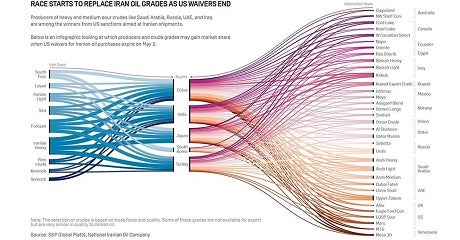
"Producers of heavy and medium sour crudes like Saudi Arabia, Russia, UAE, and Iraq are amongst the winners from US sanctions aimed at Iranian shipments," it reported.
Turkey, which says it is abiding by US sanctions not to purchase oil from Iran, has increased oil imports from Iraq to make up for the gap, according to Turkey's energy watchdog, the Energy Market Regulatory Authority.
Turkey was one of eight waivers that received initial waivers by the United States to wean itself off of Iranian oil. The others were Italy, India, China, Japan, South Korea, and Taiwan.
The Organization of the Petroleum Exporting Countries (OPEC), of which Iraq is a founding and the second-most producing member, has previously said that it wants to prevent oversupply in the global market which would lower prices.
OPEC members are expected to meet later this month or in July to strategize for the second half of this year.
On average, Iraq exported 3.572 million barrels per day (bpd) in May.
The average price per barrel sold was $66.683 — slightly down from the $67.419 mark in April, according to the Iraqi Ministry of Oil.
However in total, Iraq exported nearly 111 million barrels in May, compared to 104 million barrels in April.
The exports consisted of 3.441 million bpd per southern oil fields, 102,000 bpd from Kirkuk, and 29,000 from Qayyara.
Price for Brent Crude Oil traded internationally around $70 per barrel in early May, but fell sharply through the month to under $64 at the end of the month.
Total oil exports from Kirkuk — which had dropped from 3.06 million barrels in March to 2.57 million barrels in April — rebounded to about 3.16 million barrels for May.
Kirkuk averaged 102,000 bpd of exports through the Ceyhan pipeline that terminates in the Turkish port.
Iraq's increased supply coincides with US sanctions targeting Iran a reduction of the Islamic Republic's exports from 2.5 million bpd in April 2018 to as little as 400,000 bpd, according to recent reports.
S&P Global Platts, a leading energy and commodities industry source, reported in May that Iraq was among the countries benefiting from the sanctions.
"Producers of heavy and medium sour crudes like Saudi Arabia, Russia, UAE, and Iraq are amongst the winners from US sanctions aimed at Iranian shipments," it reported.
Turkey, which says it is abiding by US sanctions not to purchase oil from Iran, has increased oil imports from Iraq to make up for the gap, according to Turkey's energy watchdog, the Energy Market Regulatory Authority.
Turkey was one of eight waivers that received initial waivers by the United States to wean itself off of Iranian oil. The others were Italy, India, China, Japan, South Korea, and Taiwan.
The Organization of the Petroleum Exporting Countries (OPEC), of which Iraq is a founding and the second-most producing member, has previously said that it wants to prevent oversupply in the global market which would lower prices.
Brent Crude prices continued to slide on Wednesday, trading around $60 on Monday morning.
OPEC members are expected to meet later this month or in July to strategize for the second half of this year.
Comments
Rudaw moderates all comments submitted on our website. We welcome comments which are relevant to the article and encourage further discussion about the issues that matter to you. We also welcome constructive criticism about Rudaw.
To be approved for publication, however, your comments must meet our community guidelines.
We will not tolerate the following: profanity, threats, personal attacks, vulgarity, abuse (such as sexism, racism, homophobia or xenophobia), or commercial or personal promotion.
Comments that do not meet our guidelines will be rejected. Comments are not edited – they are either approved or rejected.
Post a comment