


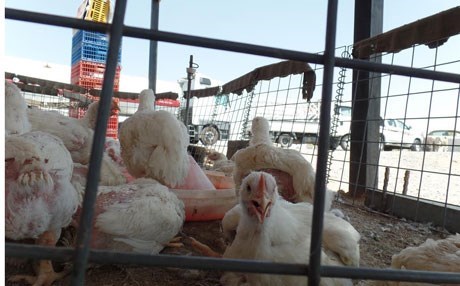
ERBIL, Kurdistan Region--Poultry farm owners in the Kurdistan Region have lost thousands of dollars as Baghdad banned sale of chickens in the center and south of Iraq following a report of two cases of bird flu in Duhok.
Ramazan Mohammad, an official at the Ministry of Agriculture in Erbil told Rudaw that that the Iraqi government’s decision caused big losses in revenue for Kurdish poultry farmers.
The ministry has since decided to balance the market by asking traders to buy at least %5 of their chicken products from local farmers.
The price of chicken in the Kurdistan Region has fallen by half since Baghdad’s decision.
The ministry official added that the risk of bird flu in the Kurdistan Region is over and both cases in Duhok were brought under control.
“The tests have shown there is no such disease in Kurdistan and Baghdad has been informed of the result, yet it takes no action to lift the ban,” he said.
The minister of agriculture Abdulstar Majid warned of cutting off the flow of water to the rest of Iraq if Baghdad continues its ban.
Mohammad confirmed the minister’s warning, saying “if the situation stays unchanged one of our options will be cutting off water.”
According to statistics provided by the Ministry, the Kurdistan Region has 1,264 poultry farms but due to the limited local demand the Kurdish farmers count on the Iraqi market for business.
Peshraw Khalid, the owner of a poultry farmer in Shaqlawa fears that he wouldn’t be able to find a market for his 30,000 chickens even though he knows he has to sell them cheaper.
“In our district alone more than 100,000 chickens have been left in the farms with no market for them,” said Khalid.
Part of the reason is that there is an equal demand for frozen chicken available in the market.
“The damage to the farms is so high that I can’t even describe it,” said Dastal Mame Ibrahim, the head of Duhok’s poultry department, adding the price of chicken there is lower than in any other province.
Haidar Farhan, an official in poultry farming sector believes the government can resolve the issue by purchasing chicken only from local farmers for the army, prisons and other government departments.
Ramazan Mohammad, an official at the Ministry of Agriculture in Erbil told Rudaw that that the Iraqi government’s decision caused big losses in revenue for Kurdish poultry farmers.
The ministry has since decided to balance the market by asking traders to buy at least %5 of their chicken products from local farmers.
The price of chicken in the Kurdistan Region has fallen by half since Baghdad’s decision.
The ministry official added that the risk of bird flu in the Kurdistan Region is over and both cases in Duhok were brought under control.
“The tests have shown there is no such disease in Kurdistan and Baghdad has been informed of the result, yet it takes no action to lift the ban,” he said.
The minister of agriculture Abdulstar Majid warned of cutting off the flow of water to the rest of Iraq if Baghdad continues its ban.
Mohammad confirmed the minister’s warning, saying “if the situation stays unchanged one of our options will be cutting off water.”
According to statistics provided by the Ministry, the Kurdistan Region has 1,264 poultry farms but due to the limited local demand the Kurdish farmers count on the Iraqi market for business.
Peshraw Khalid, the owner of a poultry farmer in Shaqlawa fears that he wouldn’t be able to find a market for his 30,000 chickens even though he knows he has to sell them cheaper.
“In our district alone more than 100,000 chickens have been left in the farms with no market for them,” said Khalid.
Part of the reason is that there is an equal demand for frozen chicken available in the market.
“The damage to the farms is so high that I can’t even describe it,” said Dastal Mame Ibrahim, the head of Duhok’s poultry department, adding the price of chicken there is lower than in any other province.
Haidar Farhan, an official in poultry farming sector believes the government can resolve the issue by purchasing chicken only from local farmers for the army, prisons and other government departments.
Comments
Rudaw moderates all comments submitted on our website. We welcome comments which are relevant to the article and encourage further discussion about the issues that matter to you. We also welcome constructive criticism about Rudaw.
To be approved for publication, however, your comments must meet our community guidelines.
We will not tolerate the following: profanity, threats, personal attacks, vulgarity, abuse (such as sexism, racism, homophobia or xenophobia), or commercial or personal promotion.
Comments that do not meet our guidelines will be rejected. Comments are not edited – they are either approved or rejected.
Post a comment