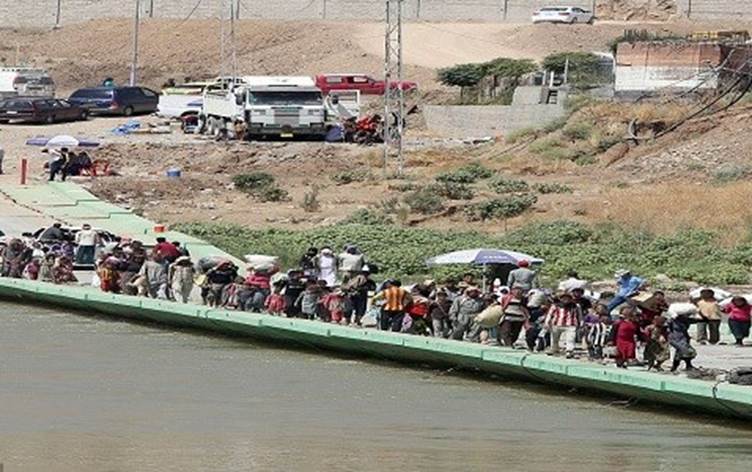



ERBIL, Kurdistan Region—Deputy trade minister of the Jazira Canton of Syria’s autonomous Kurdish administration (Rojava) welcomed the opening of the Semelka border crossing on Thursday, hoping that it will lead to trade exchange with the outside world.
“We hope it will remain open and become an official border crossing between Rojava and south Kurdistan,” Jamal Amin Hamo, deputy trade minister of Jazira canton told Rudaw TV from Derbasiye.
Hamo added, “We were hoping that the opening would be different, for our businessmen to bring goods and items into Rojava and sell it cheap to people here.”
The Kurdish government officially opened the Semelka border crossing on Wednesday “to transfer medicine, food and humanitarian needs,” Hamid Darbandi, in charge of the border crossing told Rudaw.
Darbandi also explained that the transported goods will be cheap and tax-free in order to help the people of Rojava, insisting that neither Kurdistan Region nor Rojava officials have the right to receive tax from the trade.
For his part, Hamo of the Jazira Canton said that his administration was seeking a variety of trade across the border “not medicine and food supplies only.”
He revealed that before its closure in March the Semelka border “did great for people’s lives”
Meanwhile, he denied having imposed heavy tariff on incoming food supplies from the Kurdistan Region: “It is not a matter of whether there is tariffs or not. Even in the past the tariffs our administration had imposed on goods was a penny. 1000 Syrian lira for each ton.”
He added: “In the last two months we have removed all tariffs on food items.”
According to Hamo food and other supplies were never a big issue in Rojava, being able to obtain them from other parts of Syria, saying that they rather seek trade in order to help the economy by exporting the region’s rich agricultural products.
“Our Jazira Canton is an agricultural area and all our harvest is left here with the farmers,” he explained. “We wanted these farm products to enter the Kurdistan Region and from there to elsewhere. We want to help our farmers.”
“We hope it will remain open and become an official border crossing between Rojava and south Kurdistan,” Jamal Amin Hamo, deputy trade minister of Jazira canton told Rudaw TV from Derbasiye.
Hamo added, “We were hoping that the opening would be different, for our businessmen to bring goods and items into Rojava and sell it cheap to people here.”
The Kurdish government officially opened the Semelka border crossing on Wednesday “to transfer medicine, food and humanitarian needs,” Hamid Darbandi, in charge of the border crossing told Rudaw.
Darbandi also explained that the transported goods will be cheap and tax-free in order to help the people of Rojava, insisting that neither Kurdistan Region nor Rojava officials have the right to receive tax from the trade.
For his part, Hamo of the Jazira Canton said that his administration was seeking a variety of trade across the border “not medicine and food supplies only.”
He revealed that before its closure in March the Semelka border “did great for people’s lives”
Meanwhile, he denied having imposed heavy tariff on incoming food supplies from the Kurdistan Region: “It is not a matter of whether there is tariffs or not. Even in the past the tariffs our administration had imposed on goods was a penny. 1000 Syrian lira for each ton.”
He added: “In the last two months we have removed all tariffs on food items.”
According to Hamo food and other supplies were never a big issue in Rojava, being able to obtain them from other parts of Syria, saying that they rather seek trade in order to help the economy by exporting the region’s rich agricultural products.
“Our Jazira Canton is an agricultural area and all our harvest is left here with the farmers,” he explained. “We wanted these farm products to enter the Kurdistan Region and from there to elsewhere. We want to help our farmers.”
Comments
Rudaw moderates all comments submitted on our website. We welcome comments which are relevant to the article and encourage further discussion about the issues that matter to you. We also welcome constructive criticism about Rudaw.
To be approved for publication, however, your comments must meet our community guidelines.
We will not tolerate the following: profanity, threats, personal attacks, vulgarity, abuse (such as sexism, racism, homophobia or xenophobia), or commercial or personal promotion.
Comments that do not meet our guidelines will be rejected. Comments are not edited – they are either approved or rejected.
Post a comment