


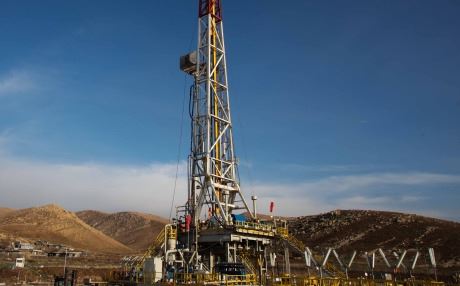
LONDON - London-listed Genel Energy announced today that it had signed an agreement with the Kurdistan Regional Government (KRG) which would combine the Miran and Bina Bawi fields under one Production Sharing Contract, lowering production risks and raising revenues for Genel, while helping ensure the KRG can meet its commitments under an agreement to sell gas to Turkey.
“These agreements represent a win-win in the commercialisation of Miran and Bina Bawi. It materially de-risks the value of Genel’s gas business, gives attractive project returns while significantly lowering our capital exposure, and provides revenues from early oil production. For the KRG, it unlocks the Miran and Bina Bawi gas resource and will enable it to satisfy domestic gas demand and its obligations under the KRG-Turkey Gas Sales Agreement. We are proud to be playing a key role in the next phase of the development of the KRI oil and gas sector,” said Tony Hayward, Chief Executive of Genel Energy.
Under the agreement announced today in a trading update, Genel would become the sole contractor and have a 100% equity interest in both gas fields by buying out the 34% stake held in Bina Bawi by Austrian oil and gas company OMV. This is expected to be approved by year-end 2014. Genel would then be in a strong position to benefit from the Kurdish-Turkish gas deal because it could enter into a gas offtake agreement, in which it would agree to sell a portion of its future production in the region.
“With oil exports, the payment mechanism and now gas agreement in place, shareholder returns become a possibility,” said Daniel Ekstein, analyst at stockbrokers UBS.
Genel, which saw its share price rise by 12 per cent on Monday on speculation that Erbil was on the verge of a deal to export up to 10 per cent of Turkey’s gas needs, has almost 40 per cent of its assets in Kurdistan in the form of the Miran and Bina Bawi fields.
Genel also reported that a total of approximately 23 million barrels of KRI pipeline crude had been exported from the Turkish port of Ceyhan in 30 lots, with a three month track record of predictable sales seeing 24 of these tankers sold and five en route to customers.
It said that 2014 production and revenue guidance remained unchanged from its last statement at 60,000-70,00 barrels of oil per day and revenue of $500-600 million, but that 2015 production was set to rise to 90,000-100,000 barrels per day. There is not projected to be a rise in revenue, however, reflecting estimates that the current lower Brent price of $80 per barrel will remain unchanged.
Separately, Gulf Keystone Petroleum Limited, an oil exploration and production company which also has operations in the KRG, said today that it was on track to achieve production of 40,000 barrels of oil per day from its Shaikan production facilities by the end of this year.
The company said that total production levels were stable, averaging 23,000 barrels per day.
Gulf Keystone exports crude oil by truck from Shaikan to the Turkish coast, and it said these had have continued uninterrupted since 29 November 2013.
“All of our production is currently being exported and 19 tanker cargoes totalling 4.7 million gross barrels of Shaikan crude oil have been sold to the international market since the Shaikan crude oil export sales began from the port of Dortyol in January 2014,” the company said in a press statement.
Both Genel and Gulf Keystone welcomed the announcement by the Ministry of Natural Resources last Friday that it would ensure contractors received payments in line with their contractual entitlements. In what was seen as a positive signal to upstream companies operating in the region, the ministry said the KRG would make an initial payment of $75 million on account to producers for exports.
“The KRG has given a firm commitment to paying contractors in full, with an initial payment to be made in November 2014 and further payments to follow on a regular basis. A normalised payment mechanism is expected in Q1 2015 as increasing pipeline exports deliver budget equilibrium for the KRG,” Genel said.
Share prices of oil companies focussed on production in Iraqi Kurdistan rose sharply after Friday’s announcement.
The Ministry of Natural Resources also announced on Friday that since January 34.5 million barrels of oil had been exported, of which 21.5 million barrels were sold through Ceyhan. The balance was trucked to Mersin in Turkey.
The total value of the exported oil in cash or kind was $2.87 billion, of which $2.1 billion was received in cash and $775 million in kind for product swaps.
The net cash received by the KRG after costs during the period was $1.7 billion. The Kurdistan Regional Government had received a further $500 million in prepayment from buyers of crude against future deliveries of oil piped to Ceyhan.
The KRG regards all proceeds from the sale of oil as part of its constitutional entitlement to 17 per cent of Iraq’s revenues, which Baghdad has withheld from the start of the year because of the dispute over independent Kurdish oil exports. Baghdad says all Iraqi oil should be marketed by the state company SOMO.
The ministry said the oil sales fell short of the KRG’s budget share but were “helping the Region survive the serious challenges to its continued welfare and stability: the vital fight against ISIS terrorists, the unprecedented influx of refugees and IDPs, and the economic sanctions imposed by Baghdad.”
Comments
Rudaw moderates all comments submitted on our website. We welcome comments which are relevant to the article and encourage further discussion about the issues that matter to you. We also welcome constructive criticism about Rudaw.
To be approved for publication, however, your comments must meet our community guidelines.
We will not tolerate the following: profanity, threats, personal attacks, vulgarity, abuse (such as sexism, racism, homophobia or xenophobia), or commercial or personal promotion.
Comments that do not meet our guidelines will be rejected. Comments are not edited – they are either approved or rejected.
Post a comment