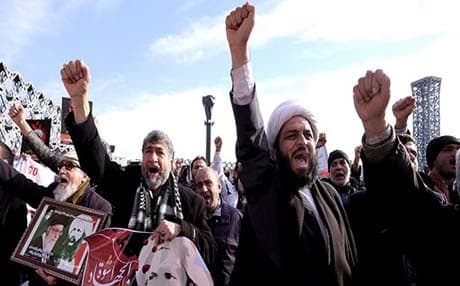
The question that is being asked is, why now. Saudi Arabia has never been shy when it comes to executing perceived enemies of the state. It is second only to Iran in executions in 2014, by a third. It could be claimed by some that the action was taken knowing the reaction of Iran, hoping the increase in tension would increase the price of oil on the world market. Oil in fact did jump at the opening of the market then fell toward a new low. Saudi Arabia could manipulate the price of crude more easily by reducing the amount it pumps and puts on the market.
Another, more political, theory is that Saudi Arabia along with its gulf coast allies have become very concerned over the reduced commitment by the US to security in the region. Russian support to Syria and the Iranian backed forces fighting for Assad as well as what seems to be Iranian control over the Iraqi government and security forces with little US response. This is added to the recent signing of a deal with Iran that gives the government in Tehran a sizable influx of cash and opens up new markets for Iranian companies, most of whom are run by the IRGC.
While the deal with Iran is supposed to stop the development of a nuclear device it is apparent to the countries in the region that it will not. If there was a hope of the US enforcing the portions of the agreement that were there to punish Iran should it violate the terms it went away when Iran test fired two missiles in violation of a UN sanction and there have been no consequences. It now falls upon the regional powers to stand up to Iran.
The split in the power base, those for Iran including Iraq and Syria, and those opposed which include Saudi Arabia, the GCC as well as Turkey. This is not a black and white choice for the west. Saudi Arabia has been a steadfast friend of the west as well as holding the west hostage at times in regards to oil. Saudi Arabia is also, culturally the polar opposite of the west and is not likely to change soon or on its own. Turkey on the other hand has for almost a century been closer to the west then its Muslim neighbors, yet today it is acting in a manner that seems to show it wants to start its own civil war in the SE portion of the country. Iran has been for more than 30 years the avowed enemy of almost everyone. It has vowed to export its version of the Islamic Revolution aboard and has made good on its promise to date.
The west will have to figure out where each actor fits in the larger scheme of things as well as figure out where the west fits into the picture. Two of the countries involved, Syria and Iraq, are failed nations. The US has a vested interest in Iraq but needs to decide what is best for all parties. Russia and Iran have vested interests in Syria. While Russia looks at Syria as a vassal state while Iraq sees it as just a training ground and jump off point to continue the revolution.
The final question then is will the current crisis between Saudi Arabia and Iran prove to be the finial tipping point that will force all sides to decide it’s time to resolve differences or will it just be another step on the road to a final confrontation that will bring ruin to the region.
Paul Davis is a retired US Army military intelligence and former Soviet analyst. He is a consultant to the American intelligence community specializing in the Middle East with a concentration on Kurdish affairs. Currently he is the President of the consulting firm JANUS Think in Washington D.C.