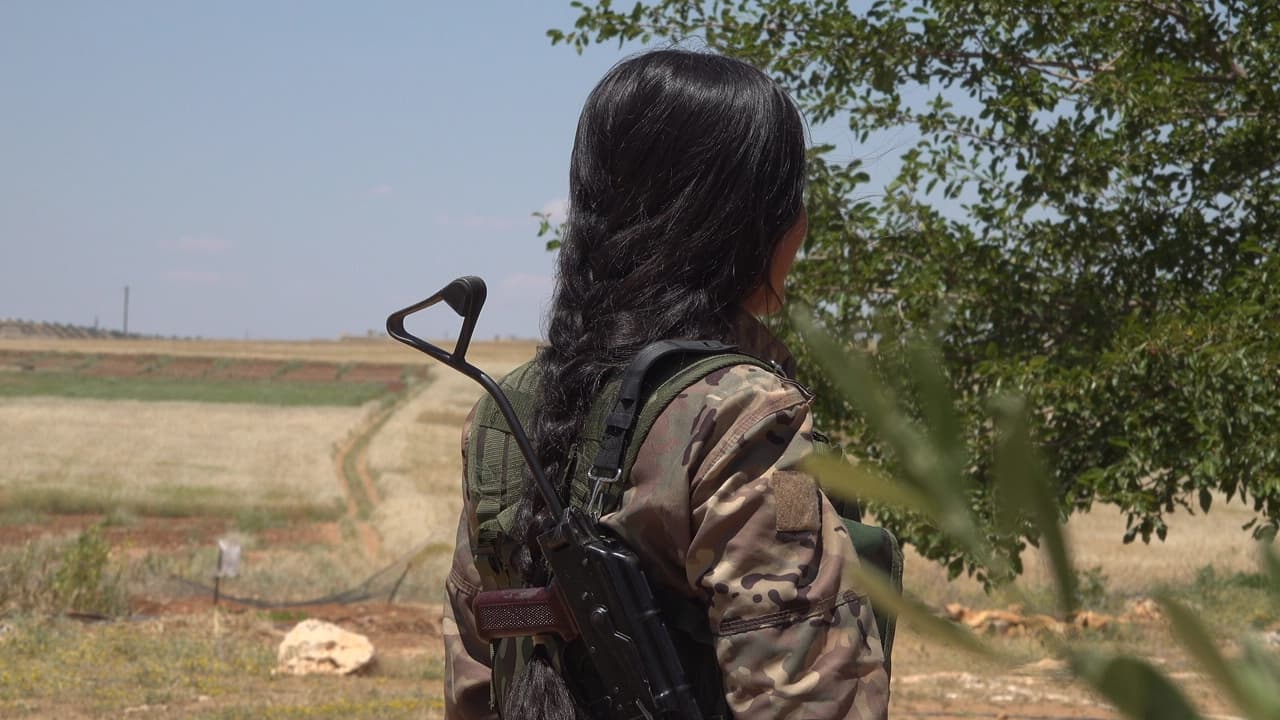
ERBIL, Kurdistan - Up to 70 percent of applications for members of the Internal Security Forces (Asayish) in the Kurdish-majority city of Kobane in northeast Syria (Rojava) have been submitted to the Syrian interior ministry for integration, a senior member of the Kurdish-led forces told Rudaw on Monday.
Amin Saleh, a high-ranking Asayish commander, stated that “the applications of around 1,000 members of the Kobane internal security forces have been submitted to a joint committee comprising representatives of the [Syrian] interior ministry and the Aleppo Security [Directorate],” for integration.
He added that “the processing of applications for other members of the Asayish is ongoing,” while noting that “the total number of their forces in Kobani stands at between 1,500 and 1,600.”
The Asayish serve as the official internal security and domestic police force operating under the authority of the Democratic Autonomous Administration of North and East Syria (DAANES) in Rojava.
The push to integrate the Kurdish-led forces under Syrian state control is part of the landmark January 29 agreement reached between Damascus and Rojava earlier this year, with the prominent mediation of then-US Envoy for Syria Tom Barrack and the Kurdistan Region’s top leadership.
The accord followed weeks of fierce clashes between Syrian forces and affiliated armed groups and the Kurdish-led Syrian Democratic Forces (SDF) - Rojava’s de facto military. It established a nationwide ceasefire, facilitated the return of internally displaced persons (IDPs), and called for the integration of civil and military institutions in Rojava under the Syrian state.
Amid the clashes, Kurdish forces were forced to withdraw from large parts of the territories where they had maintained a presence, including the provinces of Aleppo, Deir ez-Zor, Raqqa, as well as the Kurdish-majority Hasaka province in Rojava.
Kobane, however, remained under the control of the Asayish and the SDF, despite being encircled and territorially cut off from the rest of the DAANES during the military standoff.
Under the terms negotiated in the January agreement, the Syrian Arab Army agreed to remain on the outer perimeter, leaving Kobane’s internal security to the Asayish while initiating the process of their integration.
However, Saleh, who also serves as the deputy-chair of the Asayish office of the DAANES, argued that one of the key impediments hindering the finalization of the latter initiative is the pending integration of Kobane’s courts into the Syrian judicial system.
“Currently, security as the executive body in Kobane is facing constraints in the matter of courts, because the judicial system and courts have not yet been integrated with the next [Syrian] government,” he said, while emphasizing that the Kobane Asayish are set to be placed within the “structure of the Syrian interior ministry” in the future.
“The Kobane Asayish will assume their duties under the new state system, law, and the final constitution that is scheduled to be drafted, and will work as an official part of the Syrian interior ministry,” Saleh said, noting that the forces will preserve “the distinctiveness” of the Kurdish-majority region and that “upholding the rights of ethnic and religious communities will be a core principle.”