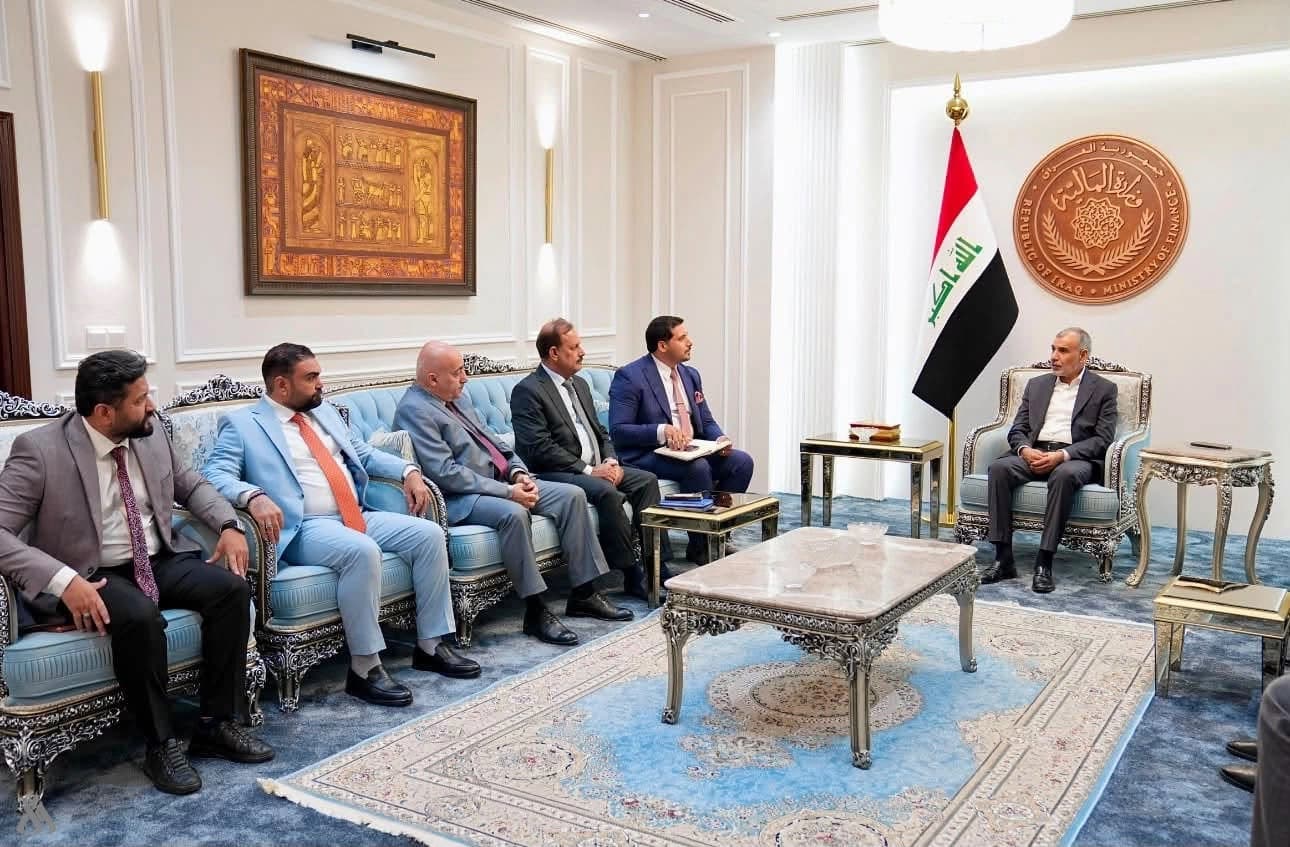

ERBIL, Kurdistan Region – Iraqi Finance Minister Falah al-Sari reassured public employees that their salaries are fully funded and dismissed reports that the government plans to delay salary disbursements to every 45 days as opposed to its current monthly payroll cycle, state media reported on Wednesday.
According to the state-run Iraqi News Agency (INA), the finance minister stressed during a meeting with economic experts and specialists on Tuesday that "employee salaries are fully secured, noting that there is no intention to distribute salaries every 45 days."
He also added that the country's monthly salary "amounts to approximately 7 trillion and 700 billion dinars [$5.8 billion], and we are working to raise the pensions and salaries of the lower-ranking posts,” Sari said.
The remarks come as Iraq has yet to begin distributing salaries for public sector employees for the month of August, despite salary disbursement procedures typically being initiated around the 18th of the month in previous months.
Employees in the Kurdistan Region - whose salaries are funded by Baghdad - continue to face frequent delays, with their payments typically distributed only after federal government employees have been paid.
Kurdish public-sector employees have also faced salary cuts and prolonged non-payment for more than a decade amid ongoing financial disputes between Erbil and Baghdad.
Sari addressed concerns over rising costs and inflation, saying that the ministry ”is working to address this inflation, control spending, and improve the efficiency of financial resource utilization.”
The minister said the government is also introducing a “program budget” covering the Finance and Electricity ministries, as well as Salahaddin and Diwaniyah provinces, as part of efforts to increase transparency and more accurately determine expenditures.
On taxation, Sari said the government had identified 3,800 individuals and large companies as major taxpayers, but only 1,300 were complying with their tax obligations. He said the ministry plans to improve coordination with relevant authorities through a “Tax Number” system and expand the tax base.
Sari also pointed to efforts to diversify Iraq’s oil export routes. “There is a Saudi-Kuwaiti pipeline passing through the Red Sea with a capacity of up to two million barrels per day, and it is possible for Iraq to participate in it,” he said.
Participation in the pipeline could provide Iraq with an alternative export route in the event of disruptions in the Gulf following the US-Iran war that began in late February, potentially strengthening the country’s energy security.
The minister’s reassurances come amid significant pressure on Iraq’s public finances. Baghdad spent about 57.18 trillion dinars ($47.3 billion) in the first half of 2026, while revenues reached around 35.14 trillion dinars ($26.86 billion), leaving a deficit of more than 21 trillion dinars ($16 billion).
Operational spending accounted for the vast majority of expenditure, at about 54.6 trillion dinars ($41.7 billion), while only 2.5 trillion dinars ($1.9 billion) was allocated to investment. Salaries and related payments accounted for around 85 percent of total state expenditures, highlighting the heavy burden of public-sector wages on Iraq’s budget.