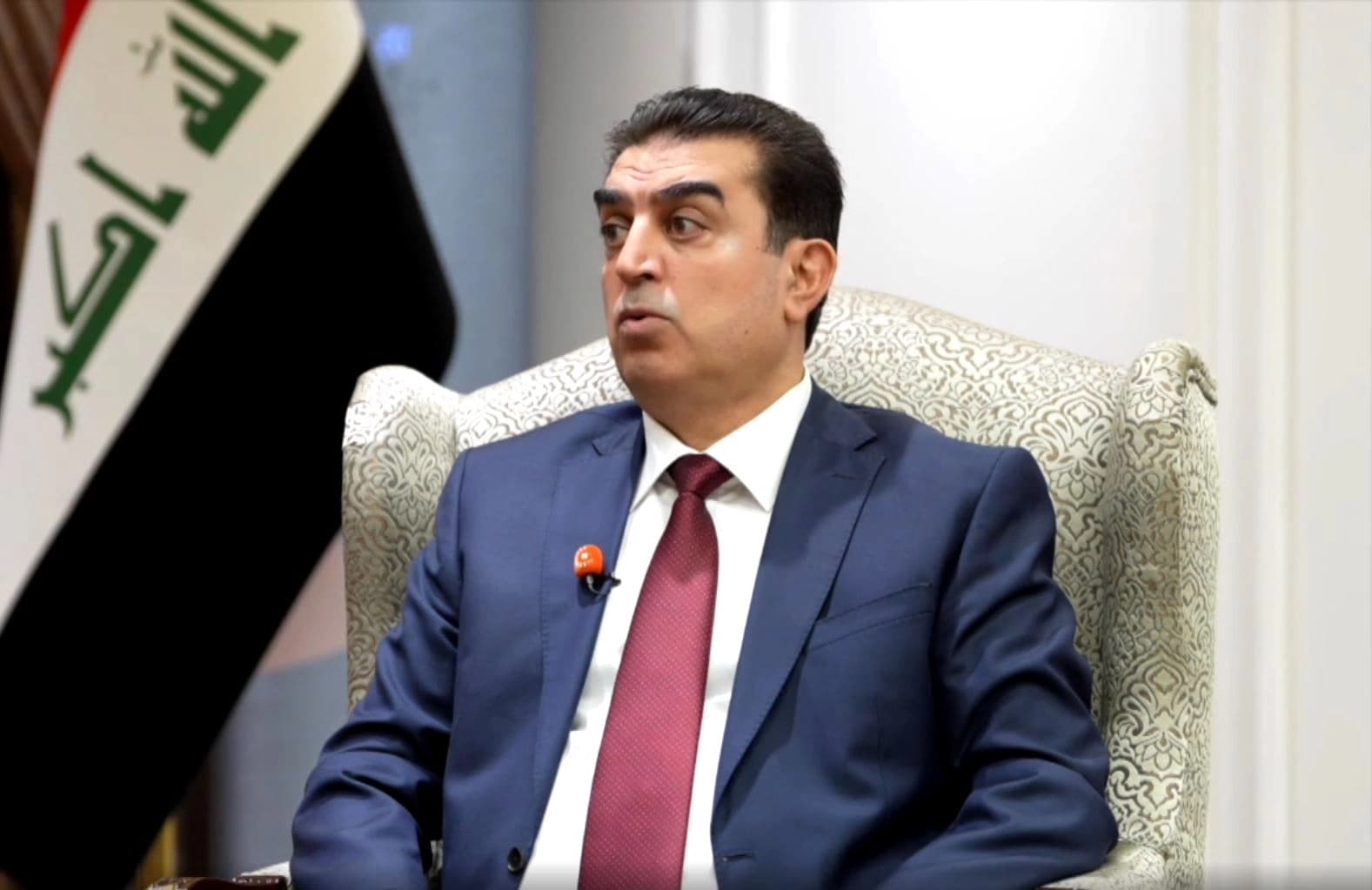
ERBIL, Kurdistan Region - Iraq will likely have to comply with renewed US sanctions on Iran to preserve its access to the American financial system, former US diplomat Joey Hood said on Thursday, warning that Baghdad faces a difficult choice as Tehran increasingly looks to Iraq for economic relief.
“Iraq is going to have to think very carefully about how it helps the United States enforce these sanctions because they're not going away anytime soon, and access to the US dollar is extremely important to Iraqi oil sales,” Hood told Rudaw's Nwenar Fatih.
“I think that it's going to put Iraq in a very tight bind—between a rock and a hard place, as we say—because Iranians are going to be more and more desperate to be able to breathe through their ‘Iraqi lung,’ as we sometimes say,” he added.
Hood said the sanctions Washington announced earlier this week were enacted in 2010 and enjoy strong bipartisan support in the United States, making it unlikely they would be lifted even after upcoming congressional or presidential elections.
He said Baghdad would ultimately have to choose between maintaining broad access to the international financial system and facilitating trade with Tehran.
“It's going to be very difficult for Iraq, but I think they're going to have to choose to abide by the sanctions,” he said.
Asked whether Washington would protect the Kurdistan Region from continued attacks by Iran and Iran-aligned groups as coalition forces withdraw from Iraq, Hood said Baghdad would bear the primary responsibility for security after the withdrawal.
He said the US would remain prepared to provide support requested by the Iraqi government to protect people across the country, including in the Kurdistan Region.
Hood also described the Iranian drone attack targeting the private office of Kurdistan Region Prime Minister Masrour Barzani as a clear warning over cooperation with Washington.
“You made a big mistake in cooperating with the United States. You're going to be punished for it,” Hood said, characterizing what he believed was Tehran’s message.
Addressing perceptions among Kurds in the Kurdistan Region and northeast Syria (Rojava) that Washington has abandoned them, Hood rejected the claim but acknowledged challenges in providing support through Baghdad.
He pointed specifically to the Kurdistan Region’s lack of sufficient air defenses, saying US and European assistance requires approval and facilitation from Iraq’s federal government.
“I think the US government will continue to be ready to provide that support, but it really needs to be approved and facilitated by the government in Baghdad,” Hood said.
The following is the full transcript of the interview with Joey Hood:
Rudaw: Hello, Joey Hood. Welcome to Rudaw. I am happy we are having this conversation at a very important time.
Joey Hood: Thank you for having me, and my greetings to you and to your viewers.
I would like to start with the latest news from today. Since the US announced its plan on Monday to further isolate Iran, there have been two important visits to Tehran - actually, there have been three. We first saw Asim Munir of Pakistan visiting Tehran. He was followed by Oman's Foreign Minister Badr Albusaidi. Today, the Qatari prime minister was in Tehran. Do you think all these efforts can help return the US and Iran to the negotiating table?
Well, yes. Eventually, I think the two sides will continue to negotiate, even though Iran severed diplomatic relations with the United States in 1979 and took the unprecedented step—and many would say, un-Islamic step—of taking hostage our American diplomats in our embassy in Tehran at that time. Despite all of that, the United States government and the Iranian government have maintained contact virtually unstopped since that time via the Swiss or Pakistan, or via other parties such as Oman or Qatar. So, yes, I do think that those efforts will eventually lead to both governments having a fruitful exchange again. But obviously, both sides right now are convinced that they each have the upper hand, and that more time will cause the other side to bring more concessions to the table. And I think that if we just wait, then that means both Iranians and Gulf countries and Iraq are just going to suffer. So I hope that these diplomatic efforts really accelerate quickly.
Trump recently threatened to carry out the greatest attack on Iran but he later decided not to go through with it following a phone call with the Saudi Crown Prince Mohammed bin Salman. Then talks between Iran and Omar began over the reopening of the Strait of Hormuz but they failed to reach an agreement. Why? The talks were officially held with the Omanis, but informally with the Americans.
Well, I think the main reason is because Oman is refusing to give in to Tehran's completely illegal demands in wanting to have sovereignty over the Strait of Hormuz and everything that goes through it. If they were to succeed in doing that, they would achieve something that no Iranian government, no Iranian Shah has been able to do for centuries, which is to have complete control over the destiny of the Gulf Arab countries and Iraq. And that's just not going to be acceptable to any of those countries in the region. And therefore, Oman, on behalf of itself and the countries of the region and the world, is telling Iran that no, we cannot allow you to have sovereignty over the strait and to decide which ships can go through and cannot go through, or how much they have to pay you. It has to be open to all shipping, just as it's been for many, many decades. And that's what Oman is sticking to, and I think that's why there hasn't been an agreement announced up until this time.
But what should we take from some of Trump’s remarks, including one in which he threatens to bomb Oman if the country does not listen to him? Does this mean that Oman has not accepted some American demands, just as it has not accepted all Iranian demands?
First of all, let's just remember that these are not the demands of the United States; these are demands of the entire world. More than 130 countries signed on as co-sponsors to Bahrain's UN Security Council resolution draft back in April, saying that the strait needs to return to freedom of navigation for all ships, and that Iran needs to stop its piracy in firing on unarmed commercial ships. There is no country in the world that has issued a statement, including Oman, that says, ‘We agree. Tehran has now defeated the Great Satan of the world, the global arrogance, and now needs to control not only the strait, but everything that goes through it, and therefore the economies of the entire region.’ That's never going to happen, and that's why no government has issued any statement in support. Now, Donald Trump famously says a lot of things, and he exaggerates, and he uses very colorful language. But let's look at the results. The only country that has bombed Oman in the past several decades is Iran, and it has bombed Oman repeatedly over the past few months—not just its land territory, but its maritime territory as well. So when we think about what country is actually putting pressure on Oman diplomatically and militarily, it's Iran.
Joey, there is an interesting question: Since the start of the war, the US has never clearly stated that its objective is regime change in Iran. However, Scott Bessent — the architect of the economic pressure campaign against Iran — has recently said clearly, both in his tweets and public remarks, that the aim is regime change in Iran. Are these Bessent’s personal views, or do they signal a strategic shift in the US administration’s policy and broader plans for Iran?
I don't think that this is a change in policy. What the United States government has been after as an objective since 1979 is changing the behavior of the regime, not to change the regime itself, or not to topple the regime. If you were to topple the government completely in Iran, there could very well be chaos, and in a country of nearly 100 million people, which borders so many other countries in the region, that could be a disaster for the region itself and not just for Iran. So I think that's why, from President Trump all the way back to President Jimmy Carter, the goal really has been to change the behavior of the regime so that it can act more like a responsible nation and a more responsible government representing the nation of Iran with the rest of the world. And a responsible government doesn't run private armies in other people's countries, just as Iran has done in Iraq, and Syria, and in Lebanon, and in Yemen, and has tried to do in the Gulf Arab countries. A normal government also doesn't invade and burn down the embassies of governments it doesn't like, it doesn't take diplomats as hostage, it doesn't conduct terrorist operations in countries like Argentina, and Germany, and all the countries of the region, it doesn't bomb all of its neighbors. All of these things Iran has done over the decades and recently.
Iranians claim that the US return to the economic pressure on Iran signals the US failure [to pressure Tehran militarily]. For example, Iranian FM Abbas Araghchi said that the return to economic pressure means a return to the plan the US has been implementing against Iran for 47 years without gaining anything, adding that this signals the failure of all US military attacks on Iran. ‘Same bull. Different bullies,’ he said in one of his posts on X. Do you think the US return to economic pressure signals the failure of the military campaign?
I think what it means is that the level of military involvement that President Trump is willing to commit to Iran has really reached its limit. Obviously, he could introduce ground soldiers, he could send in special forces operators, he could use much bigger bombs—God forbid, I mean nobody wants to see that—but obviously, the US military has a lot more firepower that the president could decide to bring to bear if he wanted to. But he has decided that he wants to see what economic pressure can now bring when it is brought alongside what military pressure he has been able to exert on the country. And that economic pressure is not small. The United States government is still in control of its own currency, the dollar, and every government has the right to decide how its currency is used. And what the US government is doing right now is telling countries and companies and banks all around the world: you can choose to continue to use the US dollar and US financial system in your transactions, or you can choose to deal with Iran, but you can't do both at the same time. And so, most of those entities around the world have already chosen to stay with the United States and the American dollar rather than to risk access to the dollar by continuing to do business with Iran. So, I think what you'll see the US government doing now is just enforcing those sanctions more and more compared to before.
But will the affected countries comply? Can the US pressure Turkey and Iraq to implement the new sanctions on Iran?
Yes, I do. I think that previous American administrations used more diplomacy rather than threats, but unfortunately, that is the approach that Donald Trump has decided to take: more pressure rather than diplomacy. However, he does have a fairly good relationship with [Turkish] President [Recep Tayyip] Erdogan, so perhaps you'll see more personal diplomacy from him in that case. He also has a lot of optimism for the new Iraqi prime minister [Ali al-Zaidi], so perhaps you'll see—especially via Special Envoy Ambassador Barrack—you may see more diplomacy in those cases than you might with some other countries. And yes, the United States does have a tremendous amount of leverage because of the importance of the US dollar to the financial system around the world, and especially in oil transactions, and so therefore it's very important to Iraq. And I don't think any country in the world really wants to risk its access to the US financial system just so that they can continue small amounts of trade with Iran, because Iran doesn't have a lot of trade actually with most countries around the world.
Can the US pressure China to comply with the sanctions?
Well, China has, as far as I know, about $10 billion of trade with Iran on an annual basis, which is not a lot, actually. But I do think that some of the smaller Chinese refineries that don't have exposure to the US financial system are going to be more of a challenge for the Trump administration because there's nothing that those refineries need in terms of access to the US dollar or the US financial system. So the Trump administration would need to try to find other ways to pressure the Chinese government to stop purchases of Iranian crude for those refineries. And that's really the question of what the administration is prepared to do and what the Chinese government might do in response, because unlike Iran, China does have a lot of financial leverage points over the United States. But at the same time, the United States is China's largest trading partner and its biggest market, so it's not going to want to upset that too much either. So the diplomacy here, I think, will be rather delicate, and the Trump administration generally is not prepared for the delicate type of diplomacy that this will require.
What impact will the US sanctions on Iran have on Iraq?
Well, we need to remember that the sanctions that the administration is talking about enforcing now were actually put into law in the United States in 2010 under the administration of President Obama, who was a Democrat. The support for this law in the United States Senate was 100 percent; there wasn't a single senator who voted against them, which tells you that sanctions on Iran enjoy very, very widespread bipartisan support in the United States. So I don't think that these sanctions are going to be lifted or changed in any way, even after the elections for the Congress in November or even presidential elections in 2028. So Iraq is going to have to think very carefully about how it helps the United States enforce these sanctions because they're not going away anytime soon, and access to the US dollar is extremely important to Iraqi oil sales. So I think that it's going to put Iraq in a very tight bind—between a rock and a hard place, as we say—because Iranians are going to be more and more desperate to be able to breathe through their ‘Iraqi lung,’ as we sometimes say, and the Iraqis are going to say, ‘Look, I want to be able to trade with the entire world. I want to be able to have a good, healthy access to the world financial system, and not just trade with Iran.’ So it's going to be very difficult for Iraq, but I think they're going to have to choose to abide by the sanctions.
As you know, Iran and its affiliated groups in Iraq continue their attacks on the Kurdistan Region. Will the US protect the Kurdistan Region as it withdraws from the Region and Iraq?
Well, the agreement is that all coalition forces should be out of Iraq by September 30th, and that means that the federal government in Baghdad has the responsibility for the monopoly of force throughout its territory and for protecting all of its population. So that also means that as of October 1st, there is no longer anything for these groups to resist. They claim that they've been resisting American occupation all of this time, even though the United States has not been occupying Iraq militarily for a very long time. And so now you've seen some of the groups have issued statements saying, ‘Well, we need not just the American forces out of Iraq, but we also need all American businesses out of Iraq, and we need the Peshmerga to be dismantled, and we need so many other things.’ I mean, what this is telling you is that they want Iraq to become a province of Iran—not just under the influence of Iran at this point, but now a full province of the country, beholden completely to Iranian hegemony. I don't think anyone's going to accept this, and so the United States, I think, is always going to be ready to respond with any type of support that is requested by the government of Iraq to help protect its people, not just in the Kurdistan Region, but throughout the country. What the Trump administration wants to do right now is to invest most of its energy in trying to bring economic development to the Kurdistan Region and to the rest of Iraq, counting on the government of Ali al-Zaidi backed up by the people of Iraq to really take control over these militias and protect the whole country.
The private office of Kurdistan Region Prime Minister Masrour Barzani was targeted by an Iranian drone. What message was the attack intended to send?
Oh, that's clear. I mean, the Iranians have been sending rockets and drones and missiles against the region for a very long time. But, you know, not that long ago, they also targeted the President of the Region, Nechirvan Barzani. This time, when they're targeting the prime minister and the intelligence director, I mean, these are very clear messages, just as they've been doing with Oman and with Qatar and the other countries of the Gulf. You know, the message is: ‘We are the victors here. You made a big mistake in cooperating with the United States. You're going to be punished for it, and if you try to continue, then you're just going to suffer more and more. So you need to accept my new order for the region.’ This is what Speaker of Parliament [Mohammad Bagher] Ghalibaf is calling it: the ‘new regional order,’ in which Iran is on top. Well, let's look around the region. What friends does Iran have among the governments of the region? Not Syria anymore. Certainly not anywhere in the Gulf. It doesn't have close allies the way the United States does. It only has ‘friends,’ so-called, among these militias that just destabilize everyone else's countries in the region. The countries with which the United States has had a close relationship over the past several decades have done very, very well. Look at the countries of the Gulf. Their GDP—their gross domestic product—from 1991 until 2026 increased by an average of 10 times. Not 10 percent, but a factor of 10. That's huge. Imagine if that happened in Iraq over the next 30 years, if we could together expand the Iraqi economy by 10 times. Iraqis would benefit all throughout the country.
Let me tell you about the sentiment on the Kurdish street. Many Kurds in the Kurdistan Region and Rojava believe that the US has abandoned them. Do you think that perception is justified?
No, I mean, there's always a challenge working with the Region via the federal government because Iraq is still one unified country, and we see this in air defense, for example. The Kurdistan Region does not have sufficient air defense. There are companies and governments that are willing to provide it, but the government in Baghdad never seems really in a hurry to help facilitate that. Now, that hasn't been as much of a problem because you had the coalition forces there in the Region with their own air defense assets, which were able to protect some parts of the Region, but not fully. And so it's really a big challenge for the governments and the companies from the United States and Europe who are capable of helping Iraq, and in particular the Kurdistan Region, to protect themselves from the missiles and drones coming at them from Iran and from Iran's proxies and puppets inside Iraq. So, like I said, I think the US government will continue to be ready to provide that support, but it really needs to be approved and facilitated by the government in Baghdad, and that's what we really need to see happen.
The US President’s special envoy, Tom Barrack, has repeatedly emphasized that they speak to central governments such as Damascus and Baghdad, despite the US previously stressing that it wants a strong Kurdistan Region within a unified Iraq. Does this signal a policy shift in the US by dealing with central governments rather than non-state actors?
Well, I wouldn't call the Kurdistan Region a non-state actor. It is an actor within the Iraqi government underneath the Iraqi Constitution. That is very different than, say, Kata'ib Hezbollah, which operates completely outside the government, completely outside the constitution, and against the interests of Iraq, firing rockets and missiles against neighboring countries. For instance, one of the missiles that they fired at the UAE came very close to creating a nuclear disaster. I mean, these groups really need to be brought under control. So that's obviously—these are different situations. I think what Ambassador Barrack and others are trying to express is the desire for a strong and unified federal government in countries like Iraq and Syria, but with strong regions and provinces within that system. So everyone wants to see a strong and prosperous Kurdistan Region. Everybody wants to see a secure and prosperous Anbar, for example, in Iraq, or Rojava in northeast Syria. But nobody wants to see a country with a weak government that can't maintain control over its regions and provinces and armed groups around the country. That's really the choice. And I think the US government, whether it's been under President Trump or his predecessors or frankly his successors, I think you're going to continue to see a policy that supports a strong sovereign central government with strong provinces and regions.