
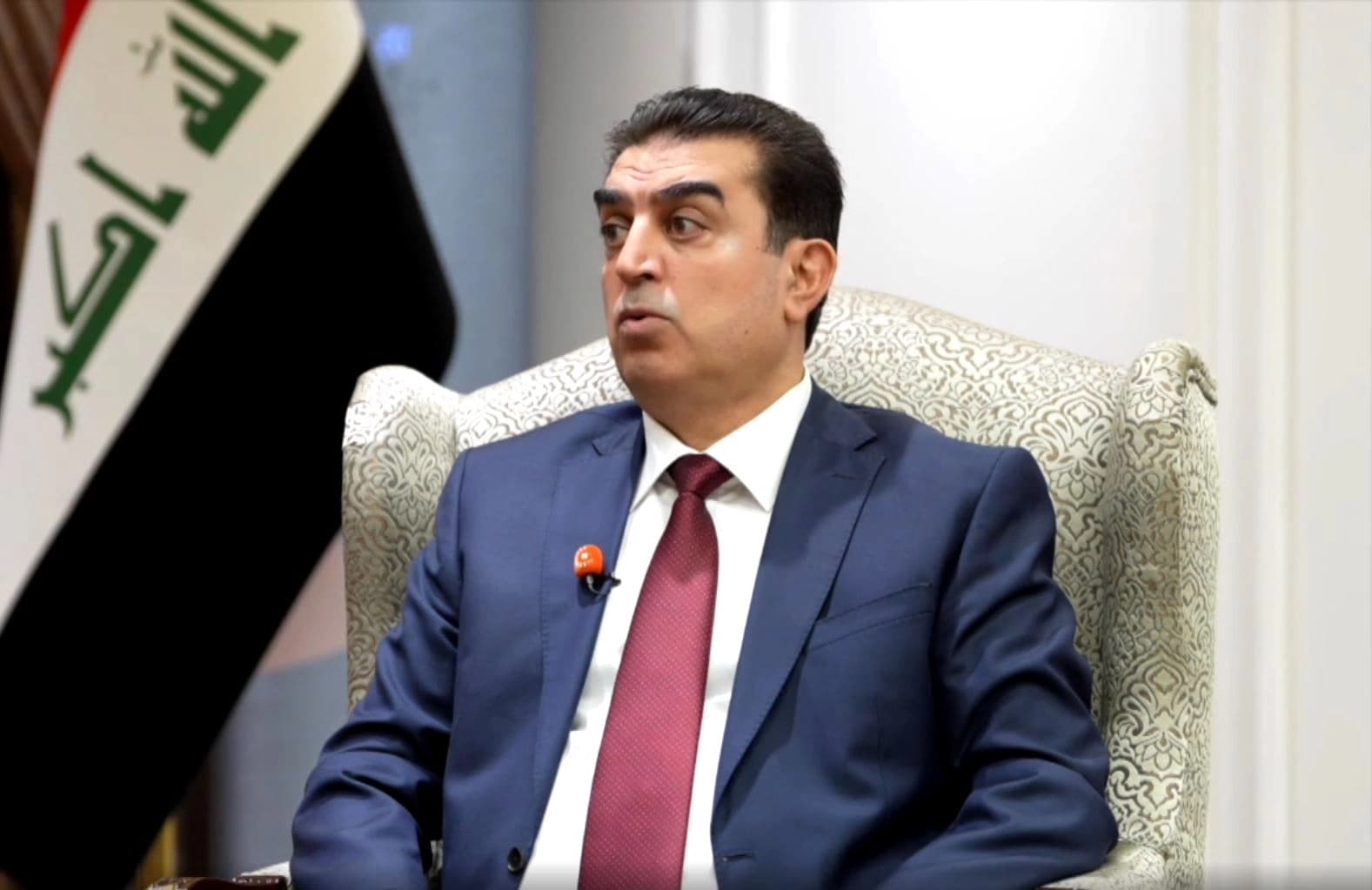

ERBIL, Kurdistan Region - A senior Iraqi parliamentary leader has warned that the proposed federal budget bill threatens regional governance and the financial entitlements of the Kurdistan Region, urging political leaders to revise the text before submitting it for a vote.
“There are many contentious issues in the proposed draft. If these provisions are passed by the Council of Ministers and sent to Parliament as they currently stand, problems will arise - not only with the Region, but with the provinces as well,” Farhad Atrushi, second deputy speaker of the Iraqi Council of Representatives, stated in a recent interview with Rudaw's Mushtaq Ramadhan, aired on Friday.
"Cutting the budget and using salaries and the Region’s share as leverage under flimsy pretexts became tools of political pressure,” Atrushi said, noting that “in many instances, this was systematically designed to weaken the Region for political ends."
The warning comes as Baghdad and Erbil navigate long-standing disputes over the Kurdistan Regional Government’s (KRG) share of federal revenues, an issue dating back to 2014 when disagreements over independent oil exports through Turkey triggered a prolonged political and economic crisis.
The persistent disputes have resulted in delayed and inconsistent salary payments for public sector employees across the Kurdistan Region, alongside frozen administrative promotions and deductions from civil service pension funds.
The draft budget bill has raised alarm in Erbil, where regional officials argue that the financial allocations prepared in Baghdad fail to uphold constitutional decentralization or meet basic public obligations.
Speaking on the viability of the current financial proposal, Atrushi cautioned that the current draft budget “does not bode well,” adding “especially for the Kurdistan Region and also for the rest of the provinces."
"It is not permissible to go backwards and talk about extreme centralization and the power of the government at the expense of the provinces and the Region, as this contradicts the spirit and philosophy of the Constitution," he stated.
Atrushi emphasized that modern governance across the country requires an overarching overhaul of existing statutes rather than reliance on legacy decrees from previous administrations.
Atrushi's remarks come as the Central Bank of Iraq (CBI) implemented new exchange rates for the dinar on Wednesday following a cabinet decision on Tuesday to devalue the currency, raising the official end-user rate from 1,320 dinars per US dollar to 1,520.
Iraq relies heavily on US dollars earned from oil exports to finance imports and stabilize its currency, but disruptions at the Strait of Hormuz following the outbreak of the US-Iran war have sharply reduced petroleum earnings and widened the country's fiscal shortfall.
Crude exports plunged from more than 99 million barrels in February to around 18.6 million barrels in March, and although shipments partially recovered to around 73.7 million barrels by August, they remained below pre-crisis volumes.
The revenue shortfall initially forced the federal government to discount bills at the central bank, which said the currency devaluation was intended to secure economic stability and support development.
Baghdad passed a three-year federal budget law in 2022, under which previous arrangements set the KRG's share at roughly 12.5 percent after deducting sovereign expenditures, including defense and foreign affairs.
The KRG has demanded 14.1 percent of the national budget based on the country's recent census in 2024, as the Iraqi government prepares the 2027 budget bill for submission to parliament before the end of the year.

.jpeg&w=3840&q=75)