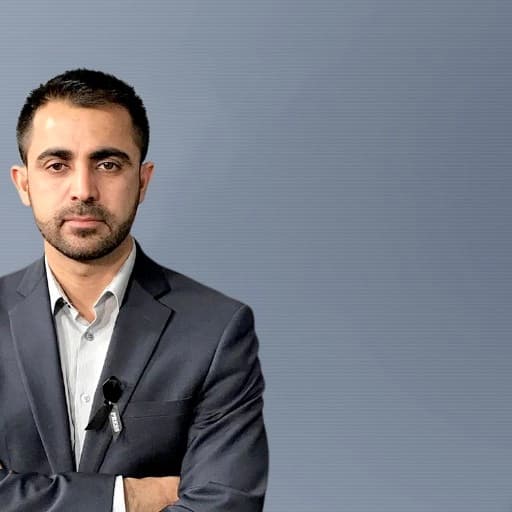
ERBIL, Kurdistan Region - If the West abandons the Kurds, its strongest allies in Iraq, it will leave the door open for Iran to expand its influence in the country, French professor Fabrice Balanche warned, amid escalating tensions between Erbil and Baghdad.
“If they [the West] abandon the Kurds, as I told you, the best allies of the West in Iraq, they let the floor to the Iranian in Iraq,” Balanche, a professor at Lyon University, told Rudaw’s Namo Abdulla in an interview on Thursday.
His remarks come as the Iraqi Prime Minister Ali al-Zaidi on Tuesday ordered federal authorities to impose control over Kurdish-protected oil fields across Nineveh, Kirkuk, Salahadin, and Diyala provinces. He has also tasked federal agencies to monitor oil exports and border-crossings in the Kurdistan Region, while “instructing” the Kurdistan Regional Government (KRG) to not export oil unless approved by the federal oil ministry.
Kurdish leaders, meanwhile, have called for the disputes to be resolved through constitutional mechanisms, emphasizing respect for the Kurdistan Region’s constitutional status, rights and federal powers rather than unilateral decisions or military pressure.
Balanche said the situation facing the Kurdistan Region mirrors the West’s withdrawal of support for Syrian Kurds, arguing that Western governments had abandoned Kurdish forces in northeast Syria (Rojava) after relying on them for years in the fight against the Islamic State (ISIS) and the former Syrian government under Bashar al-Assad.
He said the West had shifted its support to Syrian President Ahmed al-Sharaa, who seeks to establish a centralized state and opposes granting autonomy to minorities, particularly the Kurds.
“The West decided that the Kurds are not useful enough, and so they let Sharaa destroy the Kurdish autonomy in Syria,” he said, adding that he sees a similar trajectory unfolding in Iraq.
Balanche argued that the United States was no longer interested in maintaining leverage over Baghdad and had consequently become less supportive of federalism and Kurdish autonomy.
He also rejected Baghdad’s stated efforts to extend federal authority across Iraq as a genuine campaign against armed factions, describing them instead as a pretext to curtail the Kurdistan Region’s constitutional powers.
“The Iraqi prime minister is just an Iranian puppet. He has no leverage on Iraq,” Balanche said, arguing that the Iraqi army lacks the capacity to disarm powerful Shiite militias, just as the Lebanese army cannot disarm Hezbollah.
He warned that Baghdad’s initial moves to assume control of border crossings, oil and gas resources in disputed territories could eventually extend to the entire Kurdistan Region.
“The first step, it's the border: to take control of the border, to take control of the oil, of the gas, in the disputed territories. And tomorrow it will be in the whole Kurdistan,” he said.
Balanche also expressed concern that the current confrontation could reproduce the events of October 2017, when Iraqi forces and Iran-backed militias seized control of disputed territories, including Kirkuk, following the Kurdistan Region’s independence referendum.
Balanche also attributed Baghdad's latest moves, in part, to divisions between the Kurdistan Region's two main political parties, the Kurdistan Democratic Party (KDP) and the Patriotic Union of Kurdistan (PUK).
He said the timing of Baghdad's demands to assume control of oil fields and border crossings was opportune, given the political rift between the two parties.
“Of course. It's a very good timing for the prime minister to order Kurdistan to send back the oil field and the border because he's using this lack of unity,” he said.