ERBIL, Kurdistan Region - A program run by the US State Department is offering up to $20 million and the possibility of relocation to anyone with information on Tehran’s nuclear program while the two countries remain at a stalemate over nuclear proliferation.
Iran’s nuclear capabilities have been a major source of tension between Washington and Tehran. While the United States has cited concerns over nuclear proliferation to justify its ongoing hostilities with Iran, Tehran’s nuclear doctrine remains opaque, with growing domestic calls for a shift in its longstanding policy.
Washington’s request for information on Friday reflects a redoubled effort to assess Tehran’s capabilities which have remained threateningly opaque since June 2025.
Rewards for Justice (RFJ), a US-State Department program designed to financially incentivise informants on security threats to the US, offered “up to $20 million and possible relocation for information about Iran’s nuclear program, including its facilities, equipment, and associated personnel, such as those in the scientific community, or the movement of any of the above,” it stated in a post on X on Saturday.
The amount of $20 million is greater than previous incentives ranging from a couple of hundred thousand dollars to $15 million for information that would lead to the “disruption of the financial mechanism of Iran's Islamic Revolutionary Guard Corps.”
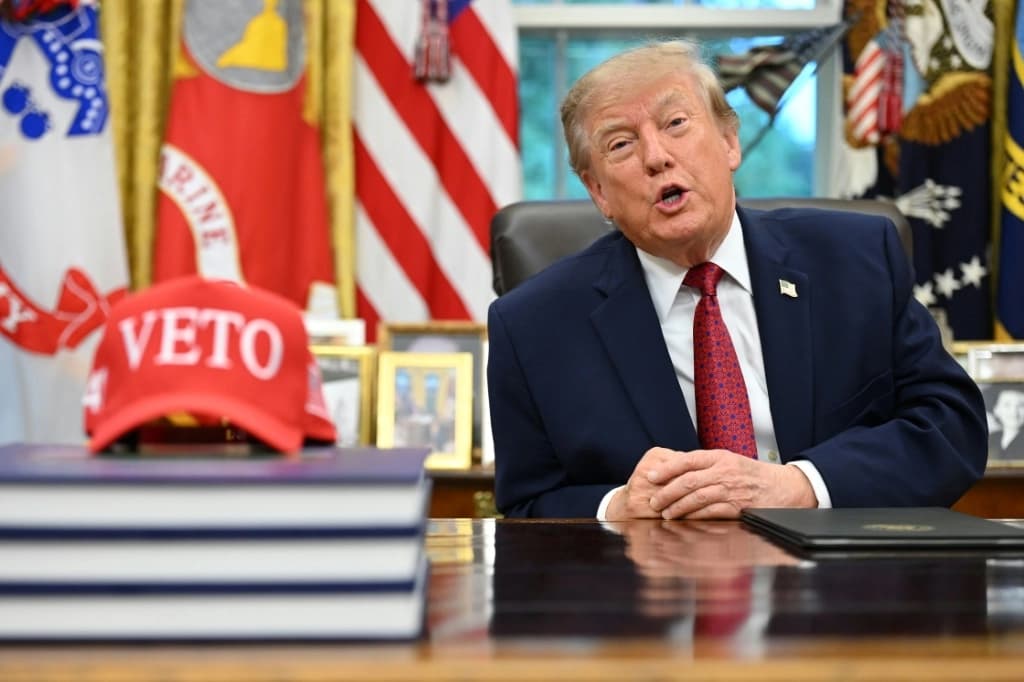
US President Donald Trump has repeatedly cited the need to prevent nuclear proliferation as a key justification for his policy towards Iran.
“If we didn’t hit Iran, you wouldn’t have Israel today,” Trump said on Friday night in Florida. “If they had nuclear, they would have used nuclear. They would have obliterated the Middle East,” Trump continued.
In a more detailed post, RFJ cited a 2025 report from the UN nuclear watchdog, International Atomic Energy Agency (IAEA), which had considered Iran’s nuclear enrichment capabilities to be “at a level that is a short technical step from the 90 percent for a nuclear weapon.”
In June 2025, the agency reported that Iran had stockpiles of uranium enriched to 60 percent purity, a level Washington has repeatedly said is unnecessary for civilian nuclear purposes.
Washington’s offer, however, underscores the uncertainty surrounding Tehran’s nuclear capabilities.
RFJ cited the IAEA’s loss of “continuity of knowledge” on Iran’s nuclear capabilities and inventories following Tehran’s continued prohibition of nuclear inspections since Israel and latterly America’s strikes on Iranian nuclear facilities in June 2025.
Israel’s “Operation Rising Lion” targeted nuclear sites, military bases, as well as senior nuclear scientists in a bid to prevent Tehran’s nuclear proliferation. The Israeli Defense Forces (IDF) listed 11 nuclear scientists killed on the operation’s first night.
Since the outbreak of the US-Israeli war with Iran, American and Israeli strikes have also targeted Iranian nuclear facilities, particularly the declared sites at Isfahan, Natanz, and Fordow.
As a result of these hostilities as well as a prohibition from Tehran, the agency has been unable to verify Tehran’s nuclear capacity.
While any remaining enriched uranium stock could indeed lead to an Iranian nuclear weapon, severe destruction at Tehran’s officially declared nuclear sites as well as a lack of credible information creates only more questions.
Fears of Iran’s capacity still remain, particularly at undeclared nuclear sites.
David Albright, founder of the Washington-based non-profit Institute for Science and International Security, which monitors Iranian nuclear proliferation, describes an ongoing threat.
“The nuclear weapons threat remains real; the regime’s intentions and efforts are unremitting," said a post on X earlier this month.
Albright’s institution has been monitoring an alleged nuclear site at Minzadayi, northeast of Tehran which was attacked by Israel in March of this year which considered it a facility involved in nuclear weapons development.
Through satellite imagery, Albright’s institute discovered “significant renewed activity” at the site which “may be indicative of an effort by Iran to establish a nuclear weapons development capability” following what was destroyed in March’s attack.
Trump has also repeatedly threatened to strike Iran’s heavily fortified Pickaxe Mountain complex since the outbreak of the US-Israeli war with Iran in late February, amid suspicions that the underground facility in central Iran is linked to a nuclear weapons program. However, the International Atomic Energy Agency (IAEA) has not verified these allegations.
Fears such as these perhaps swelled when Iran’s nuclear proliferation was raised last week by the Iranian parliament’s deputy speaker, Hamidreza Hajbabaei, who urged senior leadership to reconsider the peaceful nuclear doctrine of the late Supreme Leader Ayatollah Khamenei.
Khamenei’s doctrine previously banned the use of nuclear weapons in Iran’s military.
However, Hajbabaei told Iranian state media that, “what the people are demanding these days is a change in our nuclear strategy.“
“If Iran is in danger, we will use every legitimate and permissible means and tool,” he continued.
While questions still abound on the likelihood of Iran’s nuclear development, negotiations between Washington and Tehran remain at a stalemate over the issue.
US’ demands that nuclear limitations remain on the table have been continuously met by Tehran’s renewed calls for Washington to meet its “seven demands”, including the lifting of sanctions and naval blockade of the Strait of Hormuz.
On Friday, the Qatari Prime Minister, the mediating party between Tehran and Washington, said that neither the United States or Iran have reached a comprehensive agreement.