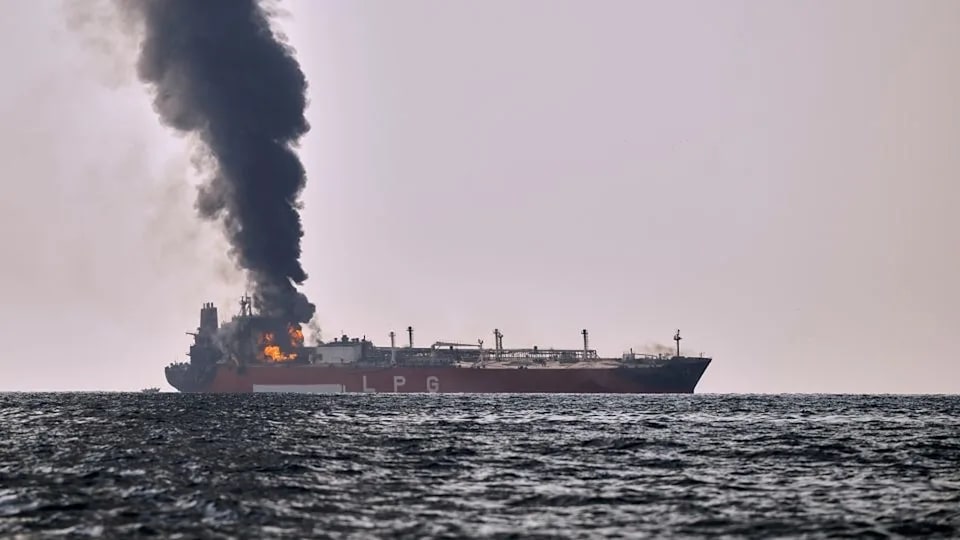

ERBIL, Kurdistan Region - A third oil tanker has exploded and caught fire after striking a naval mine near Iran’s Ghanam Island in the Strait of Hormuz, the Islamic Revolutionary Guard Corps (IRGC) said late Sunday, amid escalating maritime tensions with the United States.
The tanker was sailing about two kilometers off the island’s coast when it struck the mine, triggering a severe explosion and fire, the IRGC Navy’s public relations office said in a statement carried by the IRGC-affiliated Tasnim news agency.
The vessel was subsequently abandoned in the southern waters of the Strait of Hormuz, the statement added, without identifying the tanker or disclosing its flag, ownership or the number of crew members aboard.
The latest incidents come as Tehran and Washington remain locked in a confrontation over the Strait of Hormuz, a critical artery for global oil shipments, where maritime security has deteriorated sharply since the regional war erupted in late February.
The IRGC accused the vessel of navigating what it described as an “unsafe and illegal” route along the southern coast of the strait, despite warnings about the dangers of the passage.
It said the tanker had relied on “the false claims and promises of American officials” while covertly transiting the waters near the island.
“The entire Strait of Hormuz is under the complete intelligence and operational oversight of the IRGC Navy forces, and their control over both the eastern and western expanses of this strategic waterway is absolute and indisputable,” the statement said.
Earlier on Sunday, Iran’s regular army said three oil tankers had entered a prohibited zone east of the Strait of Hormuz after disabling their identification and navigation systems.
The army said one tanker was immobilized after striking a naval mine, while the other two “changed course and returned toward the Persian Gulf,” according to the IRGC-affiliated Fars News Agency.
In a separate accusation, Iran’s army said US forces had struck an Iranian fishing boat carrying three people near Sirik, in the southern Hormozgan province, at around 3:30am Sunday.
“Two of those aboard were taken to hospital, while the third remained missing as search operations continue,” the army’s public relations office said.
Iranian Navy Commander Shahram Irani said efforts were underway to break the US naval blockade, insisting that the country's ports remained fully operational.
“The Islamic Republic’s maritime lifeline cannot be severed,” Irani said in comments carried by Press TV on Friday.
He also claimed that US forces had been pushed back from Iran’s maritime territory and were now “reduced to seeking permission to pass through the Strait of Hormuz.”
Washington, meanwhile, has intensified its maritime restrictions on Iranian oil exports. US Treasury Secretary Scott Bessent said last Wednesday that Iran had failed to load “a single oil tanker” since Washington launched Operation Economic Outcast in August, claiming Tehran had “not a drop of oil on the water left to sell.”
US Central Command (CENTCOM) reported Friday that its forces had disabled six commercial vessels since the blockade resumed in July and redirected 158 others.
At least 28 attacks on vessels in the Strait of Hormuz and surrounding waterways had been reported and confirmed in November, maritime analyst Noam Raydan said Thursday.
The escalating maritime confrontation has coincided with mounting economic pressure on Tehran. Iran’s rial fell to a record low on Saturday, with the US dollar trading at 301,500 tomans on the open market, according to Bonbast, an independent currency-tracking website.