
ERBIL, Kurdistan Region - Iraq’s top judicial power broker, Faiq Zaidan, arrived in the Iranian capital Tehran on Tuesday, the Supreme Judicial Council (SJC) he heads announced, noting that he held a series of high-level meetings with Iran's top executive, legislative, judicial, and security officials, where talks reportedly touched on the United States’ latest sanctions on Tehran.
The meetings
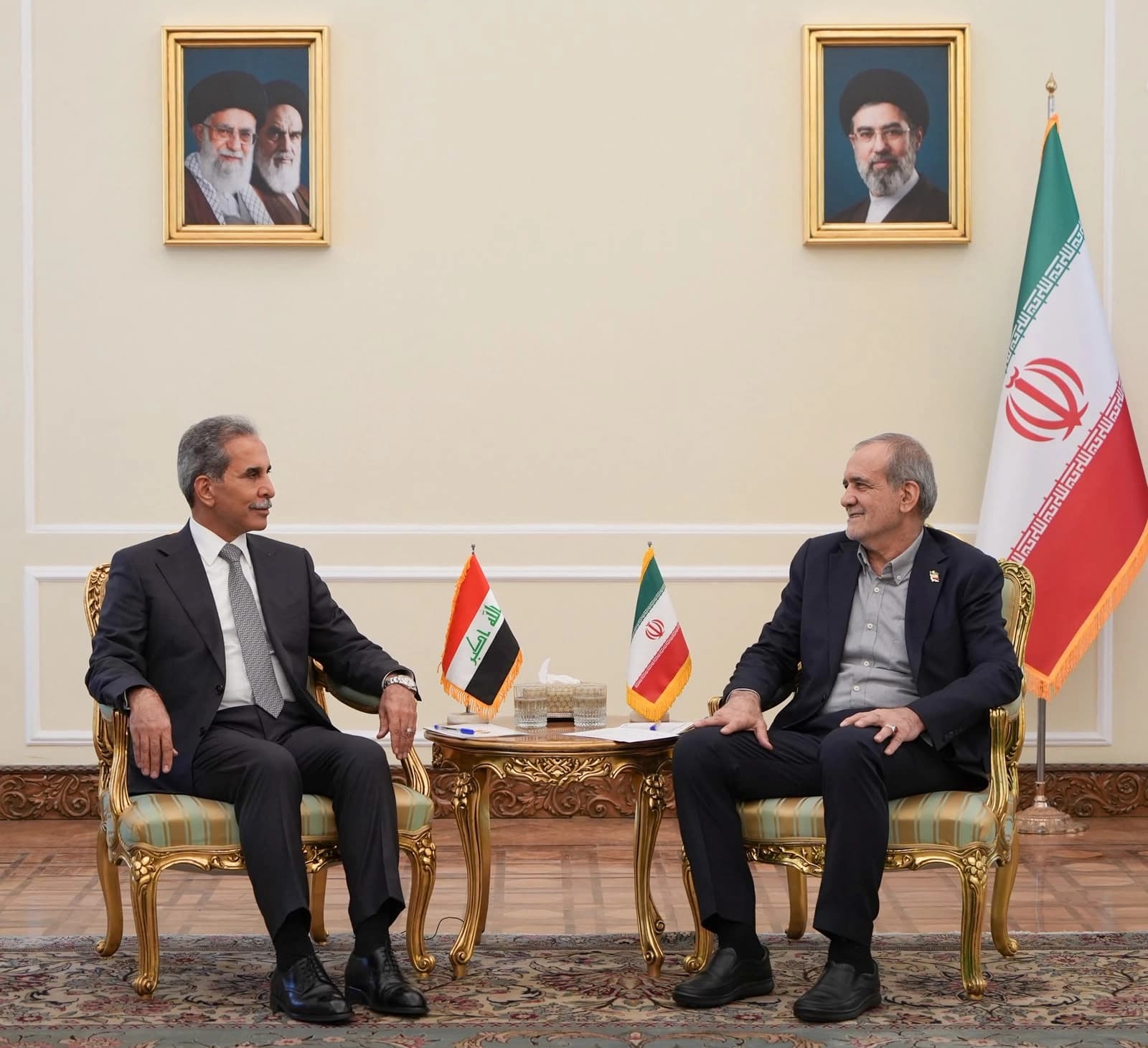
The SJC reported that Zidan led a "senior judicial delegation" to Tehran "upon an official invitation," detailing that he met with Iranian President Masoud Pezeshkian to discuss "strengthening Iraqi-Iranian cooperation, particularly in the judicial and legal fields," in a meeting also attended by Iranian Justice Minister Amin Hossein Rahimi.
Baghdad's top judicial official also met with Mohammad Bagher Ghalibaf, the speaker of Iran's parliament who is also serving as Tehran's chief negotiator with Washington, to discuss "the exchange of expertise and coordination on legal issues of common concern between the two countries."
Importantly, Zidan also met his Iranian counterpart Gholam-Hossein Mohseni-Ejei, where the two sides discussed "a number of judicial and legal files of common concern," according to the SJC.
Iran's state-run Islamic Republic News Agency (IRNA) cited Mohseni-Ejei as saying that cooperation between Baghdad and Tehran had "deepened across all areas and dimensions," adding that “in the judicial and legal sphere, relations have expanded through concluded memoranda of understanding and agreements.”
The Iranian judiciary chief also stated that the two countries' security is "interlinked," stressing the need to "swiftly and decisively neutralize" any “threat along the shared border or from foreign actors” through bilateral coordination and commended Baghdad for its efforts in pursuing those whose hands are “stained with the blood” of slain commanders from the Tehran-led ‘Axis of Resistance,’ IRNA said.
Mohseni-Ejei was further cited as dismissing what he described as US President Donald Trump administration's recent economic pressure campaign against Tehran as “nothing new,” adding that Washington would "certainly fail" in its endeavor.
For his part, Zidan, was quoted by IRNA as stating that “the government and the people of Iraq stand in solidarity with the government and people of Iran” vis-a-vis the recent US-Israeli war on the country, and as censuring the economic sanctions on Iran.
The Iraqi chief justice reportedly highlighted the importance of judicial cooperation between Baghdad and Tehran which he said stems from “an absolute belief in the necessity of strategic cooperation between the two countries,” emphasizing “the need for full implementation of the judicial agreements concluded between the two countries.”
In addition to Mohseni-Ejei, Zidan also met with Mohsen Rezaei, secretary of Iran's top security body, the Supreme National Security Council (SNSC), where the two sides "reviewed prospects for joint cooperation" to activate "judicial and security agreements" and to "exchange information and expertise to bolster counter-terrorism and organized crime efforts, in a manner that ensures the consolidation of security and stability in the region," the SJC said.
Meanwhile, IRNA cited Rezaei as telling Zidan that Iran wants "a strong and independent Iraq," while “affirming that the United States will have no place in the region's future" and that "regional countries will themselves decide their own destiny."
Rezaei reportedly “stressed the need to resolve the status of anti-Iranian armed groups stationed along the shared border,” while Zidan was cited as expressing “gratitude for Iran's support” and conveying “the greetings of Iraqi officials to the Supreme Leader of the Islamic Revolution, [Mojtaba Khamenei].”
The Iraqi chief justice further "emphasized regional cooperation and underscored the necessity of ensuring security along the shared borders of the two countries," IRNA added, further citing him as honoring the memory of Qassem Soleimani, the former commander of the Islamic Revolutionary Guard Corps' (IRGC) Quds Force, and Abu Mahdi al-Muhandis, the former deputy chief of Iraq's Popular Mobilization Forces (PMF), both killed in a US drone strike near Baghdad International Airport in January 2020.
The timing
The visit notably came a day after the US enacted a sweeping sanctions package dubbed Operation Economic Outcast, designed to aggressively curtail Iran's military capabilities and primary revenue streams.
US State Department Spokesperson Tommy Pigott said in a Monday statement that the measures target "multiple entities, individuals, and vessels enabling the Iranian regime's destabilizing activities," including “attacks against U.S. forces and allies in the region, illicit weapons procurement, cyber intrusions into American infrastructure, and the sale of energy products whose proceeds fund terrorism globally.”
Pigott added that the package specifically targets “Iranian military officials responsible for procuring weapons and directing attacks against US servicemembers and regional partners, Iran-based entities that gathered intelligence for targeting US forces and allies, and a procurement network supplying Iran's military and missile programs.”
The measures also target what Washington says is a “regime-directed cyber group” responsible for “extensive intrusions into U.S. critical infrastructure,” as well as a network of “shippers and brokers moving Iranian petroleum and petrochemical products through the [United Arab Emirates] UAE, China, Singapore, and Europe” to fund the IRGC’s Quds Force and “other regime elements.”
Operation Economic Outcast comes days after Trump on Thursday vowed to launch "the most crushing economic operation ever taken against any country" against Iran, describing the move as "economic warfare and isolation on an unprecedented scale."
In a Truth Social post, he warned that "any country that allows its financial institutions, businesses, airports, or government entities to provide any type of lifeline to Iran will itself face tremendous economic consequences," adding that "oil smuggling, swap lines, cash transfers, exchange houses, ship registries, front companies - it all needs to stop now."
The economic escalation follows the US mid-April launch of the Economic Fury campaign - the financial counterpart to Operation Epic Fury, a six-week joint US-Israeli military campaign that began in late February and saw Washington and Tel Aviv strike thousands of targets across Iran.
Tehran responded with drone and missile strikes across the region, targeting alleged US assets - particularly in Gulf Arab states - as well as Israel.
A preliminary ceasefire mediated by Pakistan followed in early April, with the Islamabad Memorandum of Understanding signed in mid-June formalizing a halt to hostilities on all fronts. However, the Understanding has since been tested by several rounds of strikes and counterstrikes, the latest of which escalated on July 8 before subsiding later that month. Washington also reinstated a naval blockade of Iranian ports in July.