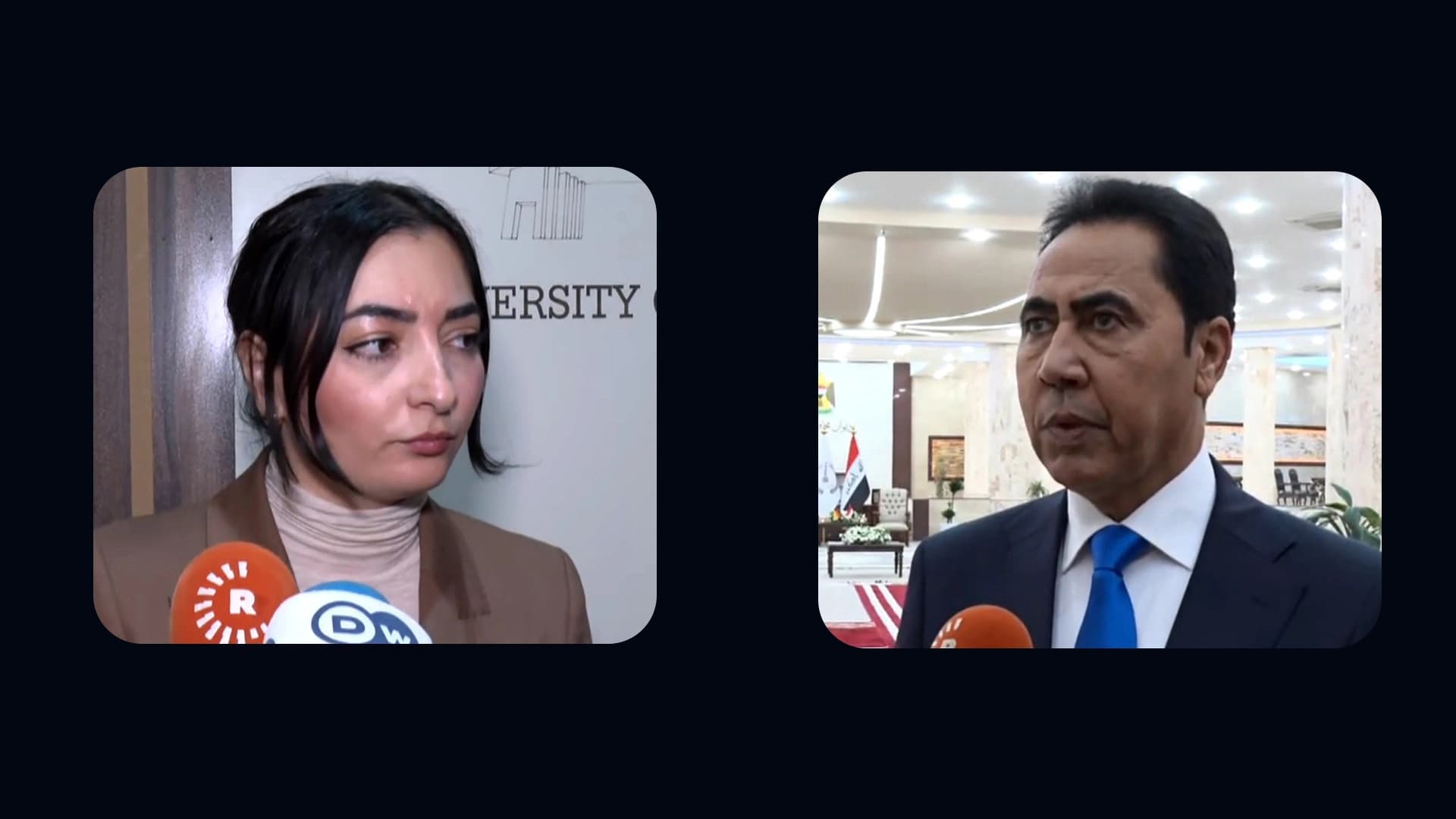
ERBIL, Kurdistan Region - Iraq aims to increase its daily oil production from 4.4 million barrels to 5.5 million barrels by the end of this year, Oil Minister Hayyan Abdul Ghani told Rudaw on Wednesday, highlighting the role of 28 American companies operating in Iraq’s oil sector.
“The plan is to reach sustainable production capacity this year at a rate of 5.5 million barrels per day through expansion in well drilling and rehabilitation operations, building surface facilities and pipelines, and increasing water injection to maintain reservoir pressure,” Abdul Ghani said.
He noted that 28 American companies currently operate directly with the ministry, including KBR, Honeywell, Halliburton, Schlumberger, Baker Hughes, Weatherford, and John Wood Group, in addition to service companies and subcontractors.
According to the minister, an agreement with French energy giant TotalEnergies is set to run for 30 years and is expected to create about 40,000 jobs across primary and secondary companies. Plans include boosting Artawi’s production to 210,000 barrels per day, processing 600 million cubic feet of gas daily from four oil fields, building a seawater injection system, and generating 1,000 megawatts of solar power.
TotalEnergies is a major investor, working in the Artawi field in Basra province and the Halfaya field in Maysan province under the South Iraq Integrated Project. The company signed a $27 billion contract in 2023—the largest foreign investment in Iraq’s history. In March, its managing director, Dunia Chalabi, told Rudaw that the firm is aiming for “full operational readiness” of its megaproject by 2027.
Abdul Ghani also confirmed ongoing negotiations with US energy giant Chevron over exploration blocks in Nasiriyah and Salahaddin provinces. In mid-August, the ministry signed an initial agreement with Chevron to develop several blocks in southern Dhi Qar province and expand work at the Balad field in Salahaddin.
The minister said Iraq has two contracts with British energy giant BP: one in Rumaila, expected to produce 1.8 million barrels per day, and another to develop four key oil fields in Kirkuk—Baba Avana, Bay Hasan, Jambour, and Khabbaz—with a combined capacity of about 450,000 barrels per day.
Iraq is also preparing contracts for fields and exploration blocks in Nasiriyah, Basra, Hamrin, Kirkuk, and Maysan provinces, as well as the Ajeel field in Salahaddin province.
Baghdad has renewed efforts to attract major international oil companies as part of its push to expand and diversify its energy sector.
This comes as Kurdish oil exports resumed through the Iraq-Turkey pipeline on Saturday after more than two years of suspension. The restart followed a deal earlier in the week between the Kurdistan Regional Government (KRG), the federal government, and international oil companies.
Exports were halted in March 2023 after a Paris-based arbitration court ruled that Ankara had violated a 1973 pipeline agreement by allowing Erbil to independently export oil beginning in 2014.
Abdul Ghani on Saturday stressed that the resumption of Kurdistan Region's oil exports will not affect Iraq’s compliance with its latest OPEC commitments, saying “they have already been counted as part of OPEC's quota.”
Malik Mohammed contributed to this report.