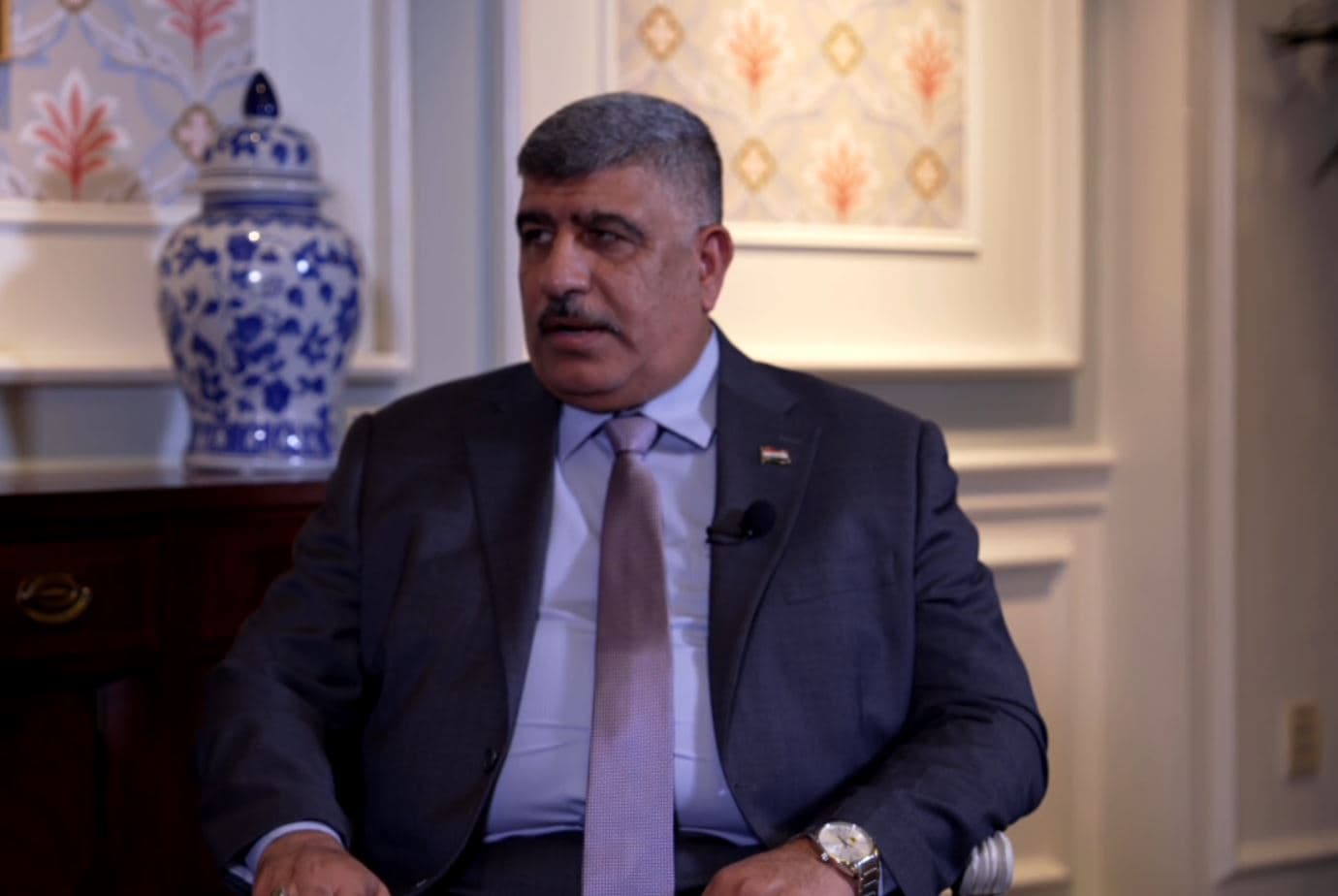
ERBIL, Kurdistan Region - Iraqi National Security Advisor Qasim al-Araji on Tuesday received US Chargé d’Affaires Joshua Harris, who reaffirmed the support of President Donald Trump’s administration for the Iraqi government led by Prime Minister Ali al-Zaidi, state media reported. The two officials also underscored the importance of restricting arms to state control, in line with Zaidi’s efforts.
Araji and Harris “discussed the overall regional and international situation,” according to a statement from the Iraqi security advisor’s office cited by the state-run Iraqi News Agency (INA), and reviewed the “continuation of cooperation and partnership between Iraq and the United States, as well as the development of bilateral relations in line with the shared interests of both countries.”
Moreover, Araji “reaffirmed to the US diplomat Iraq's longstanding position regarding the ongoing conflict in the region, emphasizing Baghdad's support for a peaceful path in accordance with international norms and diplomatic principles,” the statement said.
For his part, Harris was quoted as “reaffirming the support of the US administration and President Trump for the Iraqi government,” adding that “the United States supports an independent Iraq with full sovereignty and believes that economic growth and development should serve as the primary drivers of prosperity for Iraq and its people.”
The top US diplomat also expressed Washington's “support for efforts to ensure that arms remain under state control,” describing a recent statement by Iraq’s ruling Shiite Coordination Framework backing such efforts as “a qualitative step toward consolidating independence and sovereignty for Iraq's promising future.”
Earlier in the day, the alliance of Shiite parties that backed Zaidi’s rise to premiership announced its support for the newly elected prime minister’s push to “restrict arms to state control and separate the Popular Mobilization Forces Authority from all political, partisan, and social frameworks, in line with the Iraqi Constitution… to ensure continued cooperation between the Iraqi government and the international community.”
The Coordination Framework further affirmed that the “decision of war and peace is a sovereign national decision that belongs to the Iraqi people through its constitutional institutions represented by the House of Representatives and the elected government exclusively, and that any action outside this framework constitutes a violation of the law and the principles of the constitutional state.”
In his inaugural address before the Iraqi parliament in mid-May, Iraqi Prime Minister Zaidi vowed security reform, including through “confining weapons under state control,” adding that he would enhance the capabilities of security forces and consolidate citizens’ “confidence in democracy.”
Last week, several Coordination Framework officials told Rudaw that the prime minister had been engaging in dialogue with armed groups operating outside the PMF to bring their weapons under state control.
The PMF was established in 2014 during the Islamic State group (ISIS) blitz, which saw the group seize control of large parts of Iraq’s north and west.
Created in response to a religious edict, fatwa, by Iraq’s highest Shiite authority, Grand Ayatollah Ali al-Sistani, the PMF was initially an umbrella organization of roughly 70 predominantly Shiite armed groups, with approximately 250,000 members.
While the PMF is a state‑funded institution, it notably includes factions widely believed to overlap with the Iran-led ‘Axis of Resistance,’ which have, since the outbreak of the Iran war in late February, carried out attacks against alleged US targets in the region in support of Tehran, often operating through shadow groups under the banner of the Islamic Resistance in Iraq (IRI).
The IRI emerged in the immediate aftermath of the outbreak of the Gaza war in October 2023, with its core overlap within the PMF including Asa’ib Ahl al-Haq, Kata’ib Hezbollah, Harakat Hezbollah al-Nujaba, and Kata’ib Sayyid al-Shuhada armed groups.
In early April, the IRI claimed that it had carried out more than 750 attacks against alleged US-linked assets in Iraq and the region since the beginning of the Iran war and up to that point. However, in recent weeks those attacks have seen a drastic decline.
So far Zaidi’s efforts to address arms proliferation has left Iraqi armed groups divided between supporters and opposers of the push.
RELATED: Iraqi pro-Iran armed group moves to place weapons under state control