
The Iraqi finance ministry has intensified its efforts to prepare Iraq's 2027 budget using a new system, transitioning from the traditional line-item budget to a program and activity-based budget. This step, amid uncertain revenues and a staggering 100 trillion Iraqi dinars ($76.3 billion) allocated exclusively for salaries next year, will face major obstacles and a severe test for its success and implementation.
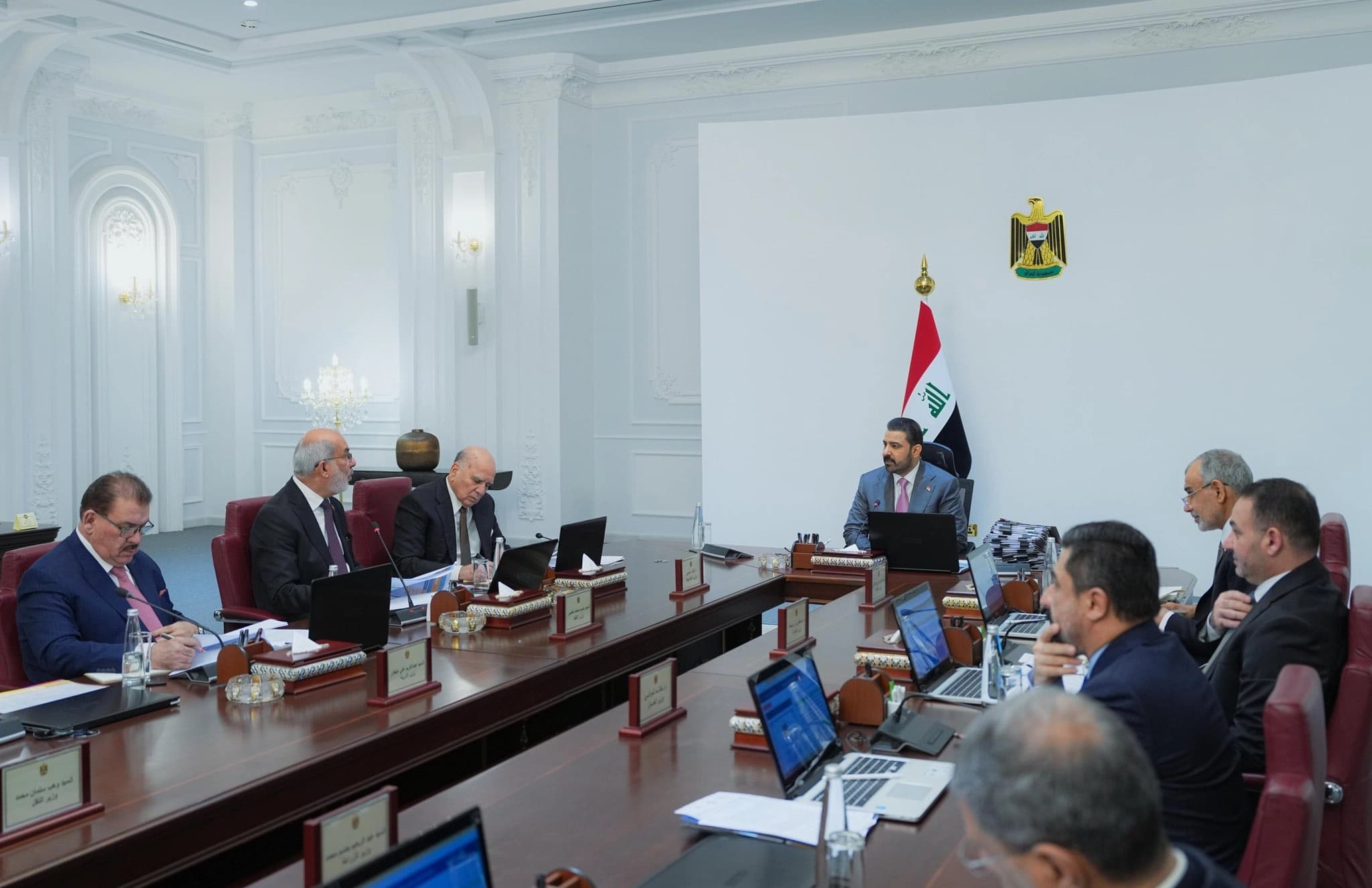
The finance minister on Monday visited the budget department to inquire about the final stages of budget preparation, stating, "The transition to a program, productivity, and efficiency budget requires joint work and continuous coordination among relevant parties. This ensures the preparation of a budget that links resource allocation directly to programs, objectives, and outcomes."
This new approach, which Iraq aims to adopt in the 2027 draft budget law, is entirely different from the past two decades.
The principles of this new Iraqi budget were approved by the council of ministers in early June, and the World Bank Group is scheduled to assist Iraq in its preparation and implementation. This budgeting method is among the measures encouraged by the International Monetary Fund (IMF) and the World Bank Group because it alters how revenues and expenditures are aggregated.
In reality, the fundamental difference between these two types of budgets is that a line-item budget focuses on "what does the government buy?" (Inputs), whereas a program budget focuses on "what does the government achieve?" (Outputs and Outcomes).
The central question now is: Given that Iraq has failed over the past two decades to implement the traditional line-item budget - always resulting in a wide gap between what parliament approves and what the government executes - can it draft a program budget law under these conditions of revenue ambiguity and massive salary expenditures, and successfully implement it alongside 100 trillion dinars in payroll costs?
Discrepancies between parliament’s budget law and finance ministry figures
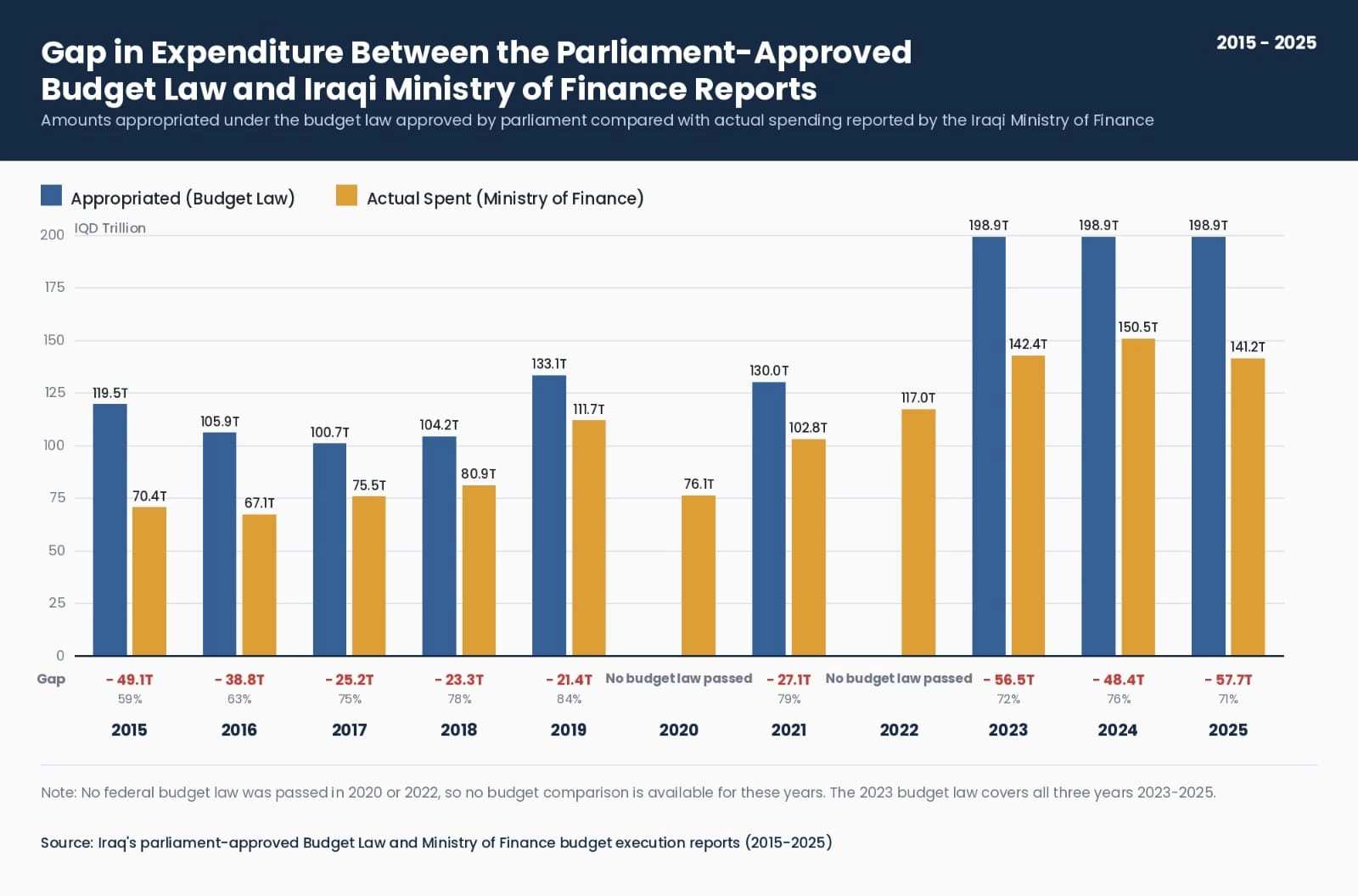
During the period from 2015 to 2025, Iraq spent two years without a budget. This year (2026) marks the third year without an annual budget, operating instead on a one twelfth spending rule.
Over the years, with and without a budget law, a significant gap is consistently visible between estimates and reality, particularly during the 2020–2026 span (three years with a budget, three without).
The 2025 Budget Example: According to the 2023–2025 budget law, total Iraqi expenditures were supposed to reach 199 trillion dinars ($151.9 billion), but actual executed expenditures totaled 141 trillion dinars ($107.6 billion). Similarly, total revenues were projected at 134 trillion dinars ($102.3 billion), while actual oil and non-oil revenues reached 124 trillion dinars ($94.6 billion), reflecting a deficit on both fronts.
When comparing the budget laws of 2015 through 2025 with actual figures from the Ministry of Finance, the discrepancies - in both expenditures and revenues - are massive:
Expenditure Variances: In 2015, the variance was 59 percent. Total expenditures were set in the budget at 119 trillion dinars ($90.8 billion), but the finance ministry managed to spend only 70.39 trillion dinars ($53.7 billion), with the largest gap concentrated in investment spending.
 Revenue Variances: In the 2015 budget, total revenues were estimated at 94 trillion dinars ($71.8 billion), but end-of-year collections reached 66 trillion dinars ($50.4 billion), a 70 percent variance. In 2024, total revenues were projected at 147 trillion dinars ($112.2 billion), closing the year at 140 trillion dinars ($106.9 billion). Conversely, a year like 2022 had no budget law at all, yet total state revenues reached 161 trillion dinars ($122.9 billion), driven by high oil prices and continuous exports.
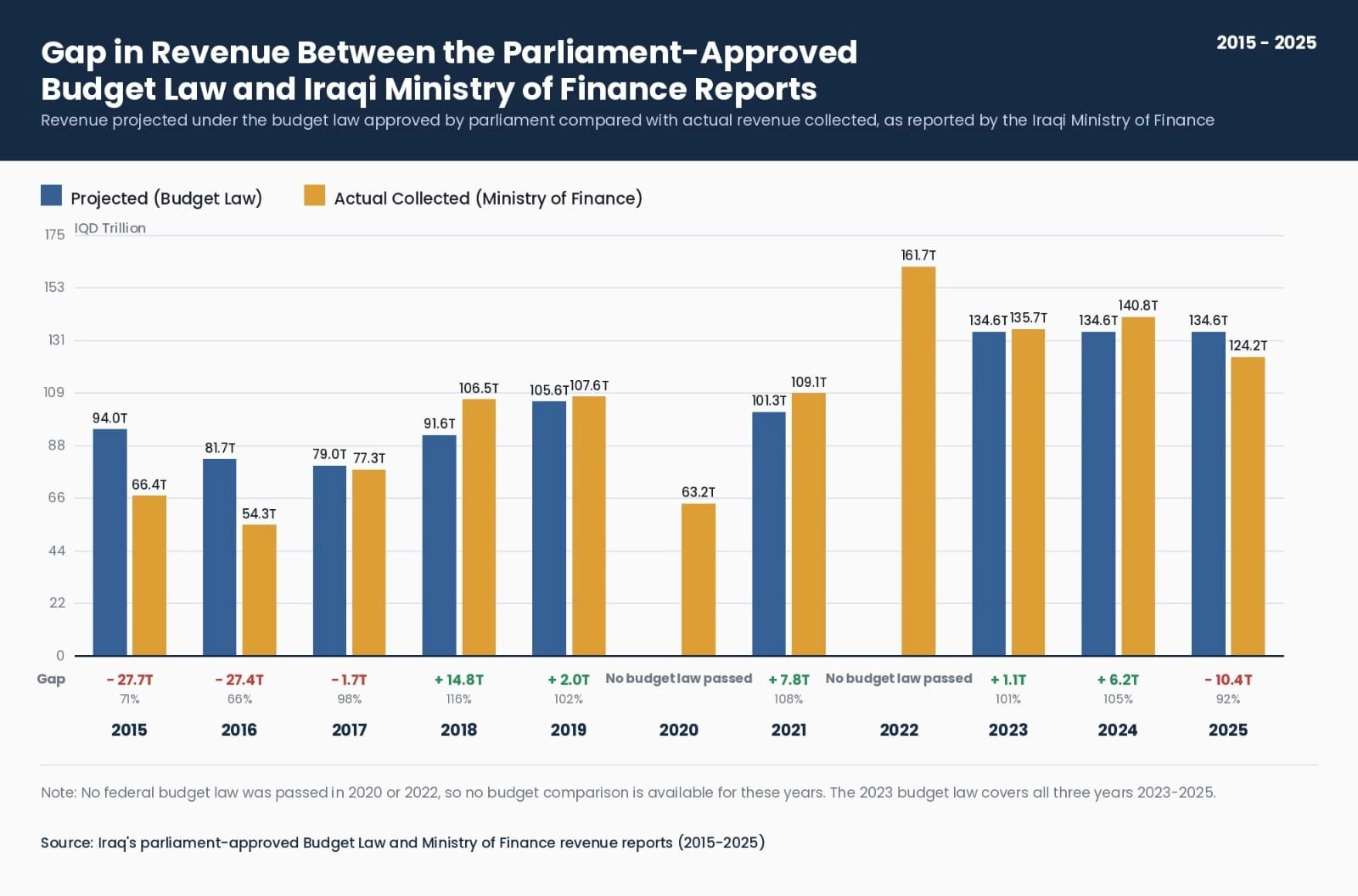
Despite these fluctuations, the data reveals a striking trend: the continuous expansion of operational expenditures driven by a swelling public sector workforce. Between 2015 and 2024, the number of state employees grew from 2.98 million to 4.08 million. When adding retirees and social welfare beneficiaries, the total reaches nearly 10 million people.
Conversely, non-oil revenues have stagnated or declined, shifting from 78 percent oil revenue versus 22 percent non-oil revenue in 2015 to 92 percent oil revenue in 2023, 90 percent in 2024, and 88 percent in 2025.
Program budgets: can Iraq implement this structure?
A line-item budget is an old, traditional format wherein the specific needs of each department are listed, and allocated funds are distributed based on purchasing goods, maintenance and general overhead. None of these expenses are tied to the services delivered to citizens.
In contrast, a program budget is a modern financial system. Funds are organized around government objectives and activities, tying expenditures directly to state strategic plans for developing sectors such as health, education and industry.
The draft currently being prepared by the Iraqi finance ministry is scheduled to be sent to the council of ministers at the end of this month, reaching parliament in November and December for review and approval. Even if everything goes according to plan, the new budget will initially be implemented in only two ministries and two provinces in 2027.
Transitioning from a traditional line-item budget to a program budget is a crucial step, but it raises immediate questions regarding its feasibility in Iraq, most notably:
Human Resources and Public Sector Productivity: With state employees exceeding four million, the average actual working time per employee per day is estimated at only about 17 minutes. How will the new budget tie human capacity to productivity?
Continuous Decline of Investment Spending: Over the past two decades, whenever spending cuts were required, the investment sector was always the primary target sacrificed. For instance, in the 2023 - 2025 budget, large gaps existed between allocated investment plans and actual spending such as in electricity and health, where gaps reached nearly 99 percent in some areas.
Revenue Ambiguity and Oil Export Volumes: Amid current Middle Eastern tensions and the Strait of Hormuz, neither oil export volumes nor oil prices are stable, complicating baseline revenue projections.
Shifting Domestic Oil Pricing Policy: Moving away from standard practices to sell crude oil domestically at discounted rates might form a pillar of the program budget. As Iraqi Prime Minister Ali al-Zaidi noted at the 8th Baghdad International Dialogue in late August, “The reality is we sell crude oil domestically for 5000 Iraqi dinars [about $3.8] or for free, which we must change and eliminate."
If global oil prices are $90 per barrel, domestic pricing would be set around $60. While this could generate roughly 20 trillion dinars (about one-fifth of a good year's total revenue) from the 1.1 million barrels supplied daily to the domestic market, achieving this faces severe practical hurdles. This was demonstrated when generators immediately cut power at midnight following early policy shifts, alongside the challenge of absorbing the 200,000 employees from oil ministry-affiliated companies into general public spending.
Bottom line
In reality, implementing this new financial system requires robust modern technological support and the integration of revenue and expenditure figures similar to Malaysia's model, highlighted in the IMF report titled "Spend Smarter."
Theoretically and legally, Iraq can adopt this budget. Practically, however, it is extremely difficult and complex unless radical reforms are made to curtail operational expenditure sizes, payrolls, and general overhead.
Ultimately, transitioning to a program budget yields two distinct scenarios: Scenario One: Greater transparency, enhanced expenditure control, and streamlined revenue collection. Scenario Two: Heightened risks and bureaucratic hurdles, leading to complex budget clauses and further neglect of vulnerable sectors.
This complex financial situation in Baghdad has a direct impact on the financial and economic standing of the Kurdistan Region, as any change in the budgetary mechanism disrupts distribution and expenditure formulas. Therefore, in our next analysis, we will examine how the Kurdistan Region's share was shaped by past budget laws over the last decade, and what it should and must demand under the new program budget framework.