
ERBIL, Kurdistan Region - Turkey’s parliament speaker on Wednesday warned that legislation supporting the peace process with the Kurdistan Workers' Party (PKK) would not be implemented unless the group laid down its weapons, as Ankara prepares to establish a parliamentary committee to monitor the disarmament process.
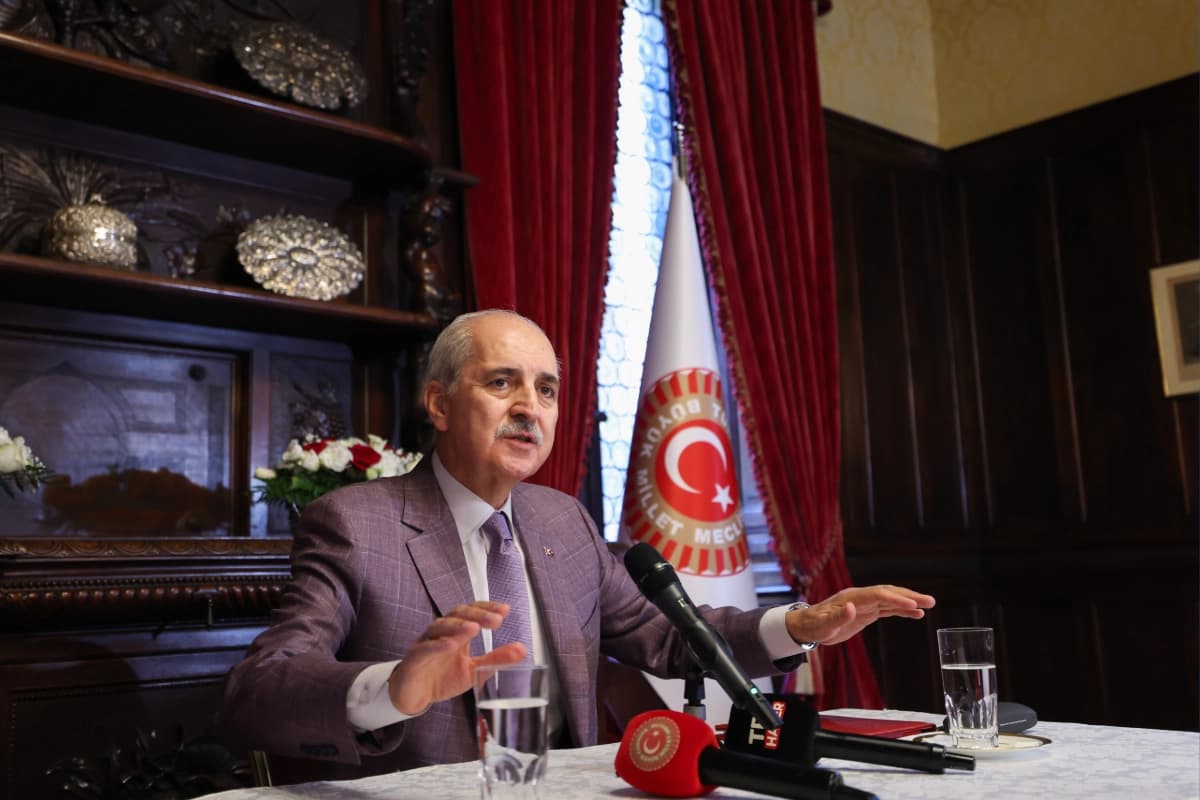
“Concerns such as ‘What if they don't lay down their weapons?’ have occasionally been raised by our citizens. If they don't lay down their weapons, the law that has already been adopted will not be implemented,” Numan Kurtulmus said during a gathering with the Turkish community in Rome, according to the independent Anka News Agency in Turkey.
“As the state, we have secured ourselves and our people. We have incorporated these safeguards into the law,” he added.
The warning comes days after the PKK announced the withdrawal of its remaining fighters from Turkey and the evacuation of several positions near the Turkish border, while urging Ankara to accelerate the peace process and take steps toward securing the freedom of imprisoned PKK leader Abdullah Ocalan.
Kurtulmus said Turkish security authorities would first have to verify that the PKK had dissolved itself and laid down its weapons, with the National Security Council confirming those findings before the legislation could be implemented.
He announced that the parliament would establish a committee in the coming days to monitor the process, with participation from all parties holding parliamentary groups.
Kurtulmus disclosed that a separate committee chaired by Turkey's vice president was already examining the implementation of the process on a case-by-case basis and that the evacuation of caves and the surrender of weapons were “proceeding as planned.”
The renewed peace process began following a February 2025 call by Ocalan, who has been imprisoned since 1999, for the PKK to disarm and dissolve. The group announced its dissolution and an end to its armed campaign in May of that year.
In August, Turkey's parliament approved legislation establishing a framework for the reintegration of PKK members, including provisions addressing criminal prosecutions and sentences, subject to verification of the group's dissolution and disarmament.
In October, the PKK announced that it had withdrawn all its remaining fighters from Turkey and abandoned four tunnels and positions on Mount Metin, near the Turkish border in the Kurdistan Region.
The group said it had fulfilled its commitments to ending the armed struggle and called on Ankara to advance legal reforms, particularly measures addressing Ocalan's status and the ability of former fighters to participate in democratic politics.
Kurtulmus described resolving the decades-long conflict as a national priority, arguing that progress would also benefit neighboring Iraq and Syria.
He expressed hope that armed groups and militias in both countries would eventually be brought under state authority, leaving weapons exclusively in the hands of government institutions.
Speaking at the Middle East Research Institute (MERI) Forum in Erbil on Tuesday, Tuncer Bakirhan, co-chair of the pro-Kurdish Peoples' Equality and Democracy Party (DEM Party), accused successive Turkish governments of pursuing policies of denial and assimilation against Kurds.
Bakirhan claimed that Turkey had spent $3 trillion on the decades-long conflict, arguing that the resources could instead have been invested in economic development and public services.
He welcomed the peace process but stressed that resolving Turkey's Kurdish issue required democratic reforms and recognition of Kurdish identity and language.
Constitutional reform remains a central Kurdish demand. Article 42 of Turkey's constitution restricts mother-tongue education in languages other than Turkish, while Article 66 defines those bound to the Turkish state through citizenship as Turks.
Kurdish political representatives have long sought amendments to both provisions to secure mother-tongue education and equal citizenship rights.
Meanwhile, Turkey's Presidential Legal Policies Council held a meeting in Ankara on Wednesday to discuss drafting a new constitution.
Justice Minister Akin Gurlek described the existing constitution, introduced following the 1980 military coup, as “undemocratic” and argued that Turkey needed a “new, civilian, democratic, freedom-oriented and inclusive constitution” inclusive of all its citizens drafted through broad public participation.
Mehmet Ucum, deputy chair of the Presidential Legal Policies Council, said the current parliament might only be able to reach an understanding on the principles of a new constitution before its term ends.
He raised the possibility of adopting a new constitution after the 2028 elections and submitting it to a referendum.
“After the 2028 elections, that is, during the 29th parliamentary term, the adoption of a new constitution through the broadest possible consensus and its submission for public approval can now be described as an unavoidable step,” Ucum said.