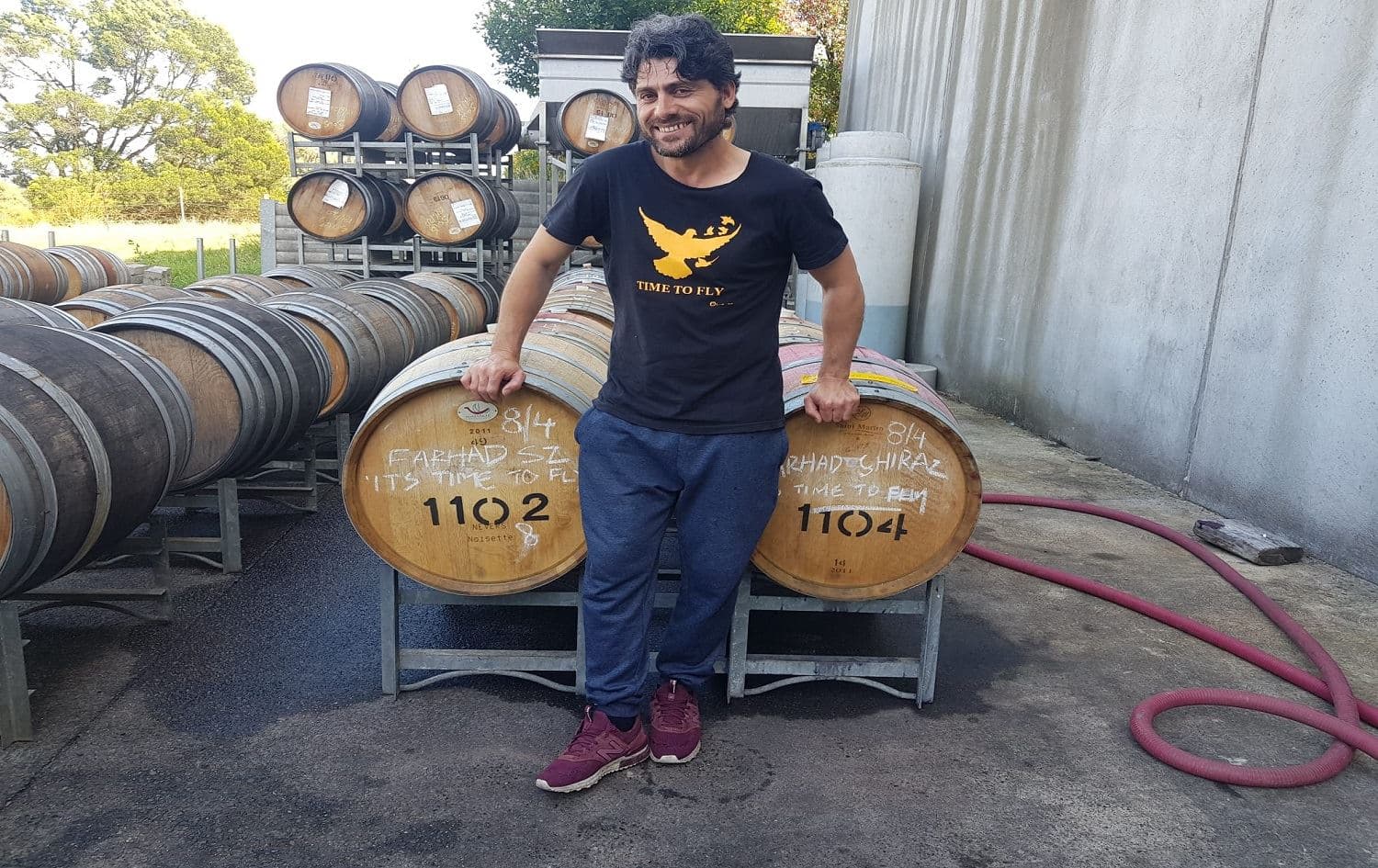

ERBIL, Kurdistan Region — After spending eight rough years in a detention center in Papua New Guinea, a Kurdish musician and asylum seeker has started his own wine-making business in Australia, producing wine with a hint of Kurdish flavor.
Farhad Bandesh left the city of Ilam in western Iran in 2013 in hopes of finding a better life in another country. Bandesh ended up in Australia, where he was transferred to Manus Island, where Australia holds asylum seekers who want to enter the country as part of an offshore processing center.
The policy of having offshore processing centers in Manus was part of Australia's 2001 Pacific Solution where people who would try to enter the country would be resettled in small islands outside mainland Australia.
The program was put on hold in 2008. However in 2013, the Australian government decided that asylum seekers who enter the country via boats without a visa shall never be settled in Australia.
Bandesh had the bad luck to enter Australia the year the policy was re-established, and he was immediately relocated to Manus Island.
He spent eight years in a detention center on the island and released six months ago on a six-month work visa to Australia.
"In this prison they made, their treatment of asylum seekers was not good," Bandesh told Rudaw's Mohammed Sheikh Fatih on Tuesday. "They made an environment that made you stressed and made you think every day of how far you are from your family and homeland."
"My time there was really tough," he added. "I would write songs in Kurdish and English during such tough times."
Bandesh started up his wine-making business after his release six-months ago.
"I started this business with a wine-making friend of mine, the wine we make has a Kurdish flavor to it," Bandesh said. "Since I am a Kurd, I make my wine the Kurdish way and I want to make this project greater so my wine can go to other countries as well."
"When I say Kurdish, I mean the traditional way of wine making where we use more physical labor," he told Rudaw English on Tuesday. "Now in many countries they use developed devices, but we try to maintain most of the physical labor just like the old times."
Five to six people work in Bandesh's business and according to his predictions, he will be able to sell the wine in five months.
"I started this business with $10,000 and I have five to six people working in the business," Bandesh said.
"For example with one ton of fresh grapes, we can make around 800 to 900 liters of wine."
Bandesh's business for now is only dedicated to the production of different varieties of red wine.
"For now I have only made red wine, I have made Cabernet Sauvignon, Sierra wine, and Shiraz ... in four to five months we will be able to sell it," he said.
Bandesh does not only make wine, he also makes music. As he was speaking to Rudaw via zoom, he was in Sydney rehearsing for his concert scheduled on Wednesday.
"When we were on the island, we were treated like we were worse than criminals, the food, the treatment, the living conditions were bad," he told Rudaw English. "There were times when they would shoot at us and beat us up, they killed one of my closest friends."
"The message of the concert is to all those who are going through a rough time in prison, we are all humans and have rights, we should be able to exercise those rights," he said, adding that he sings in different styles such as rock, classical music, and he also sings in Kurdish with one of his songs titled "Mey," which is Kurdish for wine.
Bandesh is not the only person who has made it out of Manus Island with a story to tell. Award-winning Kurdish author Behrouz Boochani documented his experience in the detention facility where he was held for six years before gaining refugee status in New Zealand.
Additional reporting by Omar Moradi