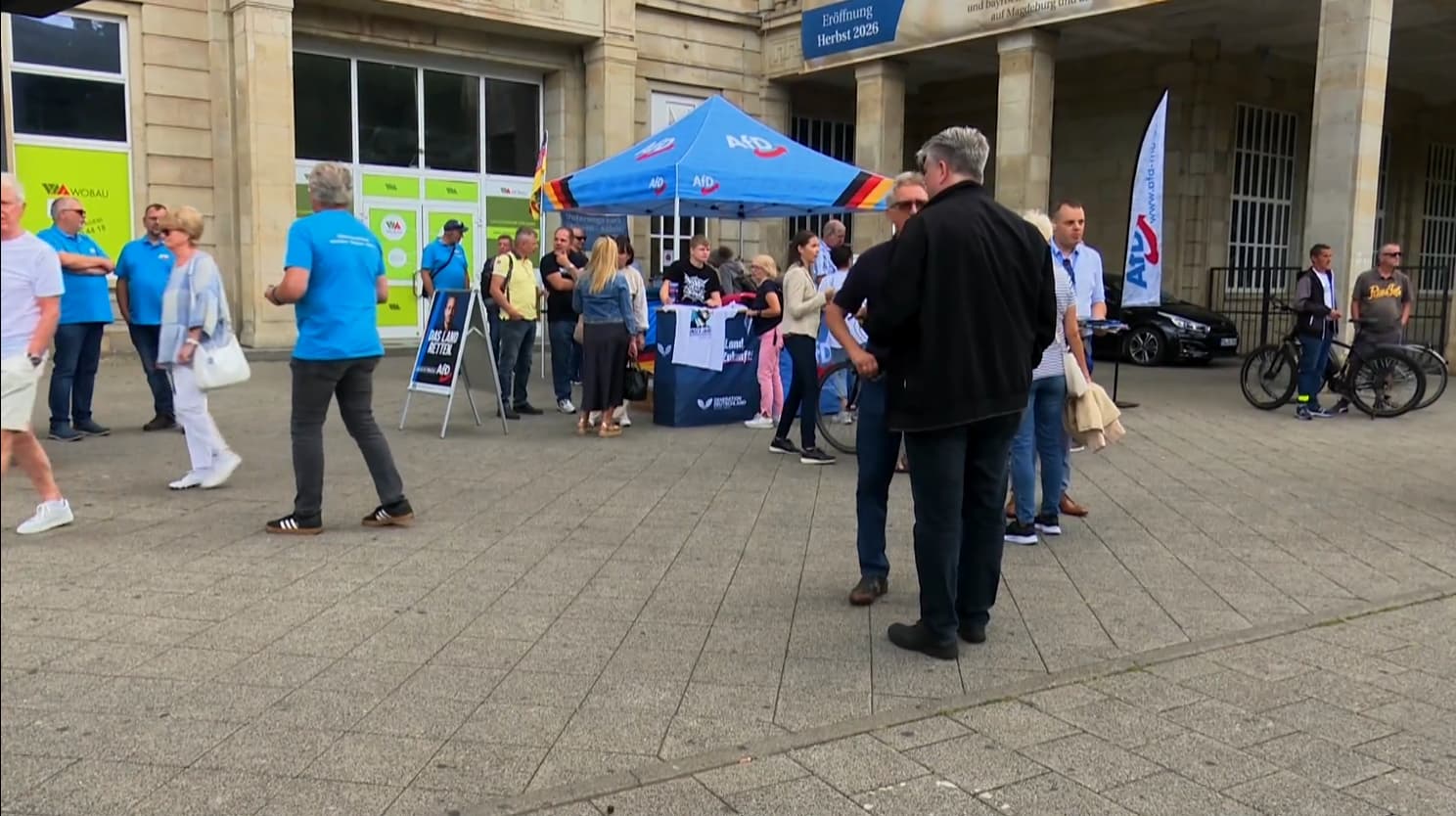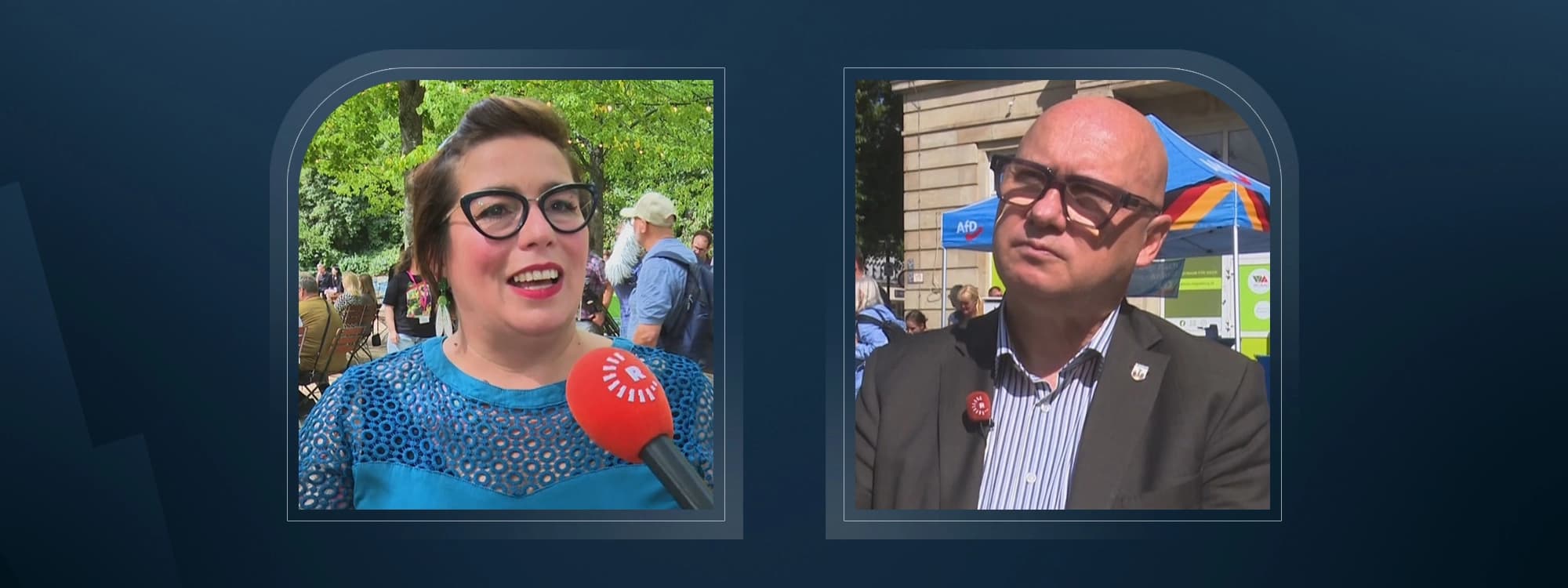

ERBIL, Kurdistan Region - In the run-up to the elections in Germany’s east-central Saxony-Anhalt region, the Green Party and the Alternative for Germany (AfD) have set out sharply contrasting visions for the state's future governance, leading figures of the parties told Rudaw, with the latter placing a bid for more votes as the former aims at maintaining status quo.
Susan Sziborra-Seidlitz, head of the Green Party list, stressed the critical need to cross the electoral threshold to ensure democratic stability.
"We are talking to 60,000 voters and more; we hope to secure 5% or more of the votes in Saxony-Anhalt," Sziborra-Seidlitz told Rudaw’s Zinar Shino on Friday. Her party holds six seats in the 97-seat state parliament.
Addressing public concerns over migration and politics, she emphasized direct engagement, stating, "We take their fears seriously, but our role is to give them courage. A far-right government might take hold, which we all fear. It could happen, and if we enter parliament, we will overcome it".
On the opposing side, Oliver Kirchner, co-leader of the AfD group in the state parliament, centered his platform on strict law enforcement and asylum policy. "Under paragraph 16a of the Basic Law, anyone who has no right to stay must leave, and rights must be revoked," Kirchner told Shino on Saturday.
He also pushed back against economic criticisms regarding his party's platform, stating, "Industrial nations need a stable energy policy to offer jobs," while criticizing reliance on solar and wind power.
When asked directly about foreign residents living and working in the region, Kirchner remarked, "For everyone who wants to be here and live like us, live in our culture, and work, we welcome them.”
Kirchner’s party has 23 seats in the state parliament.
Nearly 1.7 million people are eligible to vote in the election for Saxony-Anhalt’s state parliament.
The result is being closely watched beyond the state, as the vote could offer a broader indication of the influence of Germany’s far right on determining its future political trajectory.
Following is the full transcript of the interview with Susan Sziborra-Seidlitz, head of the Green Party list.
Rudaw: Ms. Sziborra-Seidlitz, thank you very much for your time. Why should 1.7 million eligible voters in Saxony-Anhalt give their vote to you?
Susan-Sziborra Seidlitz: We are competing for 70 thousand votes and more; of course, we are competing for five percent and very gladly for more than that of the votes in Saxony-Anhalt. And this five percent is important because, in the end, it must be decided whether, in Saxony-Anhalt, for the first time since 1945, a German state will once again be governed by the far right, or whether we will once again have a parliament in Saxony-Anhalt with a democratic majority. This depends on our 5 percent, and we are competing for that.
You are the key to these elections; how can you convince young people and those who fear the AfD and racism to go vote and choose the Greens?
We speak with people at eye level. We are present in all areas of society-among foreign communities, in the queer/rainbow community, on the side of women, alongside confident and active women, and in places where people are afraid. We talk to people in the cultural sector, with churches, and with social organizations. These are the groups that have fears and worries about a far-right government. We are in contact and exchanging views with people, taking them seriously. We take their fears seriously, but our role is also to encourage them. It is possible to prevent this far-right government that we all fear. It is possible to succeed, and if we enter parliament, this will succeed.
Are there any realistic chances of participating in the government?
The chance of participating in the government is realistic. If we are part of the state parliament, we will be part of the democratic majority that must somehow form a government. But this is a question we will deal with after September 7, and right now we are working to ensure that this democratic majority is formed.
Do you believe that after September 7, many people will migrate from Saxony-Anhalt because the AfD might win the majority of the votes?
There is no other way; the AfD will gain a large number of votes. Numerically, it might even become the winner of the elections. What is decisive is that there is a democratic majority and that the opportunity arises after September 7 to form a democratic government, because then the danger that exists, for example, for people-foreigners, as well as queer people and women-will decrease. But of course, one should not close their eyes to the fact that more than 40 percent of the people support a far-right party, which creates a feeling of threat. I understand all those people who leave the state, but I ask all of them to stay here with us, stand shoulder to shoulder, become strong together, and make sure that this state remains as colorful and beautifully diverse as always.
One final question: What went wrong on your part-the democratic parties here in Saxony-Anhalt-that you left so many votes to the right-wingers and were unable to gain them for yourselves?
The AfD gains its strength from the segment of people that we see across all European countries that hold a confirmed far-right worldview. Aside from that, there are people who do not hold a far-right worldview; they are those who perhaps have never voted until now. They are the ones who might now want to become part of a movement, or they view Mr. Siegmund [Ulrich Siegmund, leader of the AfD party list in Saxony-Anhalt] as likable, though I do not understand that.
Following is the full transcript of the interview with Oliver Kirchner, co-leader of Alternative for Germany (AfD) group.
Rudaw: Mr. Kirchner, thank you very much. As the AfD, you talk about saving Saxony-Anhalt, saving the state. Concretely, what does that mean for the people if the AfD governs this state after one year?
Oliver Kirchner: We want to return to the principle of the rule of law. We want the government to abide by rights and laws; we will do that, whereas this current government does not. It acts against Germany's existing laws by allowing mass immigration and giving money to people who migrated illegally-which Section 18 of the Immigration Act does not allow, as well as Article 16A of the Basic Law [in Germany, the constitution is called the Basic Law], stating that anyone who does not have the right to come here does not have the right to receive money. We want to change that. We also care about deporting non-Germans who commit crimes here.
Furthermore, we always involve people in issues through direct democracy and holding referendums on certain important questions in Saxony-Anhalt, because we believe our people are not stupid; rather, we should listen more to the citizens of Saxony-Anhalt and not make decisions alone, but implement what the citizens of this state want.
Mr. Kirchner, critics say that if the AfD takes over the government of this state, the region will be marginalized economically and socially. What do you say to this?
Everything related to the economy has been destroyed by this government, which pursues a wrong energy policy for our economy and allows the migration of people who want to work here.
Because they had to pay too many taxes, they migrated to Switzerland, America, and many other places; we want to bring those people back. We want to eliminate bureaucracy in the economic sector. We want some processes to be shorter than they currently are so that the middle class can take a breath and ensure job opportunities are created in the industrial sector with an energy policy that is more beneficial than the current one, which relies on solar and wind energy. In my opinion, solar and wind energy are random products that a country should never tie an industrial nation to, but rather rely on a rational energy policy to create job opportunities.
You might become the largest parliamentary group in the state parliament; which party are you ready to work with?
As the opposition, we have always submitted motion proposals and tried to participate, but all of this was blocked because the request came from the "wrong" side-from us. And we are a bit different; if we see a good request coming even from those parties, meant for the good of the citizens living in Saxony-Anhalt, we have always voted for it. Even among the Left and the Greens, there were good draft resolutions. It does not matter to us who submits the draft resolution; rather, we focus on its content. If we form the government alone, we will implement our own government program. If that does not happen, we are open to any party that wants to make better policies for these citizens with us.
I came to Germany 27 years ago, and if I had not been forced to leave due to my studies, I would still be living in the capital of Saxony-Anhalt. Would you or your party deport me?
I do not deport anyone who is in this country legally. And one can also talk about how, if someone enters this country illegally but is legally given a work opportunity, they could have come to the country legally and assisted us. We are open to anyone who wants to come here and live like us, live with us, and allow people to live the way our culture dictates; we welcome them.
What do you say about demands like the one Cem Ozdemir made to ban the AfD?
Who bans a party that has 42 percent while their own party has five percent in Saxony-Anhalt? If a party with 5 percent bans a party with 42 percent, that is ridiculous to me. I consider myself a genuine democrat; I have had no connection to the far right, and I do not know any colleagues working with us who are far-right. We simply want the situation of the people in Germany to improve-not only for Germans, but also for those people who live here with us and are citizens of this country, including Italians, Turks, and Kurds. And we make policies for them as well. The problem in Germany is that a Kurd, a Turk, or an Italian who pays taxes from their restaurant is viewed in the same light as someone who runs their affairs with a knife in a camp. We do not want that either. We want the people who pay taxes here to also have the right to vote and be allowed to choose us, because we make policies for them too; therefore, I invite them to move this state forward with us, protect the social state, and this invitation is for everyone.
Mr. Kirchner, thank you very much! My last question: What do you say to the people who are concerned and somewhat afraid that you might govern this state next week?
I understand the fear of those people who live like us. I did not understand why the Turkish restaurants in Hasselbachplatz [a neighborhood in the city of Magdeburg] closed down to demonstrate against the AfD and marched through the city alongside people carrying the flag of the MLPD-the Marxist-Leninist Party of Germany. In my view, these foreigners are allowing themselves to be used by the traditional Left. As I said, I make policies for everyone who wants to live with us like us. Anyone who wants to talk to us is welcome. I go to the owner of any Turkish restaurant and talk to them; they are not the target. The real target is those foreigners who came here illegally and want to misuse our social system. Half of the beneficiaries of our social assistance system consist of non-Germans who misuse it, and we do not want this. Even if this happened in Turkey or Iran, they would not like it, and no country wants to be exploited. Those who want to work with us are welcome, let us work together and formulate policies together; but those who are illegal and criminals, I want to return them to where they belong.
.png&w=3840&q=75)