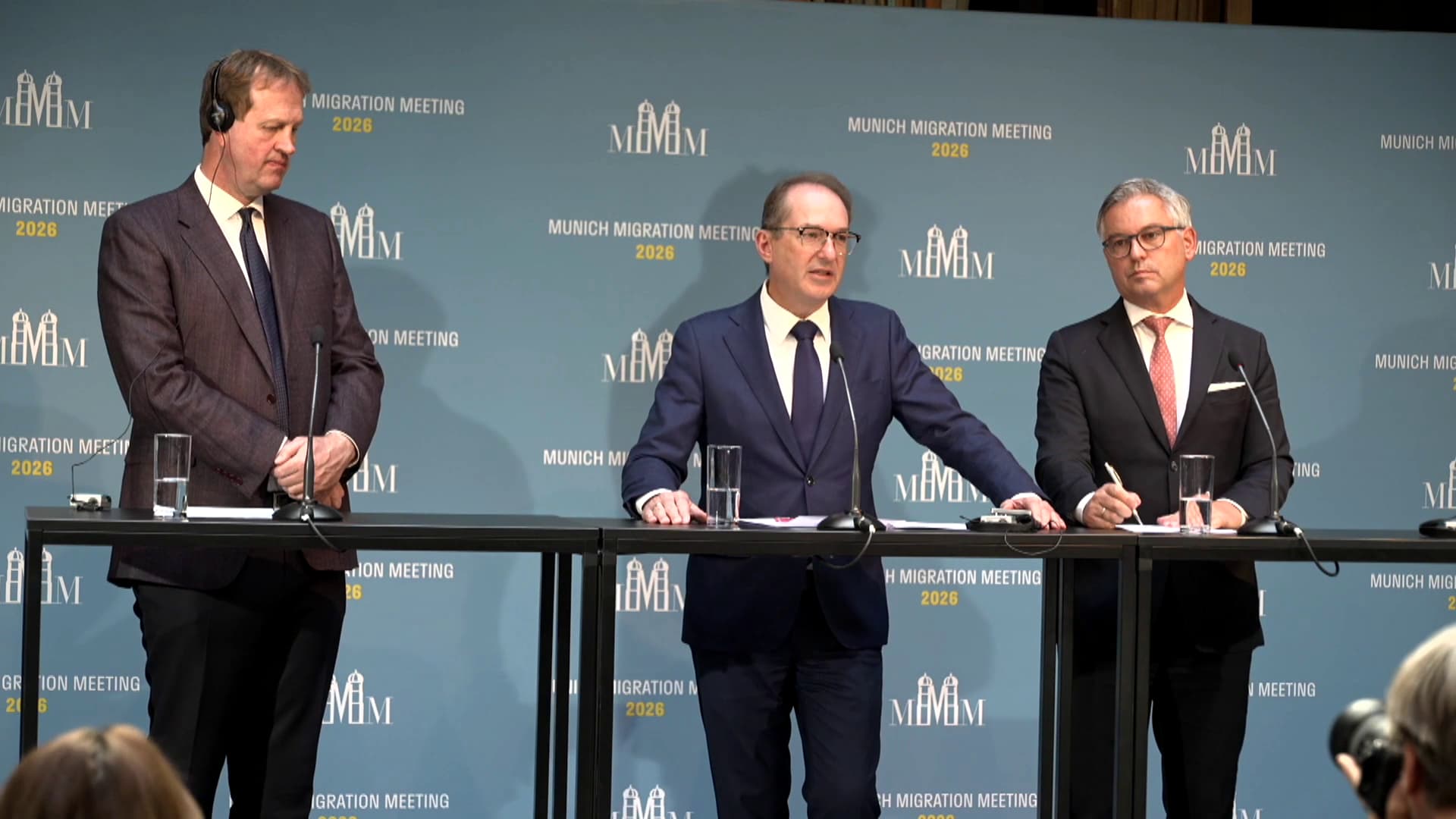
ERBIL, Kurdistan Region - Interior ministers from 17 European countries and senior European Union officials on Saturday gathered in the German city of Munich for a migration summit focused on strengthening border controls, accelerating deportations and implementing the bloc’s new migration system.
The meeting, the second summit dedicated to migration, focused on speeding up implementation of the European Union’s Pact on Migration and Asylum, which aims to overhaul how the bloc manages asylum seekers and irregular migration.
Discussions centered on strengthening the EU’s external borders, accelerating deportations and streamlining procedures for returning people whose asylum applications are rejected or who otherwise have no legal right to remain.
Jim O’Callaghan, Ireland’s Minister for Justice, Home Affairs and Migration, was among the officials attending the meeting.
“It was a very interesting meeting... Very useful exchange of views, and I was very happy to be here since Ireland at present holds the presidency of the Council of the European Union. I thought it was important to be here, and we had a very good exchange of views on a number of important issues in relation to migration,” he told Rudaw’s Alla Shally.
He said the EU is united and determined to tackle the migration issue.
Magnus Brunner, European Commissioner for Internal Affairs and Migration, said tighter migration policies were already having an impact.
“It is clear that the shift in Europe’s migration policy has had an impact, and the figures are declining. Irregular migration has fallen by 55 percent. The process of returning migrants [deportations] is working much better,” Brunner said.
He said officials also discussed priorities for the coming months, including giving the EU border agency Frontex a new mandate to allow it to operate more rapidly and flexibly.
“The member states represented here today are all working in the same direction and are united,” Brunner said.
“We must use all our strength and determination to curb irregular migration, human trafficking and the activities of smugglers, while at the same time providing legal pathways so that people can come to Europe legally to join our labor markets, because we need them,” he added.
Brunner stressed that the bloc must also continue to provide protection to people who genuinely qualify for it.
Several European countries, including Germany, the Netherlands, Greece, Austria and Denmark, have pushed for so-called “return hubs” outside the EU, where migrants with no legal right to remain in the bloc could potentially be transferred pending their return.
Rwanda is among the countries that have been discussed in Europe in connection with efforts to process or return migrants outside the bloc.
Migration has become an increasingly prominent political issue across Europe, prompting several governments to tighten asylum rules, reinforce border controls and seek agreements with countries outside the EU to curb irregular arrivals.
The EU’s Pact on Migration and Asylum, adopted in 2024, is intended to establish common rules for managing arrivals, processing asylum applications and sharing responsibility among member states.