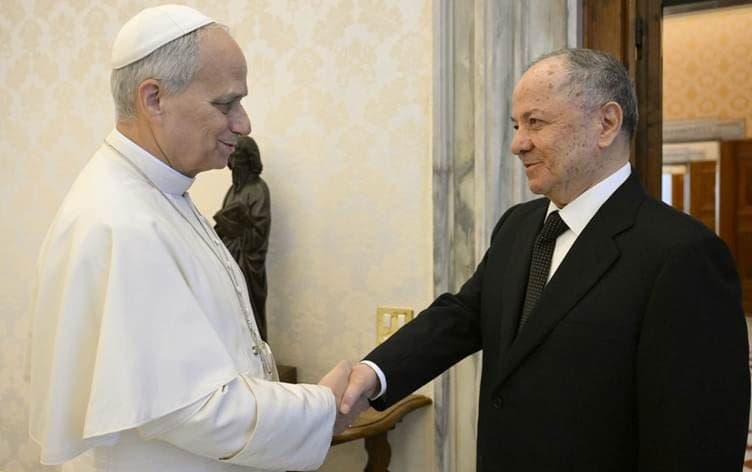

ERBIL, Kurdistan Region - President Masoud Barzani met with Pope Leo XIV at the Vatican on Wednesday, requesting “his support” for Syrian Kurds amid ongoing clashes between the Kurdish-led Syrian Democratic Forces (SDF) and armed factions aligned with Damascus.
President Barzani emphasized that he sought the pontiff’s backing “through his immaterial powers,” highlighting the moral and spiritual support he hoped to receive for the Kurdish people.
The visit marked Barzani’s second meeting with the Vatican; he previously met Pope Francis in 2014.
Accompanying him this time was Ano Abdoka, a Chaldean Christian. Barzani, who leads the Kurdistan Democratic Party (KDP), is a key figure in the Kurdistan Region’s political landscape.
Iraq’s Christian population has suffered greatly over the past two decades. Following the US-led invasion in 2003, sectarian violence forced many Christians to flee, while attacks by the Islamic State (ISIS) in 2014 particularly devastated minority communities.
According to data obtained by Rudaw English from Erbil’s Chaldean Archbishop Bashar Matti Warda in 2022, fewer than 300,000 Christians remain in Iraq today.
Tensions in Syria
President Barzani’s Vatican visit comes amid ongoing military escalations in northeastern Syria (Rojava), where Syrian army forces and allied groups have intensified operations against the SDF. Hostilities began with a mid-January campaign east of Aleppo and have since spread toward Raqqa, Deir ez-Zor, and Hasaka.
Syrian interim President Ahmed al-Sharaa said on Sunday that he had signed a 14-point agreement with SDF Commander Mazloum Abdi aimed at “immediately” halting violence and integrating SDF-administered areas into state institutions. The agreement includes transferring responsibility for ISIS detainees to Damascus, though discussions on full implementation are ongoing.
On Tuesday, President Barzani and Sharaa held a telephone conversation to discuss regional developments and measures to strengthen stability and security, according to statements from the Syrian Presidency.
Speaking to reporters after his Vatican meeting, Barzani said he urged Sharaa to prevent the ongoing tensions from escalating into “a war between Kurds and Arabs.”
He added that he told Sharaa “Kurds must be left unharmed” and called for “all problems to be resolved through dialogue.”