

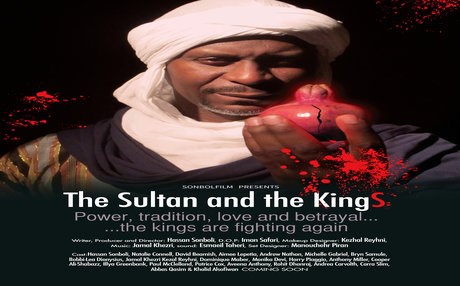
BARCELONA, Spain - For Hassan Sonboli, a Kurdish immigrant in Australia, the completion of his first independent feature film is the realization of a dream nurtured since boyhood in Iran.
The Sultan and the Kings is ready for its debut since completing post-production in March, said Sonboli, who was born in the city of Mahabad in Iranian Kurdistan in 1970.
“During my filmmaking career I have made more than 20 short films and documentaries, and The Sultan and the Kings is my first independent feature film made in Australia,” Sonboli told Rudaw.
He wrote, produced and directed the 77-minute English-language film. The Kurdish-Australian production was facilitated and sponsored by the Griffith Film School in Brisbane, Australia.
It is the story of Yusuf, a freelance filmmaker who discovers a small box in the basement of his home. He finds documents proving he is related to the great King Saladin, the heroic 12th century founder of the Ayubbid dynasty, who was a Kurd. The adventure begins when Yusuf’s find attracts the attention of a terrorist group.
Sonboli called the film part history, part docudrama and partly a musical.
Through symbols and iconic historical figures such as Saladin and King Richard the Lion Heart, Sonboli addresses current issues in the Middle East, including the problem of terrorism in the region and the world. He juxtaposes religion with Kurdish liberalism and independence.
“I worked on this film for about two years,” said Sonboli, who is part of the movie’s Eastern and Western cast of actors.
As a boy in Mahabad, it was through acting that Sonboli became smitten with filmmaking.
“I was attracted to movies when I was about eight-years-old, so I started acting in the only local theater, which was available through the only library in our city,” he recalled. “At that time, I thought that movies were made by the actors themselves. That is why I decided to join the local theater.”
Before getting any studies or training in filmmaking, he decided to make a film. He bought some film, borrowed a Super 8 camera from a local photographer and shot his first short piece.
“Surprisingly, it was accepted at a film festival and this was my first attempt and experience to get into a film festival,” Sonboli recalled.
When the Iranian Youth Cinema Society opened in his city he was the first person to excitedly enroll. He began studying filmmaking and photography, later earning awards and achievements in both fields, while also remaining busy with scriptwriting.
“Later on I migrated to Australia to start a new life. So I decided to study film academically,” he said.
For his Master’s degree in filmmaking, which he completed with honors, he made a 14-minute film called Pawana, a Girl from Halabja.
“It has been about four years now that I am studying for my Doctorate, which I am about to finish soon,” he said, explaining that he has been busy making films during that time.
First he made a 14-minute docudrama called A Woman with a Digital Camera and now he is waiting for The Sultan and the Kings to debut.

Comments
Rudaw moderates all comments submitted on our website. We welcome comments which are relevant to the article and encourage further discussion about the issues that matter to you. We also welcome constructive criticism about Rudaw.
To be approved for publication, however, your comments must meet our community guidelines.
We will not tolerate the following: profanity, threats, personal attacks, vulgarity, abuse (such as sexism, racism, homophobia or xenophobia), or commercial or personal promotion.
Comments that do not meet our guidelines will be rejected. Comments are not edited – they are either approved or rejected.
Post a comment