


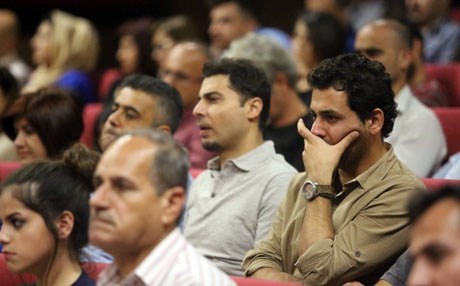
SULAIMANI, Kurdistan Region—To revive the city’s film culture and give moviegoers another option, a publishing house in Sulaimani has turned part of the building into a movie theater with affordable tickets for a mix of Kurdish and foreign films.
The screening of Letter to the King, a film made by Kurdish director Hisham Zaman about the story of five migrants in a Norwegian refugee camp drew scores of people to the new cinema inside the Sardam publishing house.
The cinema project was the brainchild of the Ghazalnus literary center.
Movie goers have the option to buy single tickets for 5,000 Iraqi dinars or buy a monthly membership for 30,000 (US$25) which would allow them to see 10 films a month.
Nabaz Khalid from the Salim cinema management told Rudaw that they have set such affordable prices because they have taken into consideration people’s financial difficulties and also because they want as many people as possible to watch their movies.
“The opening of this cinema is a good thing, and that is a step towards creating a cinema culture,” Kia Ksar, who lined up with his wife outside the ticket booth to watch Letter to the King told Rudaw.
Ksar complained that the media has ignored the cinema and the world of films, but grateful for a small project like this.
Khalid said that the films also screen at different times throughout the month in order to match people’s personal schedules and so that everyone has a chance to see the film they want.
Sulaimani city was once known for its three popular cinemas: Sirwan, Rashid and Dilshad. But in recent years two of them were torn down and the site turned into shopping centers for their downtown locations.
Dana Fayaq, a Kurdish writer said that there was not much of a public protest or outcry against the demolition of these decades-old cinemas mainly because the Kurdish society looks down on the culture of cinema and film fans alike.
They see a cinema is a place of sin.
“We think those who go to the cinema are street people and we look at it as an act of immorality,” said Fayaq.
As a story writer, Fayaq believes that people like him have a part to play in changing the public perception and showing the positive side of the cinema.
“As far as I am aware, the staff here seek movies with high quality and want to engage viewers,” he said of the Sardam cinema project. “The cinemas remain empty because people don’t differentiate between the home screen and cinema screen. But we have to know the differences are big. They don’t know the joy of watching movies on the big screen.”
Kurdish director Shawkat Amin Korki whose new and award-winning film A Place to Play was next in the queue at the Sardam cinema hailed the opening of this small affordable theater as a big step.
“The cinema is in crisis and the cinemas opened in the last five or six years have shown more American movies,” Korki told Rudaw. “But the current cinema tries to screen artistic movies. This has to be applauded.”
Korki thought this first step has a long way to go as “there exists a big gap between the cinema and the viewers.”
Korki believes that for two decades people in Kurdistan have relied on television for film but that it is time to switch to the cinema screen which he said projects like this could help.
It would be a place, he said, for Kurds to see Kurdish films that have only been premiered at foreign film festivals abroad and still unknown to the local audience.
The Ghazalnus cultural center plans to show foreign films too and for this it has set up a team of 25 translators to provide Kurdish subtitles.
Comments
Rudaw moderates all comments submitted on our website. We welcome comments which are relevant to the article and encourage further discussion about the issues that matter to you. We also welcome constructive criticism about Rudaw.
To be approved for publication, however, your comments must meet our community guidelines.
We will not tolerate the following: profanity, threats, personal attacks, vulgarity, abuse (such as sexism, racism, homophobia or xenophobia), or commercial or personal promotion.
Comments that do not meet our guidelines will be rejected. Comments are not edited – they are either approved or rejected.
Post a comment