


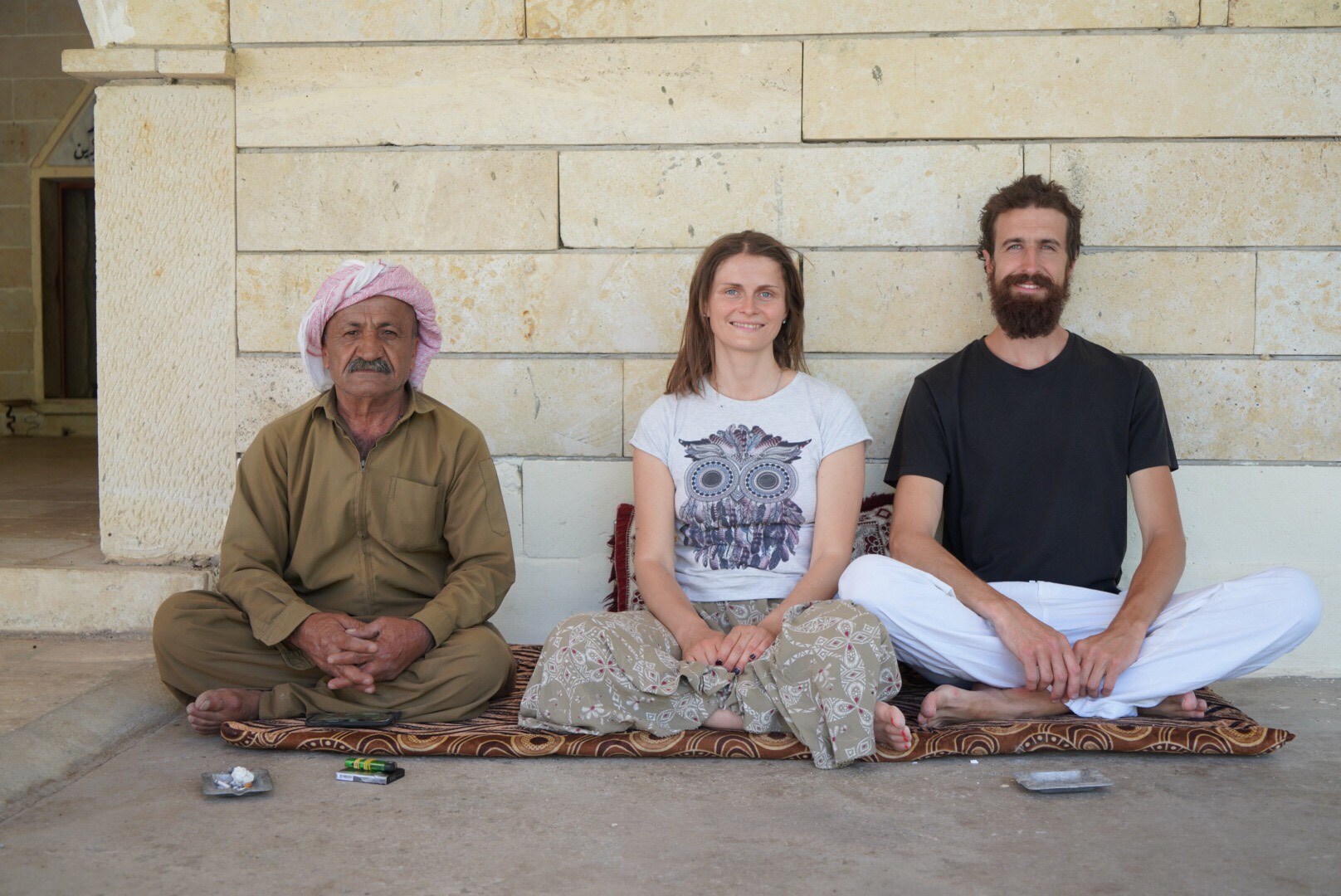
We didn’t tell our families that we were going to Kurdistan. War has been a major topic of news coming out of the region for decades, and we didn’t want our parents and friends thousands of kilometers away – in Argentina and Russia – to worry about us. So we decided to go to Kurdistan and see everything with our own eyes.
The old Volkswagen bus we’ve been traveling in had some mechanical problems, so we were still a bit scared of getting stuck in the middle of the road, even though all my Kurdish friends assured us it was safe. We had felt this fear before: crossing from Colombia to Panama next to the Darien Gap--an area notorious for its drugs, arms, and human trafficking--driving through some zones of Peru, El Salvador, Honduras and Mexico. All those areas can be very unsafe, but in this case our fear was more about the unknown than a specific danger.
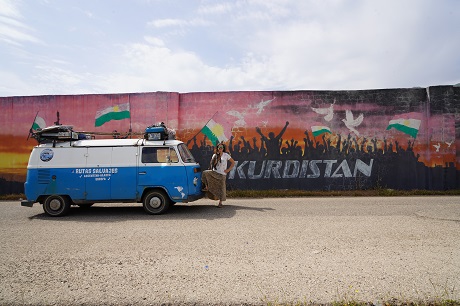
Volkswagen bus in front of mural. Photo: from the authors
In the end, we tried to leave our fears behind and headed to the border through eastern Turkey, where Turkish forces are currently fighting the Kurdistan Workers’ Party (PKK) in the mountains. The atmosphere is very tense, and there is a military base and a checkpoint every 50 kilometers. At one of the checkpoints, a policeman asked where we were going. “Kurdistan,” we replied and immediately saw his face change. “Republic of Turkey, no Kurdistan,” he said. “Ok, but we are going to Erbil, Kurdistan,” we clarified. “Iraq. You are going to Iraq,” he insisted. From then on we tried to avoid the “K-word” and just used Erbil instead.
Three days and dozens of checkpoints later, we finally reached Kurdistan. We stopped at a park in a small town near Dohuk and almost immediately became the local attraction. Some people brought us water, others brought us ice cream. Then two Peshmerga appeared and invited us to have dinner with them. It was Ramadan, and I got a sense that every dinner was a little celebration of the end of another day of fasting. We were glad to share in that celebration. With no language in common we became masters in pantomime that evening. We managed to talk about families, everyone’s kids, countries we visited, and our future plans. After dinner the Peshmerga offered us a shower – a rare and important thing for a traveler, especially in the Middle Eastern heat.
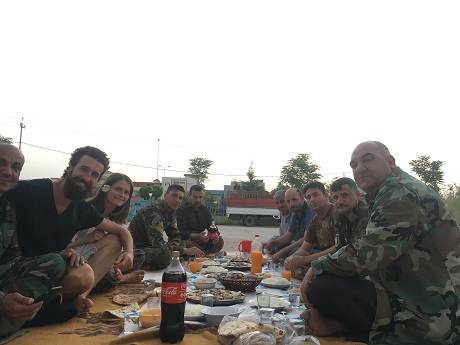
Dinner with Peshmerga
Lalish was our next stop. We just wanted to explore it a little bit on our own, but were lucky enough to meet Luqman, a Yazidi journalist and teacher, who offered to show us around. A Yazidi priest and a nun gave us breakfast, then some people invited us for lunch. We stayed at Luqman’s house that night and met his family and friends.
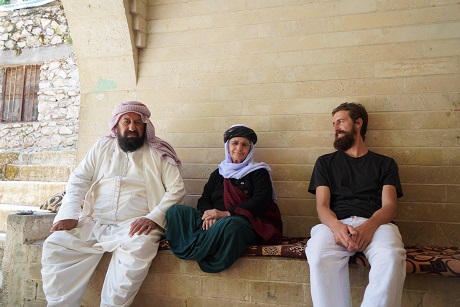
In Lalish with Shekhe Wazir (priest) and Dai Asmar (nun) Photo: from the authors
Every day of the entire week we stayed in Kurdistan, we were amazed by the hospitality of Kurdish people. They invited us to their houses, fed us delicious food and taught us a lot about local history and culture. Soccer was an obligatory topic of every conversation. “Looks like Kurds are bigger fans of the Argentina national team than us,” Franco would say jokingly. When our soccer team played a game in Argentina our friends stayed up all night with us to watch the match at 3 am.
Safety was another thing that surprised us. People kept doors of their houses open and we left the van in the street, sometimes unlocked, and nothing ever happened. Nothing in Kurdistan reminded us that these people just finished fighting a four-year war against the Islamic State (ISIS). However, after talking with people we realized that besides joyfulness, hospitality and openness there was also fear and uncertainty. “Still, every single day I’m scared for my family,” Luqman told us when we asked him about the war against ISIS.
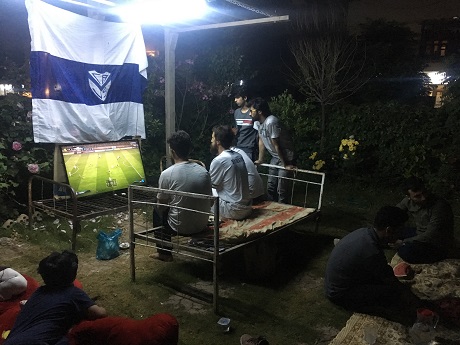
Playing PlayStation before watching soccer at 3 am. Photo: from the authors
Maybe it’s because of the fact that this region has witnessed more war than peace over the past few decades, but people somehow manage to do what appears impossible: enjoy life and feel fearful at the same time. While they enjoy the present, they seem constantly worried about their uncertain future. If even after all this violence Kurdistan and its people are so welcoming and generous, what would it be like if they had a lasting peace?
By Olga Khrustaleva and Franco Paltrinieri
Comments
Rudaw moderates all comments submitted on our website. We welcome comments which are relevant to the article and encourage further discussion about the issues that matter to you. We also welcome constructive criticism about Rudaw.
To be approved for publication, however, your comments must meet our community guidelines.
We will not tolerate the following: profanity, threats, personal attacks, vulgarity, abuse (such as sexism, racism, homophobia or xenophobia), or commercial or personal promotion.
Comments that do not meet our guidelines will be rejected. Comments are not edited – they are either approved or rejected.
Post a comment