


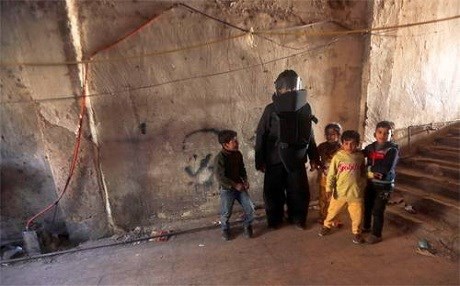
ERBIL, Kurdistan Region—A Baghdad artist has created a bomb disposal suit as a piece of performance art to bring attention to the risks Iraqi citizens face as they go about their daily lives.
Hussein Adil, 20, came up with the idea to build and wear the suit around Baghdad after a close friend was killed in a suicide car bombing last year.
In his art, Adil hopes to draw attention to the people’s need for protection. "I wanted to show the public what we have come to,” he was quoted as saying by AFP, “…and plant this question in their heads: what if we all looked like this?"
Adil and three friends were on their way to drink tea at a café in the Karrada neighborhood of Baghdad. Adil paused to take an important phone call and told his friends he would meet them at the café. Moments later, he heard the explosion that killed his friend Ammar al-Shahbander.
Al-Shahbander was the Iraq country director for the Institute for War and Peace Reporting (IWPR) who died in that bombing May last year.
Over 2,500 people died from violence in Baghdad in 2015, according to Iraq Body Count, an organization documenting the violent deaths of Iraqis since the United States’ 2003 military intervention. Of those killed in 2015, over 1600 died in explosions and over 200 were killed in suicide attacks in the city.
Adil constructed the bulky suit, including helmet and visor, himself, “because there aren't many bomb suits in Iraq," he said, noting ironically, "We have to be one of the countries in the world that needs them the most."
His friend, Muslim, wears the suit, drinks tea, visits shops and says to people that he found some level of security inside the mock-protective gear. "I knew it wasn't a real suit,” he said. “But at one point I actually felt it was protecting me and started imagining all the things I could do."
Muslim attracts mixed attention when he is out in the suit. Some are amused by him, others look worried, and some barely acknowledge the odd outfit.
Adil is repeating the performance in various locations throughout Baghdad and is planning a photo exhibition.
Comments
Rudaw moderates all comments submitted on our website. We welcome comments which are relevant to the article and encourage further discussion about the issues that matter to you. We also welcome constructive criticism about Rudaw.
To be approved for publication, however, your comments must meet our community guidelines.
We will not tolerate the following: profanity, threats, personal attacks, vulgarity, abuse (such as sexism, racism, homophobia or xenophobia), or commercial or personal promotion.
Comments that do not meet our guidelines will be rejected. Comments are not edited – they are either approved or rejected.
Post a comment