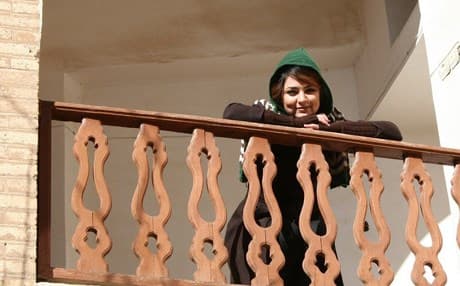
Chiman Rahmani is a Kurdish singer from Sarpol-e Zahab in Kermanshah, a predominately Kurdish province in western Iran (Rojhelat as it’s called by some Kurds). She spoke with Rudaw's Hiwa Salah in an interview that was published on July 22, 2019.
In the interview, Rahmani discusses her work, solo vs. group music, issues facing female artists in Iran, popular trends in music among the youth in Iran, her audience, cultural sensitivities in the Islamic Republic, and trying to bring Lurs and Kurds together because they share much in common.
“The only problem for female singers in east Kurdistan is that they cannot sing alone on stage nor have concerts because they think a woman’s voice is haram — that you shouldn’t hear woman’s voice alone,” she says.
Rahmani, who lives in Kermanshah and runs a mushroom farm, is the daughter of Yadullah Rahmani, a renowned Kurdish singer, journalist, and researcher. In addition to being an artist, Chiman Rahmani is vocal in her support for women fighting for the Kurdish struggle and against female genital mutilation.
Hiwa Salah, Rudaw: Is working within a musical group better or working solo?
Chiman Rahmani: Working with a music group is good, not only for singers, but also for musicians because you gain more experience when working with a musical group. Moreover, each member has expertise in a certain field, and they all employ their expertise towards serving the group and working on one thing…
Then why do you appear less often with musical groups?
The reason why I do not work with musical groups much is because there is not a group I could work with in Kermanshah. If you live in Tehran, there are very good groups. I currently live in Kermanshah, and it is very difficult to work with a group outside of Kermanshah. That is why I have been trying to work alone, but I have always thought group works are better.
What are the problems faced by female Rojhelati singers?
The only problem for female singers in east Kurdistan is that they cannot sing alone on stage or have concerts because they think a woman’s voice is haram — that you shouldn’t hear woman’s voice alone. We can’t publish solo albums without the approval of Iran’s cultural authorities. Otherwise, there are no other problems with which women have to struggle. There are only some families who do not permit their daughters to sing. Fortunately, this has decreased a lot now.
What do youth in Rojhelat listen to today… more classic or modern songs?
Youth in Rojhelat mostly listen to modern music. They like new styles. However, this does not mean that they have fully abandoned the original songs and music. Indigenous songs need to remain and be respected.
To what extent have Kurdish artists been able to make use of technology for recording songs?
Technology has been used and has been made use of in some works of art. Songs can now be recorded better and in a higher fidelity. Musicians can make use recording technology in a very good way. However, in some places, technology has harmed art and artists because some of those youth, who don’t have a good singing voice, use technology to tamper with their natural voice. This eventually makes singers lazy, and they will depend more on technology.
What types of people listen to your songs?
Maybe this question is difficult to answer as I don’t know if all age groups listen to my songs or not. However, I present all of my work with the strongest conviction. I use all my capabilities and power in my work so to relay my message to listeners and fans of Kurdish music and songs. Sometimes they complain as to why I don’t have romantic pieces, or some happy and halparke (Kurdish dance) songs.
However, I always want to have a human message in my songs. My first work was about the issues women face in society. My second work was about the female fighters [of Rojava] who protected themselves and their land with bravery. My third work was to respect prominent Kurdish artist Fatana Walidi. My latest work was a song to get the Lurs people closer to Kurds; trying to tell Lurs that they are not different from Kurds. That is why all of my songs contain a message.
Translation by Mohammed Rwanduzy