


By Élena-S. Eilmes
COLOGNE, Germany – Valan Raouf has been sewing dresses since she was a teenager in Kurdistan. But she turned her skills into a business after moving to Germany, catering to a growing clientele of young Kurdish women embracing fashion and tradition.
While years ago it was nearly impossible to find a seamstress if one was not lucky enough to have a skilled mother, aunt or mother-in-law, more and more Kurdish women are now offering their sewing skills.
“I feel that more and more young girls want to wear our beautiful traditional dresses,” Valan said, adding that demand “is definitely on the rise.”
With Germany hosting 800,000 Kurdish immigrants – the largest community in Europe – that is no surprise.
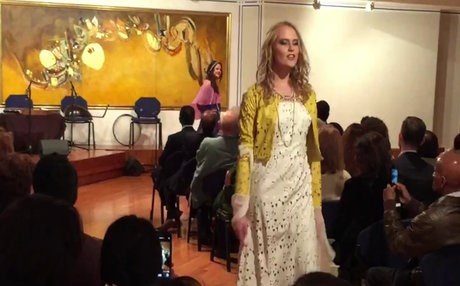
Kurdish fashion shows are held regularly across Europe. In Germany, they are mainly hosted in cities such as Berlin, Koblenz or Heilbronn, organized by seamstresses like Valan to promote their businesses, or privately by Kurds proud of their cultural heritage.
Valan’s customers are mainly young women from the Kurdistan Region (South Kurdistan), but occasionally she will make dresses for Kurds from other parts of Kurdistan, or even for non-Kurds.
Her 23-year-old daughter Vanya may be her biggest fan.
“I love Kurdish dresses. They express our culture and should be chosen over western evening gowns for Kurdish occasions,” she told Rudaw.
“My mother brings back fabric from trips back home or asks my aunts to go shopping for her and mail their findings. When not travelling, she will also visit local fabric markets and select fabrics that will look gorgeous made into a Kurdish dress,” she explained. “And there is always the internet.”
Vendors based in Erbil and Sulaimani with an established local clientele are also recognizing the signs of the times, slowly starting to offer mailing services to customers in Europe.
As she caters to a customer, Valan carefully unfolds a length of embroidered velvet before the client, juxtaposing it against a piece of chiffon in the matching color. She is one of the very few seamstresses in Germany who can sew the complicated style worn in East Kurdistan (in Iran), whose top is fitted to the body.
She tells the anecdote of a customer who held onto two pieces of prized, heavily embroidered fabric until she was sure of her skills. Before parting with the cloth, she tested Valan’s skills on a simpler dress first.
Even in the Kurdistan Region, buying ready-to-wear gowns is not very popular. For festive occasions women and girls will go on shopping trips to hunt down fabric, then either sew it themselves or take it to a seamstress for a tailored fit.
Choices there are endless: dedicated areas in the bazaar will offer everything imaginable, from simple to ornate, plain, beaded, sequined or interwoven with metallic thread.
While Kurds from South and East Kurdistan are generally used to their traditional costume and inclined to wear it occasionally even in exile, things can look very different elsewhere.
When Parez Karim, born and raised in Sulaimani, married her Kurdish husband from Turkey, she suddenly was surrounded by young women who had never seen a traditional Kurdish dress from close up.
She had grown up wearing beautiful dresses in both the eastern and classic South Kurdish style. But with the decades of Turkish repression against any symbol of Kurdish culture that eased only in the early 1990s, the rich heritage of Kurdish attire had suffered. Kurdish men in Turkey still are not allowed to wear the traditional sal u sepik and pusi -- a kind of scarf – under a ban issued earlier this year.
An engineer by day in Hanover, 28-year-old Parez started to first outfit friends and relatives who admired her personal style.
Later, she started equipping whole wedding parties and eventually began to have fabric sent from Erbil which her cousin handpicks and her mother sews.
The resulting dresses are for sale and the proceeds kindhearted Parez donates to mainly refugee children.
“I felt that I should give something back, and this gives me the opportunity to both promote our culture – one dress at a time – and help those in need at the same time. Especially with the war still going on, there is just so much demand,” she told Rudaw.
Stefanie Ba, a German in Berlin who has been involved in the Kurdish community for more than 15 years and runs a Facebook page sharing Kurdish events throughout Europe, credited social media for popularizing Kurdish fashion in the diaspora.
“When I started out with a Kurmanci folklore dance group, you really did not see many traditional dresses at North Kurdish weddings and events,” said Stefanie, who is in her early 30s. “It was usually us and a few unwavering grandmothers. But then something happened. Young women were starting to show up in Kurdish outfits, first in styles reminiscent of their own region, later in fashionable South Kurdish styles.”
For Parez, “Kurdish dresses are joy and lightness. Even during hard times, with their bold colors and sparkling embroidery, they symbolize the beauty of life.”
Comments
Rudaw moderates all comments submitted on our website. We welcome comments which are relevant to the article and encourage further discussion about the issues that matter to you. We also welcome constructive criticism about Rudaw.
To be approved for publication, however, your comments must meet our community guidelines.
We will not tolerate the following: profanity, threats, personal attacks, vulgarity, abuse (such as sexism, racism, homophobia or xenophobia), or commercial or personal promotion.
Comments that do not meet our guidelines will be rejected. Comments are not edited – they are either approved or rejected.
Post a comment