BARCELONA, Spain – Next month another war will begin in the Kurdistan Region -- but all the shooting will be on film.
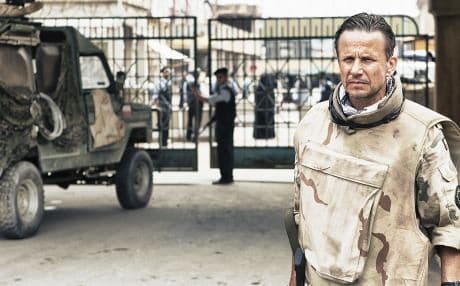
“Karbala” is a feature-length Polish production based on an event after the fall of Saddam Hussein, when a group of ill-equipped and half-starving Polish soldiers found themselves in the middle of a Shiite uprising in the holy Iraqi city.
“It is rather the story about people who were thrown into extreme conditions and didn’t expect to fight with such intensity, but they overcame their fear and just persevered to the end,” said Ziyad Raoof, the Kurdistan Regional Government (KRG) Representative in Poland.
This was the largest battle in which Polish soldiers had participated after the end of World War II.
The movie narrates the story that took place during the holy day of Ashura in April 2004, when the Shiites of Karbala rose up against the US-led multinational forces, which included a Polish contingent. The confrontation took place at Karbala’s City Hall, where the allied forces had their headquarters.
The battle lasted four days and the Poles were able to put down the uprising, despite being very poorly armed and on starvation rations. Towards the end of the battle they were aided by Bulgarian troops.
“The film is based on two threads. One is the story of the soldiers who defeated the uprising and the other the story of a paramedic accused of cowardice on the battlefield,” said Raoof.
“It is a story about the real soldiers who came here on the second shift just to somehow make some money and to sit safely. It turned out that they stood in the fire of uprising and had to overcome fear in order to maintain in some way the ethos of a soldier,” he added.
The film is directed by Krzysztof Łukaszewicz and is based on a book by Polish journalists Marcin Górka and Adam Zadworny.
Poland supported the US invasion of Iraq in 2003 and Warsaw sent 2,500 troops, mostly to help with reconstruction missions, protecting sites and training Iraqi forces.
In Poland the participation of Polish troops in Iraq has been controversial: a total of 23 Polish soldiers were killed in Iraq and an undisclosed number -- estimated at around 150 -- were wounded.
Warsaw has always said that soldiers sent to Iraq were well equipped.
But journalists Gorka and Zadworny, who interviewed dozens of sources and traveled to Iraq several times, revealed that the equipment was as old as the Warsaw Pact of 1955: the military vehicles had canvas coverings instead of armor, guns failed due to sand and soldiers’ boots cracked in the heat.
Although Gorka and Zadworny told the story of the battle in their book, and maintain that Polish and Bulgarian soldiers killed hundreds of insurgents, officially no such battle took place: the Polish Army had kept the involvement in the fighting a secret. Authorities did not want to alert public opinion at home about the reality of the Iraq War and their mission.
Polish troops withdrew from Iraq in 2008, when they had some 900 troops stationed there, down from a peak of 2,500 in the first years of the war.
Some scenes of the movie, such as pyrotechnic effects, helicopter scenes and some street scenes from Karbala have already been filmed at different locations in Poland, including a studio converted to look like a street in Karbala. Other parts of the film are to be shot in Kurdistan, in and around Erbil, said Raoof.
“Due to the dangerous and dramatic current situation in Iraq, terrain photos of this movie cannot be shot in Karbala,” he added.
Karbala will not be the first Polish film shot in Kurdistan: a Polish film about Afghanistan, directed by Patryk Vega, was recently shot in Erbil, according to Raoof.