


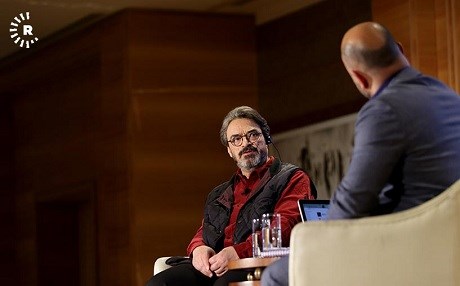
SULAIMANI, Kurdistan Region – A musician infuses his work with passion, regardless of his or her ethnicity, argued Hossein Alizadeh, prominent Iranian musician and composer whose music has been used in many Kurdish settings.
"You do not have to be a Kurd to compose Kurdish music, but the rhyme has to be compatible with the native language of the music. As a musician you have to give feeling to the music. Then, you can compose the music according to the events of the movie,” Alizadeh said during a discussion in Sulaimani on Monday, moderated by Kurdish daf player Hajar Zahawy.
In Kurdistan, the Iranian composer is best known for his album ‘Ney-Nava’ after it was used several times during commemorations of the Halabja chemical attack.
He said he did not compose the music with the genocidal Anfal campaign in mind, but “I feel proud that you have associated it with Anfal.”
Ney-Nava was released in 1983, during the Iran-Iraq war. Alizadeh said his visit to the Kurdistan Region has revived the album.
"Thirty-five years after writing this piece of music, I came to Kurdistan. All the parts of the music were revived. I was on the other side of the war, but you were on this side of the war. Our hearts were beating for each other and none of us liked this imposed war,” he said.
Alizadeh is also known for the soundtrack of the film Turtles Can Fly, set in a Kurdish refugee camp on the Iraq-Turkey border.
He plays two stringed instruments – the tar and setar.
Born in 1951, Alizadeh says that he was a child when his older brother introduced him to the instruments.
“Even though I had not even taken a single music class, I had the imagination to produce music and conduct parties. I had this connection and love since my childhood. When my teacher asked me at school what I wanted to be in the future, I said, ‘I want to be creative – one that creates anything.’”
He was just 12 when he started playing music. He studied music at the University of Tehran and later at the University of Berlin. He has performed around the world and received a number of prestigious awards for his work.
The event was sponsored by Rudaw Media Network.
"You do not have to be a Kurd to compose Kurdish music, but the rhyme has to be compatible with the native language of the music. As a musician you have to give feeling to the music. Then, you can compose the music according to the events of the movie,” Alizadeh said during a discussion in Sulaimani on Monday, moderated by Kurdish daf player Hajar Zahawy.
In Kurdistan, the Iranian composer is best known for his album ‘Ney-Nava’ after it was used several times during commemorations of the Halabja chemical attack.
He said he did not compose the music with the genocidal Anfal campaign in mind, but “I feel proud that you have associated it with Anfal.”
Ney-Nava was released in 1983, during the Iran-Iraq war. Alizadeh said his visit to the Kurdistan Region has revived the album.
"Thirty-five years after writing this piece of music, I came to Kurdistan. All the parts of the music were revived. I was on the other side of the war, but you were on this side of the war. Our hearts were beating for each other and none of us liked this imposed war,” he said.
Alizadeh is also known for the soundtrack of the film Turtles Can Fly, set in a Kurdish refugee camp on the Iraq-Turkey border.
He plays two stringed instruments – the tar and setar.
Born in 1951, Alizadeh says that he was a child when his older brother introduced him to the instruments.
“Even though I had not even taken a single music class, I had the imagination to produce music and conduct parties. I had this connection and love since my childhood. When my teacher asked me at school what I wanted to be in the future, I said, ‘I want to be creative – one that creates anything.’”
He was just 12 when he started playing music. He studied music at the University of Tehran and later at the University of Berlin. He has performed around the world and received a number of prestigious awards for his work.
The event was sponsored by Rudaw Media Network.
Comments
Rudaw moderates all comments submitted on our website. We welcome comments which are relevant to the article and encourage further discussion about the issues that matter to you. We also welcome constructive criticism about Rudaw.
To be approved for publication, however, your comments must meet our community guidelines.
We will not tolerate the following: profanity, threats, personal attacks, vulgarity, abuse (such as sexism, racism, homophobia or xenophobia), or commercial or personal promotion.
Comments that do not meet our guidelines will be rejected. Comments are not edited – they are either approved or rejected.
Post a comment