


By Raed Asad Ahmed
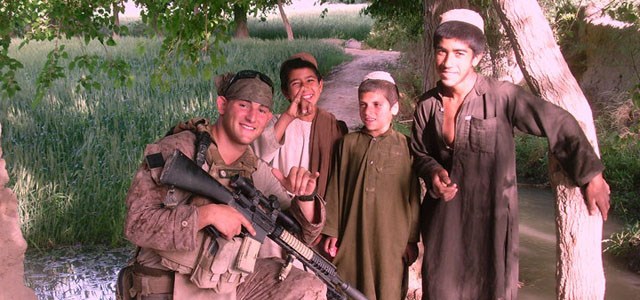
RB, whose initials were used in place of his name at his request, was born in 1989 in Mississippi. He grew up in a rural town in Mississippi where he loved hunting and fishing. He joined the military after the Spetember 11, 2001, attacks on New York and the Pentagon . He met his recruiters while playing American football, joining the Marines and serving as a Scout Sniper in Iraq and Afghanistan during 2008 and 2009. His main job was to monitor the roads at night for insurgents planting IEDs. One day in Iraq, RB was the target of an insurgent sniper at his military base. One of his fellow Marines got hit and badly injured. RB saved his injured comrade and received a Navy Marine Corps Achievement Medal. In addition to his job as a Scout Sniper, RB trained Iraqi police and army and witnessed some of the problems would later surface about the Iraqi Army and police.
RB met with Rudaw’s Raed Asad Ahmed in November in Honolulu, Hawaii, to discuss his military experience in Iraq.
Rudaw: How did you become a scout sniper?
RB: I come from a country place, a like rural place. It is in the South. I grew up hunting, fishing, you know, an outdoorsman. I joined the military in 2007, right during the surge.
How old were you back then?
19, almost 20.
How did you decide to join the military? What was the reason?
Basically I still remembered 9/11, you know, it was pretty vivid, and my dad was a military man, he was in the Air Force. I think all that played a part in it. And then there was the surge, the recruiters were actively going out to football fields, going out to schools, they were pushing really hard to increase the troop size.
That’s how you met them?
Right, they came to me. They got me on the football field.
American football?
American football.
Your current rank and unit?
I was in 1st battalion 3rd Marines. I was with 13 Scout Sniper Platoon.
Sniper platoon?
STA platoon, Surveillance Target Acquisition, that’s the politically correct term for platoon (smiling).
Why a sniper and not something else?
I had a tryout for snipers, did the end-out and made it into the platoon.
So it was based on your…was it like a desire, to become a sniper?
Yeah, kind of yeah…the movie Shooter came out in America at that time and I thought it was pretty cool.
And because you previously had experience in hunting before?
Yes, I grew up hunting my whole life. I think it kind of played into my personality, and then I was really big, bigger than a lot of the other Marines.
Could you tell us about your role in the unit?
Sniper role…the job is basically to be the direct eye, ear, and the trigger finger for battalion commander. It is basically to relay data, you know, to relay information. That’s why it is called STA Platoon, Surveillance Target Acquisition, because mostly the primary job is surveillance, watching and then relaying information via the radio.
How many times were you deployed?
Twice, once to Iraq and once to Afghanistan.
To Iraq? What year?
2008 and 2009.
Anything interesting happen to you in Iraq?
Yeah, we had a lot of IEDs [Improvised Explosive Device] emplacement. That was the main thing that I was doing when I was there.
What was the most interesting thing that happened to you?
Once we got hit by an IED, and it popped up the back tire.
Where?
MSR Michigan…that’s what we call it.
Michigan?
So, the roads to me might not be the same roads to you because the roads to me are in military terms.
Which city?
Fallujah.
So you were hit by an IED, what happened?
It just popped the back tire.
That was the most interesting thing?
No, no, no. We still had guys put IEDs at night, and that was our job, to watch. Our primary job was to watch the roads at night, because we watched with thermals, night-vision so we could see them digging IEDs.
I also saved a Marine. That was one thing I am most proud of.
How did it happen?
He was hit by a sniper on our base.
So you were not out patrolling or anything, you were on your base?
Yes, and we were stretching C-wire. It was totally unexpected. I knew what it felt like to be on the other end of the scope, you know. That was kind of the craziest thing that happened to me.
So, a fellow Marine was hit by a sniper, then what did you do?
So we were stretching C-wire, Concertino wire, on the top of the wall.
And the way you do it is you stretch the wire and put a sandbag, you stretch the wire and put a sand bag, you stretch the wire and put a sand bag…(takes a deep breath)… They got us in the middle of this wall and the wall was like 3 miles long, and they hit him right in the middle, so the only exit was on the south gate and we were on the north wall. We were stuck. We were basically trapped when they hit us. The Marine fell to the enemy side, he fell to the outside of the wall. And I knew it was a sniper because I was a sniper, you know. And if you start to go over the wall, that’s what he wants. He is going to take more people out. I climbed on top of the wall and I began throwing sandbags over the wall, you know, to stack sandbags in front of him [the injured Marine] so we were able to help him. We gave him a tourniquet. We saved him [and] he is still alive.
How did it make you feel?
It definitely changed my whole...
Perspective?
Right, because I was hit… I saw what it was like to be on the other side of the sniper’s rifle.
Were you involved in a shootout or intense combat situation?
Oh yeah. We faced some AK-47, in a situation what we call spray-and-pray, pop-up and then go behind the wall, they ditch the AK somewhere then we don’t know who it was. It was hard to prove. So, what do you do, what do you do? Detain everybody? It is an insurgency.
Do snipers count their kills?
Yeah, they do. It comes from a historical thing. But I don’t think, today it is not really a big thing like it was initially. Like Carlos Hathcock, White-Feather, he was the man who created the Scout Sniper Program in Vietnam. Back then, they did count. Carlos Hathcock had 93 confirmed kills. He was the father of the Scout Sniper Program.
So do you count your kills?
Yes, I guess so. You count the people you shoot at, you can’t really confirm how many people you killed. I shot a lot of people, but how many people I killed, is questionable.
How does it feel when you kill someone? Does it make you feel bad?
It does, but then you have to think how many Marines have you saved. How many army soldiers you saved by taking out that guy that was going to blow up a whole convoy, or blow up a truck. I lost Marines to IEDs like that, so I know.
So when snipers locate a target, do they have the initiative to take him out immediately?
No, normally we always try to detain him. We don’t want to shoot him.
That is the last thing and usually never happens because we mostly detain him. We call the Iraqi police, the Iraqi Army or the Afghan police or the Afghan Army (AA), we have acronyms so I am used to the acronyms. We call the Iraqi police (IP).
So how did your military service change you life as a person?
(Pauses). It did in several ways. It made me more aware of the world. I was from a really small country place in Mississippi. I was pretty ignorant to the world, you know. I had a very Orientalist view of the Middle East. I was from the Bible Belt of the South. So, when I went to Iraq, I thought ‘Oh, I am in the Bible,’ you know... because you hear these stories growing up as a Christian, and I definitely had an Orientalist view. And then, seeing how much modern and how people thought in the way they were, you know, it just changes your whole perception of the world. I had a very American-centric view of the world. I think it changed me a lot.
So After you came back to the city, how do you see life? Is it different than before?
No. Not really.
Do you remember your combat friends?
Oh yeah, that is probably the hardest thing. I don’t think I will ever have the friendship, and the camaraderie that I had with those guys, never, because you go through so much hell together, especially if you are the same group, the same generation. You go through the same tryouts together. You go to the same schools together. You go through the same torment together. You become so close to each other, and I am still friends with those guys today. We usually move off all over.
Why do you think American soldiers join those private contractors?
I think some of them for money, and some of them probably for that mentality, that…you know, I think America is very pro-guns, pro… I don’t know. I am pro-gun myself.
About your service in Iraq, how long did you stay there?
Seven months, about seven months. I was there during the surge, 2008. But I was not in the initial invasion.
How extensive was your contact with the people there?
Pretty extensive, a lot of questionnaire and pamphlets for security. We had a lot of interaction with the Iraqi police, a lot of interchange with the police and the army. We have trained them, we have taught them, and we took them on patrols.
So how do you evaluate the Iraqi police?
(Long sigh) I think they were terrible.
And the reason you think they were terrible?
It is hard. You know, that is the question. We all asked ourselves that. We all sat drinking beer and wondering like why those [expletive deleted] were so horrible, we do not have an answer.
They were not motivated?
They were not motivated. Sometimes you hear the common answer that they are too backwards, right. They are just too far behind, they don’t understand. But, that’s not it, but I think they were … smart people. I don’t know what. I don’t understand.
And the Iraqi army?
The Iraqi Army was better than the Iraqi police. The Iraqi police force was a joke. The Iraqi Army was a little better. But they still have a lot of practices that are…
They lack practice?
They lack obedience. They lack discipline. And they have a lot of practices that are, I would say homosexual.
Homosexual practices?
Oh man, yeah. They do. In Afghanistan is the same way. In Afghanistan is probably even worse.
You mean during the service?
Yeah, yeah. Even the Iraqi army guys came and hit on me before. They were like feeling my flank, and I was like [get] off me…it was like…I don’t know (shaking his head)
So you said you got a medal before, what medal was that?
Yeah, it was a Navy Marine Corps Achievement Medal, we call it a NAM for short.
Are you in touch with the guy you saved?
Yeah, I still talk to him. He got his medal in service. He got his Purple Heart from George W Bush. The President gave him his purple heart.
The collapse of the Iraqi Army in that short time in Mosul, how do you explain that? They left all their weapons, their Humvees that were given to them.
I was surprised with the amount of weapons we gave them, all these weapons, Mine-Resistant Ambush Protected (MRAPs), and Humvees, that was kind of surprising, because we definitely gave them the fire power to succeed. But the infiltration over there makes it so hard. ISIS probably infiltrated the Iraqi Army because it is so easy. Because even when I was with the Iraqi police we had attacks from them as they were dressed in police uniforms, or may be they were police that changed sides. It just happens.
My final question, you see now the Kurdish Peshmarga are fighting ISIS, and they also sent Peshmarga soldiers to fight ISIS in Syria. Did you have the chance to meet some of the Kurdish Peshmarga when you were in Iraq?
No, I did not meet any Peshmargas. I did a lot of guardian angel security overmatch, and sniper over watch.
From the way you follow the news, how do you evaluate their performance?
The Peshmerga, I have always heard about them. They are great. They are warriors and fighters. They like the US and the US likes them because they have a kickass attitude. I think the US has that kind of attitude as well. I also think they don’t take any [expletive deleted] and they stand for themselves. And that was the thing we could not stand about the Iraqi Army: they could not stand and they had no backbone. They were a joke. I think the Peshmarga have a backbone. They are fighting and they are passionate. They are fighting for their homeland.
Comments
Rudaw moderates all comments submitted on our website. We welcome comments which are relevant to the article and encourage further discussion about the issues that matter to you. We also welcome constructive criticism about Rudaw.
To be approved for publication, however, your comments must meet our community guidelines.
We will not tolerate the following: profanity, threats, personal attacks, vulgarity, abuse (such as sexism, racism, homophobia or xenophobia), or commercial or personal promotion.
Comments that do not meet our guidelines will be rejected. Comments are not edited – they are either approved or rejected.
Post a comment