


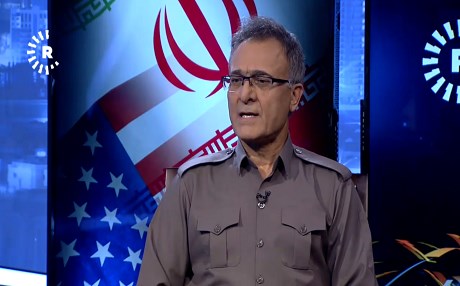
Khalid Azizi, former leader of Iran’s Kurdistan Democratic Party (KDP-Iran), says that as long as regime change in Iran is not part of the US agenda, Iran’s Kurdish parties, along with other political opposition in Iran, will remain on the American backburner.
Azizi added during the interview with Rudaw TV’s Hiwa Jamal that ran on June 12, 2019, that the international community has wrongly condensed the Iran issue into one of atomic bombs and nuclear weapons – ignoring the current regime’s human rights violations.
He attributes the inability to enact regime change in Iran to the regime’s weakening of opposition parties through expulsion abroad and repression at home.
KDP-Iran splintered from the Kurdistan Democratic Party of Iran (KDPI) in 2008. Though it does not currently see armed conflict as an option for Iranian Kurds, the KDPI’s Peshmerga have been clashing with Iranian border guards and Islamic Revolutionary Guard Corps (IRGC) since early 2015.
Have Kurdish parties or Iranian opposition parties in general, taken any precautions in the face of recent escalating tensions between Iran and the US?
Fortunately, civil movements in Iranian Kurdistan have developed greatly in the course of the past few years. Parallel to that, Kurdish parties of Iran, particularly Komala and the democrats [KDPI, KDP-Iran] have formed a Joint Coordination Center [in Koye]. Together we can become a good alternative to stand against any challenging scenarios we may face in the future.
Do you have any cross-party committees that speak on behalf of all Kurdish parties and meet with the US and Europe about upcoming events?
Sometimes we meet [officials] from the US and Europe as a group. But we have to look at the situation here. The US wants to drag
Iran to the negotiating table by imposing mounting economic, diplomatic and political pressure. They want Iran to eventually compromise. At the moment, the Americans do not plan to bring forward an alternative to Iran.
If we look back at the Iraq War era, the US had an alternative, working alongside 17 countries. They used to meet with the Iraqi opposition. They did the same thing in the case of Afghanistan. For now, the US does not have an agenda to instigate regime change [in Iran]. So long as regime change is not part of the agenda, the US will not take the Iranian opposition into account.
Why don’t the Iranian opposition parties revolt to rise up against the deterioration of Iran’s economy, people’s financial hardships, and the containment of Iran by outside powers?
A revolution took place in Iran 40 years ago. I don’t believe a new revolution is meant to imitate or become a copy paste of that revolution. There have been protests against the Iranian government with people pouring out on to streets of big cities. Such protests
have also taken place in Iranian Kurdistan. The problem is that what is being talked about right now is Iran vis-a-vis the outside world, and with the US over the nuclear issue, particularly since Trump took office as president.
We have to address the numerous potential scenarios that could pan out because of these mounting pressures on Iran. One of the scenarios is that there could be a fully-fledged war against Iran like that of Iraq, which I do not expect that to happen. Another potential scenario is that Iran may refuse to bow to pressure from America and does not respond to its warnings to come to the negotiating table or agree to conditions, in which there will be an organized, limited attack. This could end in one of two ways — Iran agreeing to come to the table, or people taking to the streets, exacerbating Iran’s problems...
There was news yesterday that there are internal problems among Iran’s Islamic Revolutionary Guard Corps. Today, there was news that Iranian intellectuals and writers have reportedly called on Khamanei to step down. So, do you not think continued pressure from the US have exacerbated Iran’s internal politics?
According to the information we have received and the information available out there, Iran is locked in a huge internal issue —
notably, economic sanctions. These financial pressures have entangled Iran and its people in a big way, this is undeniable. In the meantime, a lot of internal quarrels and problems have arisen, to the point that some people demand Khamenei go, or that fundamental laws be changed, or other some new proposal to rescue Iran from its many problems. For the time being, the regime has not let the space be created for people to instigate any change.
Do not you think it is to do with Iranian people who are angry with the government not having an opposition leader to lead them towards a regime change?
I have said plenty of times that Iran has many opposition parties, but when doing politics being on the opposition side is not an art — you have to become a real alternative. This is the main problem with Iranian opposition parties — they never became a real alternative in Tehran.
What is the reason?
There is an abundance reasons. In the beginning the Islamic Republic of Iran [in 1979], expelled most of the opposition groups, the
majority of whom have resettled in the US and Europe. Some of them have distanced themselves from Iranian society. Iranian government also silenced those in opposition operating inside Iran, including the Green Movement, Reformists, and the like. Iran repressed them all. As a result, there was no space for any opposition in or outside the country.
I would like to mention that the problem lies with the international community too as over the past few years they have narrowed down the problem of Iran to just nuclear weapons and atomic energy. They have ignored the people of Iran, its opposition groups and its strong civil movements, particularly in Kurdistan. The Islamic Republic of Iran has therefore capitalized on the absence of a strong, supported opposition, leaving no opportunity for the outside world to help find an alternative for them.
Why has the international community ignored Iran’s human rights violations and the suppression of opposition groups and instead only focused on the problem of nuclear weapons and atomic bombs?
In all the meetings we have had, particularly the last time I was in Washington and meeting with American officials, they had just
condemned the missile attacks on us [in Koya] and we thanked them. We told that that if they really sought to get rid of the problems Iran poses, including in nuclear terms, a responsible and democratic state must hold power in Tehran — one that believes in agreements. But the problem is that the [US] Democrats and the current US administration have the same policy of changing the conduct of the current Iranian regime, not a regime change. That’s the dilemma here. The USA has not had a well-conceived or productive plan.
Do you think that the Kurdish parties of Iran want to lead for change, or do they instead want a development to come from elsewhere that they can capitalize from? Have you lost hope in doing the former?
We are not hopeless. We are optimistic despite the fact that we have suffered many problems over the past 40 years as our leaders
have been terrorized, and [bases] have come under missile attacks – but we are maintaining our struggle.
Why do the Kurdish parties of Iran have little influence over Kurds in the country, compared to the PKK in Turkey?
Turkey and the PKK are very different from Iran and the Kurdish Democratic parties. Over the past few years, and at least following the missile attacks [on Koya], we called on people to protest, but people did not heed the request. There are currently massive Kurdish movements in Ilam and Kermanshah though. There are two paths before us. One is that we should capitalize on the collapse of the Iranian regime to create a space for ourselves to work in.
Azizi added during the interview with Rudaw TV’s Hiwa Jamal that ran on June 12, 2019, that the international community has wrongly condensed the Iran issue into one of atomic bombs and nuclear weapons – ignoring the current regime’s human rights violations.
He attributes the inability to enact regime change in Iran to the regime’s weakening of opposition parties through expulsion abroad and repression at home.
KDP-Iran splintered from the Kurdistan Democratic Party of Iran (KDPI) in 2008. Though it does not currently see armed conflict as an option for Iranian Kurds, the KDPI’s Peshmerga have been clashing with Iranian border guards and Islamic Revolutionary Guard Corps (IRGC) since early 2015.
Have Kurdish parties or Iranian opposition parties in general, taken any precautions in the face of recent escalating tensions between Iran and the US?
Fortunately, civil movements in Iranian Kurdistan have developed greatly in the course of the past few years. Parallel to that, Kurdish parties of Iran, particularly Komala and the democrats [KDPI, KDP-Iran] have formed a Joint Coordination Center [in Koye]. Together we can become a good alternative to stand against any challenging scenarios we may face in the future.
Do you have any cross-party committees that speak on behalf of all Kurdish parties and meet with the US and Europe about upcoming events?
Sometimes we meet [officials] from the US and Europe as a group. But we have to look at the situation here. The US wants to drag
 This could end in one of two ways
If we look back at the Iraq War era, the US had an alternative, working alongside 17 countries. They used to meet with the Iraqi opposition. They did the same thing in the case of Afghanistan. For now, the US does not have an agenda to instigate regime change [in Iran]. So long as regime change is not part of the agenda, the US will not take the Iranian opposition into account.
Why don’t the Iranian opposition parties revolt to rise up against the deterioration of Iran’s economy, people’s financial hardships, and the containment of Iran by outside powers?
A revolution took place in Iran 40 years ago. I don’t believe a new revolution is meant to imitate or become a copy paste of that revolution. There have been protests against the Iranian government with people pouring out on to streets of big cities. Such protests
The regime has not let the space be created for people to instigate any change.
We have to address the numerous potential scenarios that could pan out because of these mounting pressures on Iran. One of the scenarios is that there could be a fully-fledged war against Iran like that of Iraq, which I do not expect that to happen. Another potential scenario is that Iran may refuse to bow to pressure from America and does not respond to its warnings to come to the negotiating table or agree to conditions, in which there will be an organized, limited attack. This could end in one of two ways — Iran agreeing to come to the table, or people taking to the streets, exacerbating Iran’s problems...
There was news yesterday that there are internal problems among Iran’s Islamic Revolutionary Guard Corps. Today, there was news that Iranian intellectuals and writers have reportedly called on Khamanei to step down. So, do you not think continued pressure from the US have exacerbated Iran’s internal politics?
According to the information we have received and the information available out there, Iran is locked in a huge internal issue —
The Islamic Republic of Iran has capitalized on the absence of a strong, supported opposition
Do not you think it is to do with Iranian people who are angry with the government not having an opposition leader to lead them towards a regime change?
I have said plenty of times that Iran has many opposition parties, but when doing politics being on the opposition side is not an art — you have to become a real alternative. This is the main problem with Iranian opposition parties — they never became a real alternative in Tehran.
What is the reason?
There is an abundance reasons. In the beginning the Islamic Republic of Iran [in 1979], expelled most of the opposition groups, the
The problem is US Democrats and current US administration have the same policy of changing the conduct of the current Iranian regime, not regime change
I would like to mention that the problem lies with the international community too as over the past few years they have narrowed down the problem of Iran to just nuclear weapons and atomic energy. They have ignored the people of Iran, its opposition groups and its strong civil movements, particularly in Kurdistan. The Islamic Republic of Iran has therefore capitalized on the absence of a strong, supported opposition, leaving no opportunity for the outside world to help find an alternative for them.
Why has the international community ignored Iran’s human rights violations and the suppression of opposition groups and instead only focused on the problem of nuclear weapons and atomic bombs?
In all the meetings we have had, particularly the last time I was in Washington and meeting with American officials, they had just
We are not hopeless. We are optimistic...
Do you think that the Kurdish parties of Iran want to lead for change, or do they instead want a development to come from elsewhere that they can capitalize from? Have you lost hope in doing the former?
We are not hopeless. We are optimistic despite the fact that we have suffered many problems over the past 40 years as our leaders
Kurds in Iran and the Kurdish parties do their best to struggle within the framework of Iran
Why do the Kurdish parties of Iran have little influence over Kurds in the country, compared to the PKK in Turkey?
Turkey and the PKK are very different from Iran and the Kurdish Democratic parties. Over the past few years, and at least following the missile attacks [on Koya], we called on people to protest, but people did not heed the request. There are currently massive Kurdish movements in Ilam and Kermanshah though. There are two paths before us. One is that we should capitalize on the collapse of the Iranian regime to create a space for ourselves to work in.
The other is; if this government is not going to collapse that easily, we should not just stand idly by — we should be on the scene, persuading people not to surrender the existing civil and popular movements. I would like to say that Kurds in Iran and the Kurdish parties do their best to struggle within the framework of Iran. If we compare ourselves as Kurds and Kurdish parties in Iran to non-Kurdish opposition groups, I would say we are better prepared.
Comments
Rudaw moderates all comments submitted on our website. We welcome comments which are relevant to the article and encourage further discussion about the issues that matter to you. We also welcome constructive criticism about Rudaw.
To be approved for publication, however, your comments must meet our community guidelines.
We will not tolerate the following: profanity, threats, personal attacks, vulgarity, abuse (such as sexism, racism, homophobia or xenophobia), or commercial or personal promotion.
Comments that do not meet our guidelines will be rejected. Comments are not edited – they are either approved or rejected.
Post a comment