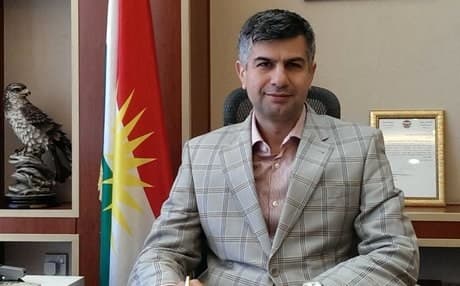
The health system in Kurdistan needs to be reorganized, and to make sure it does not collapse, help from abroad is desperately needed, says the Director General of Health in Duhok, doctor Nezar Ismet Taib. Although earlier reports about the closure of three hospitals in Duhok are not correct, he is warning that a lack of doctors is dangerously paralyzing the system. As a result, the Duhok governorate only has 4.5 doctors per every 10,000 inhabitants. This caused an enormous burden on those few, dedicated doctors, Taib says.
Rudaw: What is going so wrong with the health system that you decided to call for help?
Dr. Nezar Ismet Taib: The numbers of active doctors are decreasing, and at the same time, those of junior doctors have not been enough for Duhok for the past years. If this gap continues, we will be obliged to shut down departments and reshape hospitals, adapting their function in accordance with the needs.
Doctors who are leaving are not the main concern, that is a lack of junior doctors. For years, we have been asking the Ministry of Higher Education to focus on geographic areas and their needs when accepting medical students. And to recruit more students. But the centralized system is based on their final exam score, and when students graduate, they get recruited into their own geographic area; so if they are from Sulaymaniya, they will work there. We need to first increase the number of students at the colleges of medicine and nursing in Duhok, and also to send a higher percentage of the graduated students to Duhok.
So the main problem is with the number of new doctors?
Junior doctors have a two-year internship in the hospitals, then they go to the countryside for a year. Last year we were in need of 140 junior doctors, and only we got thirty. So we had a gap of 110 doctors. Another twenty were temporarily transferred from Erbil. As a minimum requirement, we could survive with sixty junior doctors, but now we have not even had fifty. And we lose the juniors again when they leave for the countryside, yet if they do not go there, those hospitals will have problems. The gap is getting bigger every year. This year University of Duhok College of Medicine accepted 115 medical students, who will graduate in six years’ time, with some of them not succeeding of course…
To overcome the problem, a short term solution would be to redistribute the junior doctors according to the needs of the hospitals, encouraging doctors to stay, and others from the rest of Iraq to come and work here. For the long term, the development of the health sector needs to be planned.
With the internally displaced fleeing the Islamic group ISIS, also doctors came to the Kurdistan Region. What happened to them?
The government in Baghdad first decided that they could only be transferred to other Iraqi areas, not here. Recently that was changed to make it possible for a temporary period, and now we are transferring them mainly to the camps. Many of those junior doctors are now in Kirkuk and Erbil, and we are working on getting them here.
In previous years, we recruited 35 to 40 doctors from Baghdad, but they all left us and went to Europe. You depend on them, and then leave you without even informing you. Now we accept transfer, don’t recruit anymore.
Doctors have also left you because of the crisis, and the reduced pay, didn’t they?
The crises in the region, the economic crisis, the security crisis, the humanitarian and now the political crisis all together have caused doctors to leave. This year, the government is paying doctors 25 to 40 percent of their salaries. This affects mainly the young doctors, who do not have their own clinic and are more dependent on their salary.
Some leave, to work in the private sector, or to NGOs where they are better paid, and others leave the country to seek asylum. Some of the doctors want to be specialized in a better system. Several of our doctors went to Germany, even without a study leave, which could mean they will not come back.
Over the last four years, 118 doctors took leave without payment in Duhok. From the paramedics and medics, 136 took a leave; some are working elsewhere because we could not pay them, some left the country. On top of that, in 3 years, we had 317 doctors who retired.
It is not just about salaries, the workload is huge. The same numbers of doctors leaving apply in Erbil and Sulaymania, but in Duhok the burden is much higher. We have 4.5 doctors per 10,000 civilians, in Erbil it is 15 per 10,000 and in Sulaymaniya almost 13. For the nurses the situation is comparable.
Does this mean the doctors that remained have to work more?
The burden is higher here than anywhere else. Doctors are dedicated, work extra hours voluntarily, go to the refugee camps. We are proud of them. Many doctors are overworked, especially as they are working in critical areas with trauma patients. They are working continuously, do not have proper breaks. All we can do is to listen to them, support them, motivate, and give them a chance to talk. And from time to time we can give them a break, when international NGOs ask for candidates for workshops. We ask our international partners for more support, providing training opportunities abroad to cope with the chronic emergency.
How are you coping, with the crisis still not subsiding?
We don’t go for high quality services anymore, but for essential services. And therefore we work more on prevention through education, vaccination, and early detection of diseases. Last year, we had a few cases of cholera and were able to control them. It should not happen, but when we do get an outbreak of cholera or measles, that will cause a huge crisis.
We know we don’t have the capacity, so we called for international support to prevent the health system from collapsing. The help of UN organisations was crucial. International organisations are helping with health care for the refugees and IDPs. And Germany and Italy helped with capacity building for the host community, so we could maintain our services.
About half of our in-patients are IDPs and refugees. The burden on the hospital is doubled or tripled. For example, if we took one CT scan before, now we take ten. Because the needs of IDPs and refugees are higher than others. It is thanks to the international help that we manage to maintain the services.
What is the result of the gap in the medical field for the IDPs and refugees?
It is affecting them, but because the focus of the international NGOs is on them, that helps us running the medical centres there. Many of the displaced medical staff are working there. The quality of services in the camps is good. Only when they are referred to our host community, IDPs are affected too. When we send our doctors to them, it affects some of our services, but even so, now our policy is to send our doctors and nurses part time to the NGOs in the camps, so they will be regularly paid. This is our policy to be able to keep them. It’s a way of coping, because if you cannot pay them they leave…
Why have you decided to talk so openly about these problems?
If you cannot pay your doctors, you can at least ask for help abroad. As it was requested and secured for the salaries of the Peshmerga. Because if the health system collapses, who will be responsible?